Donate Newsletters

VIDEO: The Pacific Northwest Can End the Free Lunch for Carbon Polluters

Have you ever tried to briefly explain to someone why we need to hold carbon polluters accountable? Here’s a 60-second explanation. This is the first in a series of short videos about how the Pacific Northwest can use a carbon price to protect our communities and accelerate our transition to clean energy.

Key takeaways:

  • The biggest polluters are getting a free lunch. Oil and coal companies profit while they pollute our atmosphere for free.
  • Our families and communities are picking up their tab. In the Pacific Northwest, we are seeing more kids with asthma, damages to the shellfish industry, dwindling water supplies, and record wildfires.
  • We can fix this by making polluters pay for their pollution.

A Carbon Pollution Policy with All the Fixin’s

A purely regulatory approach to cutting carbon is like Thanksgiving dinner without the turkey. But just charging polluters without any other policies is like eating turkey by itself with no cranberry sauce or stuffing to make it delicious, no mashed potatoes, green beans and yams to round out the meal, and no pie to sweeten the experience. In Oregon and Washington, we want the full dinner. Here’s how serving up a carbon price carefully paired with other policies makes for a delicious meal.

Policies can complement making polluters pay in the following ways:

  • Keep costs down by slashing carbon that a price can’t reach because of market barriers
  • Achieve other benefits—cleaning the air, developing new clean tech industries—in addition to trimming carbon pollution
  • By doing both of the above, complementary policies can pick the low-hanging fruit as well as the exotic fruit and put them all together in one reasonably priced basket.

Read more

Why Price Carbon—Can’t We Just Regulate It?

Most Americans—including most Republicans—want to regulate carbon pollution. Oregon and Washington have already set legally binding limits on the climate-changing gas. Next, climate change warriors in Olympia and Salem are trying to make those limits enforceable. They’re considering hard emissions caps enforced through limited permits and complemented by an array of targeted policies.

But what if Oregon and Washington’s lawmakers fail to insert sharp incisors in their beyond-carbon rules? Desperate for revenue to fulfill its McCleary obligations, Washington might pass a modest carbon tax not designed to slash pollution. Oregon might do the same, for its own revenue reasons. Such taxes would nudge the states’ economies toward a clean-energy transition, it’s true, but they would not guarantee that emissions drop to the statutory goals.

And, I shudder to ponder it, but the legislatures might simply refuse to price carbon at all, at least not yet.

In fact, a few state legislators, briefed on the fine points of carbon pricing, have rolled their eyes at the political challenges and said, “Why do we have to price it? Can’t we just regulate it?” Polls suggest some voters would actually prefer direct regulation. The logic is seductive: Polluting is irresponsible behavior. Polluters should knock it off. If they don’t, authorities should make them.

This article describes that scenario: what would it look like if we just make polluters emit less carbon?

Read more

The #1 Question from Progressives about Revenue-Neutral Carbon Taxes

Last time, I shared the #1 question from conservatives about revenue-neutral carbon taxes like the Carbon Washington proposal to implement a BC-style carbon tax and use the revenue to cut sales taxes and business taxes:

How do you know it’s going to stay revenue-neutral?

This time I’d like to share with you the #1 question from progressives about revenue-neutral carbon taxes:

How do you know it’s going to stay revenue-neutral?

It’s the same question! The motivations for asking the question, of course, are different. Conservatives ask because they’re worried about government getting bigger, that is, when we compare revenues from the existing tax system X with revenues from a potential new tax system Y, they want to make sure that X ≥ Y. Progressives ask because they’re worried about government getting smaller, that is, they want to make sure that X ≤ Y.

Read more

The #1 Question from Conservatives about Revenue-Neutral Carbon Taxes

I give a lot of talks about revenue-neutral carbon taxes—especially the Carbon Washington proposal to implement a BC-style carbon tax and use the revenue to cut sales taxes and business taxes. The question that is far and away the #1 question asked by conservatives is:

How do you know it’s going to stay revenue-neutral? It sounds all well and good to combine a carbon tax with dollar-for-dollar reductions in sales taxes and business taxes, but the legislature will just raise the sales tax back up, so pretty soon we’ll get stuck with both taxes.

I have two responses, one for realists and one for cynics.

Read more

Four Carbon Cap-Tax Hybrids

Fits like a fleece vest.

A tax and a cap are just different vehicles for delivering the same thing: a carbon price that holds polluters responsible for their pollution, drives the transition to clean energy, andstaves off the worst risks of climate volatility. With a tax, you know the price in advance but not the quantity of carbon pollution per year; with a … Read more

Marching Forward Against Climate Change

The day before the People’s Climate March, the Wall Street Journal (WSJ) published an opinion piece by Steven Koonin titled: “Climate Science is Not Settled.” The title conforms to the merchants of doubt’s strategy of sowing doubt and confusion, but it is not even an accurate summary of the article. The article actually affirms that the main things almost everybody thinks of when they hear “climate science”—whether climate change is happening and whether it is caused by people—are quite settled.

Interestingly, next to the climate article was Robert Sapolsky’s always-excellent column, which this week was about insect decision-making. Apparently, a solo ant can efficiently make easy decisions, but hard decisions are better when made with the wisdom of the ant crowd. Bees faced with an unclear decision are indecisive and may refuse to decide at all. The climate article with its muddled message about how to decide to act, the WSJ’s mismatched headline peddling confusion and indecision, and the day of marches all over the world demanding that decision-makers take immediate action on climate—the conjunction of these things made me think about how we humans decide. Sometimes our stellar ability to collect and share information seems to trip us up instead of help us move forward. But I remain hopeful that we can be better deciders, like ants, not like bees.

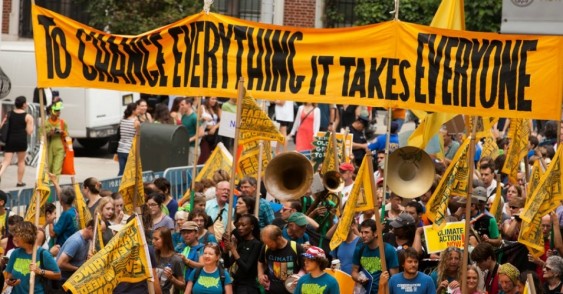
My hope is not unfounded: countries around the world and 10 US states have already bypassed indecision, and Oregon and Washington are poised to take action. This weekend hundreds of thousands of climate marchers around the world, including thousands in Portland and Seattle, showed the people’s growing power to overcome the merchants of doubt’s poisonous whisperings.

People's Climate March 2014 NYC, by flickr user South Bend Voice, cc.
People’s Climate March 2014 NYC by South Bend Voice used under CC BY-SA 2.0

Read more

Everything You Need To Know About Carbon Pricing Explained in Cartoon

This article was originally published on PBS Newshour’s Making Sen$e blog May 30, 2014, reprinted here with permission.

One of my goals in life as an environmental economist is to harness market forces to fight climate change. And I like to find innovative ways to communicate that message: hence the stand-up economist gig, which started as a hobby and is now my full-time occupation.

Another innovative communication approach is cartooning, and I’m delighted to share with you a chapter from my new book, The Cartoon Introduction to Climate Change, co-authored with and illustrated by Grady Klein. Grady and I also wrote the two-volume Cartoon Introduction to Economics, and both of those books touched on climate issues a bit. The new book provides an expanded treatment of climate science and policy using the same engaging cartoon format. (For more on our collaborative artistic process, see our Island Press Field Note that follows a page from idea to printed page.)

Cartooning has a bit of a bad reputation here in the U.S. in that people think it’s “just for kids” silliness. But in fact, cartooning is a terrific way to convey information, and my books with Grady are based on the idea that something can be fun and intellectual at the same time. That’s also true of my stand-up comedy career, and both the comedy and the books involve boiling down complicated topics and making them accessible to high school and college students and the general public.

Read more

×