Donate Newsletters

Recent Coal Export Trends: Q2 2014

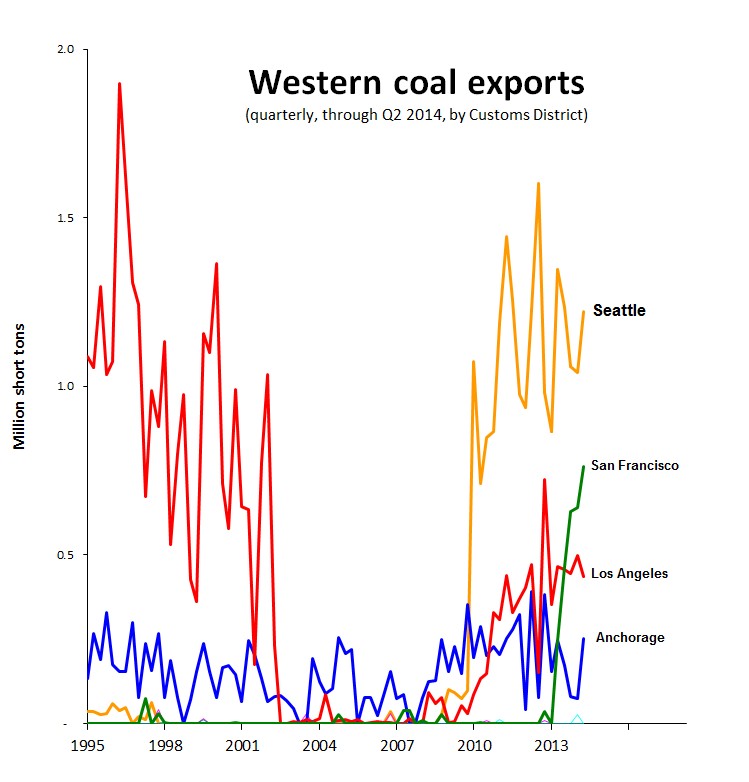
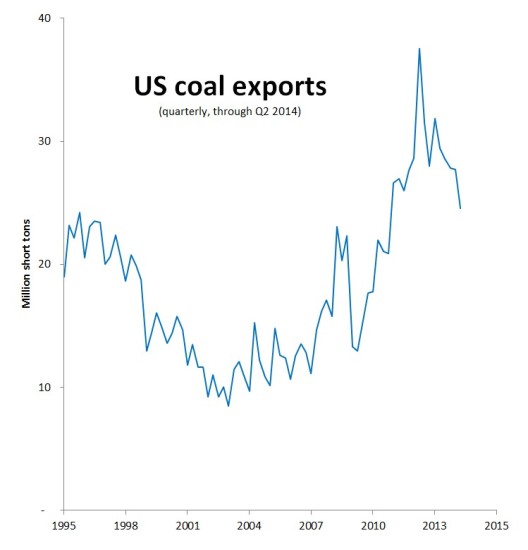
Here’s a look at the latest US Department of Energy figures in its quarterly coal export report, which take us up through the second quarter of 2014:

Original Sightline Institute graphic, available under our Free Use Policy.
Original Sightline Institute graphic, available under our Free Use Policy. US coal exports_Q2 2014 (Data from US Energy Information Administration’s Quarterly Coal Report.)

Nationally, coal exports fell again in the second quarter of 2014.

The US exported almost 24.6 million tons of coal in the second three months of the year. It was still a lot by historical standards, but it represented the fifth straight quarterly decline and a  reduction of 35 percent from the industry’s high water mark in the second quarter of 2012.

Read more

Prediction: Cloud Peak’s Coal Export Division Will Start Losing Money in 2015

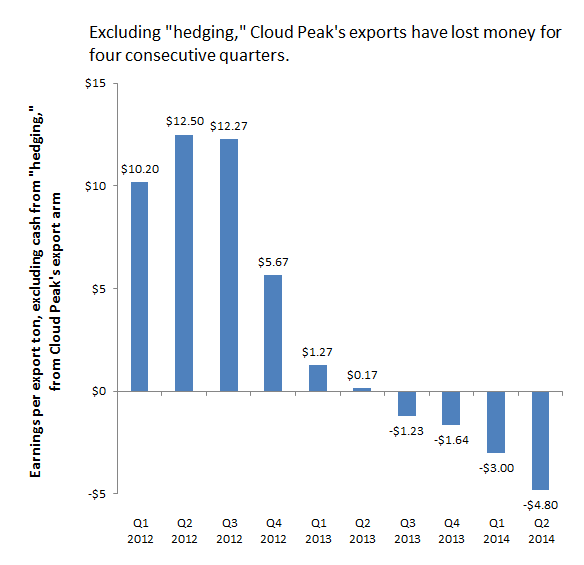
Cloud Peak Energy—a major coal producer in the Powder River Basin, and one of the top coal exporters in the western US—will release its third quarter financials in a few weeks. And even though international coal prices have been in free-fall for almost three years, I expect that Cloud Peak’s financial reports will show that the company’s export (or “logistics”) division made money from June through September 2014.

Yet I also expect that, just beneath the surface, the firm’s financials will show that Cloud Peak lost money exporting coal to Asia, just as it has for the last four consecutive quarters.

[prettyquote align=”right”]Just beneath the surface, Cloud Peak’s financials will show that the firm lost money exporting coal to Asia—just as it has for the last four consecutive quarters.[/prettyquote]

So how is it possible for a coal company to report profits from its export division, but losses from actual export sales? The answer: even though Cloud Peak’s coal export sales are bleeding red ink, the company is still benefiting from big bets that the company made years ago on the coal futures market.

But I believe that those lucky bets are poised to run out, starting in 2015.

Read more

The Big Problem with Letting Small Railroads Haul Oil

The disaster in Lac-Mégantic, Quebec—where 47 people were killed by a Bakken oil train derailment—is commonly understood to have resulted from a train slipping its brakes and then rolling downhill into town where it crashed disastrously. It was a tragedy, but it should not be considered just a mechanical accident.

In truth, it was a self-reinforcing chain of events and conditions caused by underinvestment, lack of maintenance, and staff cutbacks. And it’s a lesson the Northwest should heed because it illuminates the risks of allowing small regional and short line railroads to pick up unit trains of crude oil from bigger railroads like BNSF and transport them short distances to refineries and terminals. The Northwest is home to at least two small railroads with big oil-by-rail aspirations. One already hauls oil trains several times a week through Portland and small towns in northwest Oregon while the other, plagued by a string of recent derailments, aims to service no fewer than three terminals at the Port of Grays Harbor.

The story from Quebec—of what happened to the Montreal, Maine & Atlantic (MMA) railroad—is the story of a disaster waiting to happen. MMA was a regional railroad assembled in 2002 by a holding company from the assets of bankrupt Iron Road Railways, which owned four small railroads operating in Maine, Vermont, and Quebec. MMA had struggled financially from the start just as its major customers in the forestry industry also struggled. It went through a series of cutbacks to staff and maintenance.

Read more

Lecture: The Thin Green Line

Last week I gave a talk at Western Washington University about the massive coal, oil, and gas export projects slated for sites throughout the Pacific Northwest. Over the course of about 45 minutes I explored the changes confronting this region, as well as some of the opportunities we have to act as a sort of … Read more

Event: “The Thin Green Line” in Bellingham

Next week, I’ll be in Bellingham at Western Washington University talking about the massive coal, oil, and gas export projects slated for sites throughout the Pacific Northwest—or, as we at Sightline have come to call our region, the Thin Green Line. It’s the place that stands between big energy companies’ inland fossil fuel stores and … Read more

A Month of Disappointments for Coal Exporters

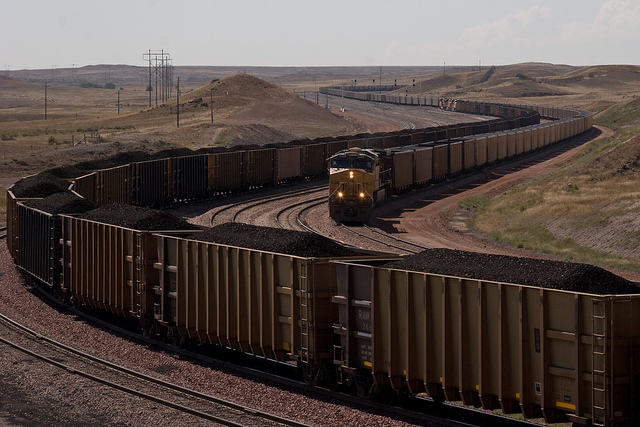
Miles-long coal train

It’s been a tumultuous month for proponents of massive coal export terminals in BC, Washington, and Oregon. In fact, there’s been so much news that it’s been hard to keep track of it all. So here’s a synopsis of the month’s biggest stories: Oregon’s denial of the Morrow Pacific coal export project has sent would-be coal exporters … Read more

How State Public Money Pays for Coal Exports and Oil Trains

Communities across Oregon and Washington are growing increasingly agitated about the risks of fossil fuel export. Proposed coal terminals generated unprecedented opposition from local residents and, more recently, dramatic increases in oil train traffic have many questioning the grave safety risks associated with a cargo so prone to explode. Yet at the very same time, … Read more

Disputing a Study on Coal Exports and Climate

I’ve never seen anything like this: an academic study that assumes that a privately held power company will continuously violate state and federal environmental laws.

That’s just one of several surprising flaws in a recent paper by researchers from Duke University and the University of Calgary. The study purports to show that, under certain assumptions, exporting coal to Korea will reduce the amount of CO2 emitted per megawatt-hour of power produced globally. Yet the study is based on premises so absurd that they render the authors’ conclusions meaningless.

Read more

Canada vs. the USA on Oil Train Standards

With what passes for chest-beating in the world of railway regulation, US politicians this summer claimed that the Transportation Department’s newly proposed crude oil, ethanol, and flammable materials train rules made the US Number One when it comes to tank car regulation—and that we are doing better than Canada. In his reading of a July … Read more

“If We Cannot Escape, Neither Will the Coal”

Across the Northwest, Native communities are refusing to stand idle in the face of unprecedented schemes to move coal, oil, and gas through the region. It’s a movement that could well have consequences for global energy markets, and even the pace of climate change. Now is a good moment for pausing to examine some of … Read more

×