Donate Newsletters

How Tesoro Manipulates Washington State Politics

The Texas oil company Tesoro has big plans for Washington. Long an operator of a refinery near Anacortes, Tesoro recently unveiled plans for the biggest oil-by-rail facility in the US on the Columbia River at Vancouver. The scheme, which has become a lightning rod in the region, has already run into severe delays and cost increases and the company is scrambling to rebrand its proposal.

In a recent interview with the local newspaper’s editorial board, Tesoro executives tried to argue that the project is consistent with Governor Inslee’s agenda.

Inslee “has every reason to say yes… “I think (the oil terminal) fits into what he wants to accomplish,” said one VP.

That’s a Texas tall tale if we’ve ever heard one. In truth, it would be hard to find any company anywhere with a record more diametrically opposed to Governor Inslee’s agenda.

The fact is that Tesoro has a well-documented track record in Washington of meddling at the ballot box, funneling money to shadowy Republican groups, and financing anticlimate campaigns. In 2010, Tesoro started bankrolling Tim Eyman initiatives to the tune of $90,000. In the last two election cycles, the firm doubled-down on its political activities in the state, spending an additional $577,673 on candidate donations, lobbying, and funding political action committees.

Original Sightline Institute graphic, available under our free use policy.

A review of public records shows that Tesoro delivers not only petroleum products, but also a heavy dose of dirty energy money into Evergreen State politics. To better understand how Tesoro cultivates influence in Washington State, let’s follow the money.
Read more

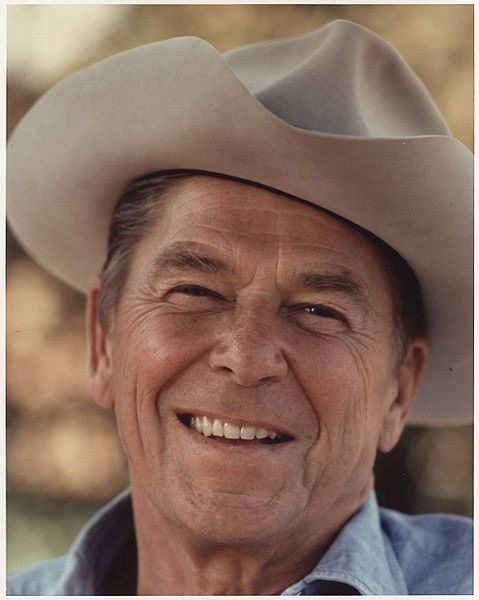
How Ronald Reagan and Bill Clinton Made Oil Trains Less Safe

Oil trains are not safe—a string of cinematic explosions has made that clear—and they’re not nearly as tightly regulated as they should be. This regulatory lapse isn’t just a one-off failure of the federal agencies charged with oversight; we’re in a jam that’s been decades in the making. Since Ronald Reagan, in fact.

When the feds released draft rules for oil trains this past July, they also published a draft Regulatory Impact Analysis (RIA). Though it’s technical and often-overlooked, the RIA is a hugely important document that weighs the benefits to the public against the costs to the private sector of new rules—rules that might require tank car upgrades, train braking improvements, safer rail routing, and speed restrictions. This cost-benefit analysis for federal rules designed to protect people and the environment has long been a tactic favored business conservatives, and it’s been the law of the land since 1982 when then-President Reagan required by executive order that federal rules pass a cost-benefit test.

In 1993, President Bill Clinton affirmed and expanded Reagan’s regulatory legacy with Executive Order 12866, so that nowadays agencies must quantify the anticipated present and future benefits and costs as accurately as possible—and then proceed with a new rule only if the benefits justify the costs. All of which may sound sensible enough, but consider this: that means the benefit of you being alive is evaluated in the same equation that measures the oil industry’s profit margin. And with exploding trains, that’s not just hyperbole.

Read more

Oil Trains: The Industry Speaks for Itself

A year and a half after an oil train inferno ended 47 lives in Lac-Megantic, Quebec, the crude-by-rail industry rolls on, virtually unimpeded. It’s hard not to feel horrified when, one after another, we register the place names of oil train explosions—Aliceville, Alabama; Casselton, North Dakota; Lynchburg, Virginia—as grim warnings of what could happen in so many other North American communities.

Government regulators have been slow to act, their responses painfully milquetoast. As a result, much of what I do involves research into the often-complex details of federal rulemaking procedures, rail car design standards, insurance policies, and the like—all the issues that Sightline is shining a light on.

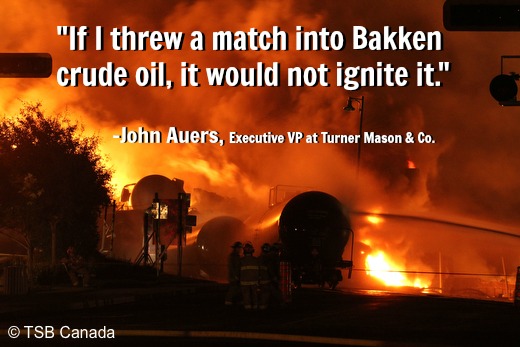
Yet on some level it’s not about any of that. It’s about a reckless and unaccountable oil industry that—in the most literal and obvious way—profits by putting our lives at risk. Every time I hear one of their accountability-shirking lines, I can’t help recalling images from those tragedies and near-tragedies. The juxtaposition is so startling that we decided to undertake a small photo project to capture it. We hope that you’ll find the following useful in your own work, and if so, that you’ll share the images with your own networks.

Read more

Regulating Coal Hazards in Seward, Alaska, and Beyond

Northwest communities faced with the prospect of new or expanded coal terminals would do well to study their real-life impacts in other places. As Sightline has reported extensively, coal terminals have a marked tendency to produce chronic local pollution. To take just one nearby example, consider the Seward Coal Loading Facility in Alaska, which has plagued its neighbors for years and now faces serious legal actions because of its practices.

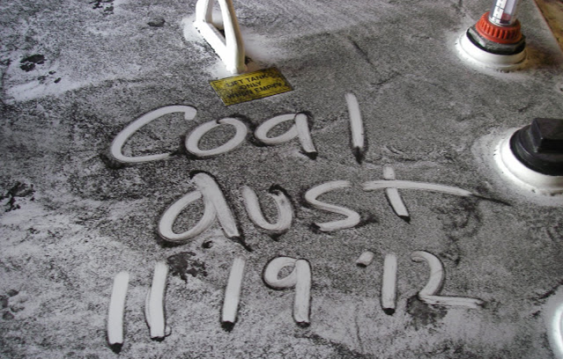
The current dustup in Alaska can be traced back to at least the spring of 2007 when coal terminal operators in Seward loaded a ship during high winds, releasing large clouds of coal dust in the process. In response, the Resurrection Bay Conservation Alliance, a community organization, brought the dust clouds to the attention of Alaska State regulators by supplying photos and video evidence of dust blowing off the terminal’s stockpiles, covering nearby fishing boats and neighborhoods.

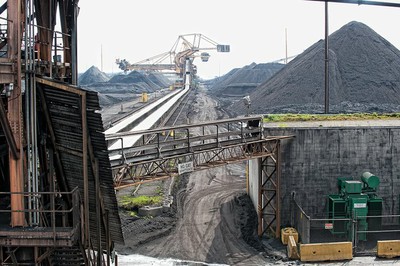
Coal dust coating near Seward Coal Loading Terminal (2). Seward, Alaska. Photo by Russ Maddox, Resurrection Bay Conservation Alliance. Used with permission.
Coal dust coating near Seward Coal Loading Terminal., Seward, Alaska. by Russ Maddox (Used with permission.)

Read more

What Do Oil Train Explosions Cost?

Given the nasty tendency for oil trains to explode when they derail, it’s probably worth asking what a catastrophic accident might cost. No doubt, the thousands of communities visited daily by oil trains would like to know what sort of financial risks they are exposed to. Unfortunately for these governments, the available data suggest that a reasonable worst-case-scenario explosion could do several billion dollars of damage—sums far in excess of railroad insurance coverage.

But how many billions are we talking about?

The Facts about Kinder Morgan

report pic_facts about kinder morganEnergy giant Kinder Morgan has big ambitions. The firm aspires to multiply its coal export capacity in the Gulf Coast region even as it seeks permission to build a huge new oil pipeline in the Pacific Northwest. These projects could boost Kinder Morgan’s profits, but they also raise serious questions about what the projects might cost neighboring communities.

Today, Sightline Institute is publishing a new report, “The Facts about Kinder Morgan,” that examines the facts about the company’s behavior. The report reveals that the company’s track record is one of pollution, law-breaking, and cover-ups.

In public, Kinder Morgan points out that it is already operating coal export facilities in Virginia, South Carolina, Louisiana, and Texas. Or, as the company’s spokesperson said when the firm was pushing a failed coal export plan in Oregon, “What we’re proposing is not something we don’t already do.” And that’s exactly the problem.

Read more

What Ambre Says About Its Financial Collapse

In case you missed the news, Ambre Energy—the Australian firm behind two of the three remaining coal export projects in the Pacific Northwest—is selling its North American coal business to the company’s largest creditor, a risk-hungry private equity firm called Resource Capital Funds. Ambre will realize just $18 million from the sale, even though it claimed as recently as last fall that its North American coal assets were worth between $200 and 400 million.

Over the past several days, we’ve started to see Ambre Energy’s PR strategy emerge: the firm’s North American executives are now crowing with delight that their operations are being unloaded at fire sale prices! After all, they now say, handing your business over to your creditors is a sign of financial strength, not weakness. So a story in the Longview Daily News quotes Bill Chapman, CEO of Ambre’s Millennium Bulk Terminal project, spinning the sale by saying, “The news is all good,” and implying RCF’s purchase shows that investors remain excited about the financial prospects for coal exports. And Everett King, president and CEO of Ambre Energy North America, bragged: “Their interest is validation: RCF likes the projects.”

This raises a question: Is RCF’s purchase of Ambre’s coal operation really a sign of financial strength for the company’s coal export plans?

I think the best way to answer that question is simply to quote from Ambre’s own financial disclosures—which show that the firm was running out of money, laden with debt, and had no reasonable hope of raising capital before it defaulted on its loans from RCF. [prettyquote align=right]Ambre was running out of money, laden with debt, and had no reasonable hope of raising capital before it defaulted on its loans.[/prettyquote]

More importantly, the company had been trying since 2012 to raise money from anyone other than RCF. The company even tried to raise money by selling off individual assets. Yet Ambre found no audience for its overtures: no buyers, no lenders, and no new source of capital. Finally, this past July, RCF cut Ambre off, refusing to provide them with any more money…a move that set up Ambre for the financial crisis it now faces.

In short, Ambre is selling its North American operations because the firm is deep in debt and out of options, and is essentially handing over its assets to its chief creditor in lieu of declaring bankruptcy.

Read more

What Happened When a Hazardous Substance Train Derailed on a Puget Sound Beach

If you’ve ever wondered how an oil train derailment might go down on the shores of Puget Sound, it might look a bit like the winter night derailment in 2011 that spilled sodium hydroxide on a beach at Chambers Bay south of Tacoma. It was hardly the kind of disaster that has resulted from oil trains derailing, but it still makes for a rather instructive lesson in how these things happen.

Sodium hydroxide, more commonly known as lye, is used as a chemical base in the production of pulp and paper, textiles, drain cleaners, and other products. (It’s also the major ingredient that makes lutefisk unpalatable.) It’s caustic, corrosive to metal and glass, and it can cause fairly serious burns. You want to be careful handling it but—notably unlike the volatile shale oil traveling daily on the very same rail line—it does not erupt into 300-foot-tall fireballs.

If it had been an oil train, things could have been much, much worse.

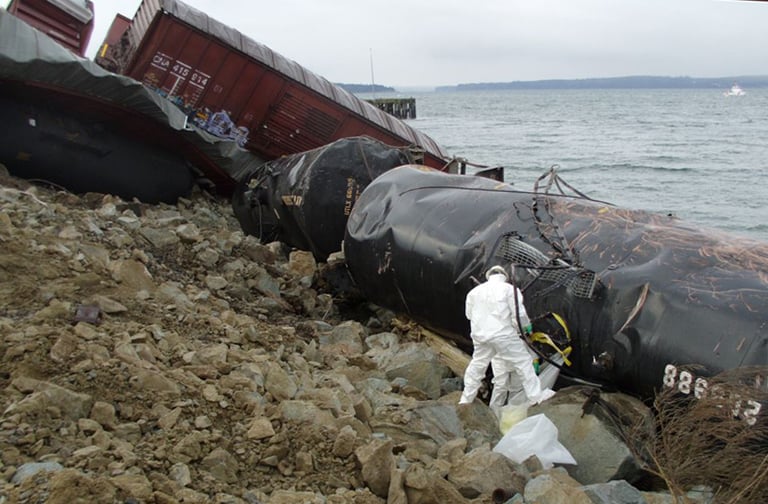
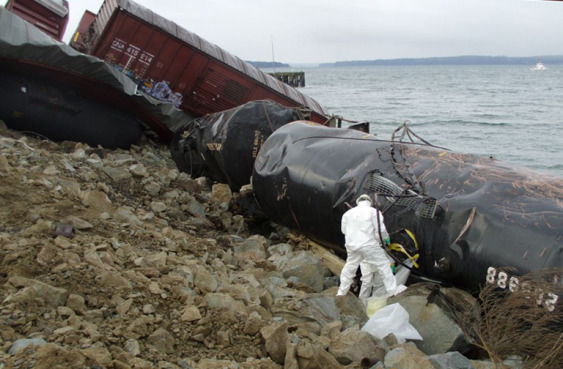
Chambers Bay derailment by WA Ecology_2
Image by Washington Department of Ecology

What happened is this: around 8 pm on February 26, 2011, a north-bound freight train derailed, sideswiping a south-bound train that was carrying (among other things) four loaded tank cars of sodium hydroxide in a liquid solution. One of those cars was damaged in the collision and leaked a relatively modest 50 gallons onto the beach before response crews plugged the leak.

Read more

The Money Behind Northwest Coal Exports

If you’ve been following the Northwest coal export debate, you’ve probably heard of Ambre Energy—the struggling Australian firm that’s behind two of the three remaining coal terminal proposals in Washington and Oregon. Ambre made headlines back in August, when the state of Oregon denied a key permit for the company’s proposed Morrow Pacific coal terminal project on the Columbia River.

But even if you’ve heard of Ambre, you may not have heard of the company’s main financial backer: a tight-lipped private equity firm called Resource Capital Funds (RCF). Focused on minerals investments, RCF has a truly global reach: it’s registered in the Cayman Islands; maintains offices in Denver, New York, Toronto, and Perth, Australia; and invests in mining and minerals projects all over the world. With more than $100 million at stake with its investment in Ambre, RCF has become the chief financial backer of Northwest coal exports.

And while you might think that having the backing of a global investment firm like RCF would be a sign that Ambre is a solid company with strong financial prospects, you’d actually be mistaken. A review of the firm’s past investments shows that RCF actively seeks out risky projects with a high potential for failure.

Read more

How Fossil Fuel Money Plays in Northwest Elections

Over the last few years, the Northwest has been embroiled in an increasingly heated debate over its participation in fossil fuel exports. Energy companies’ plans to build coal terminals, oil depots, and gas pipelines are drawing out protestors, grabbing headlines, and earning plenty of attention from elected officials.

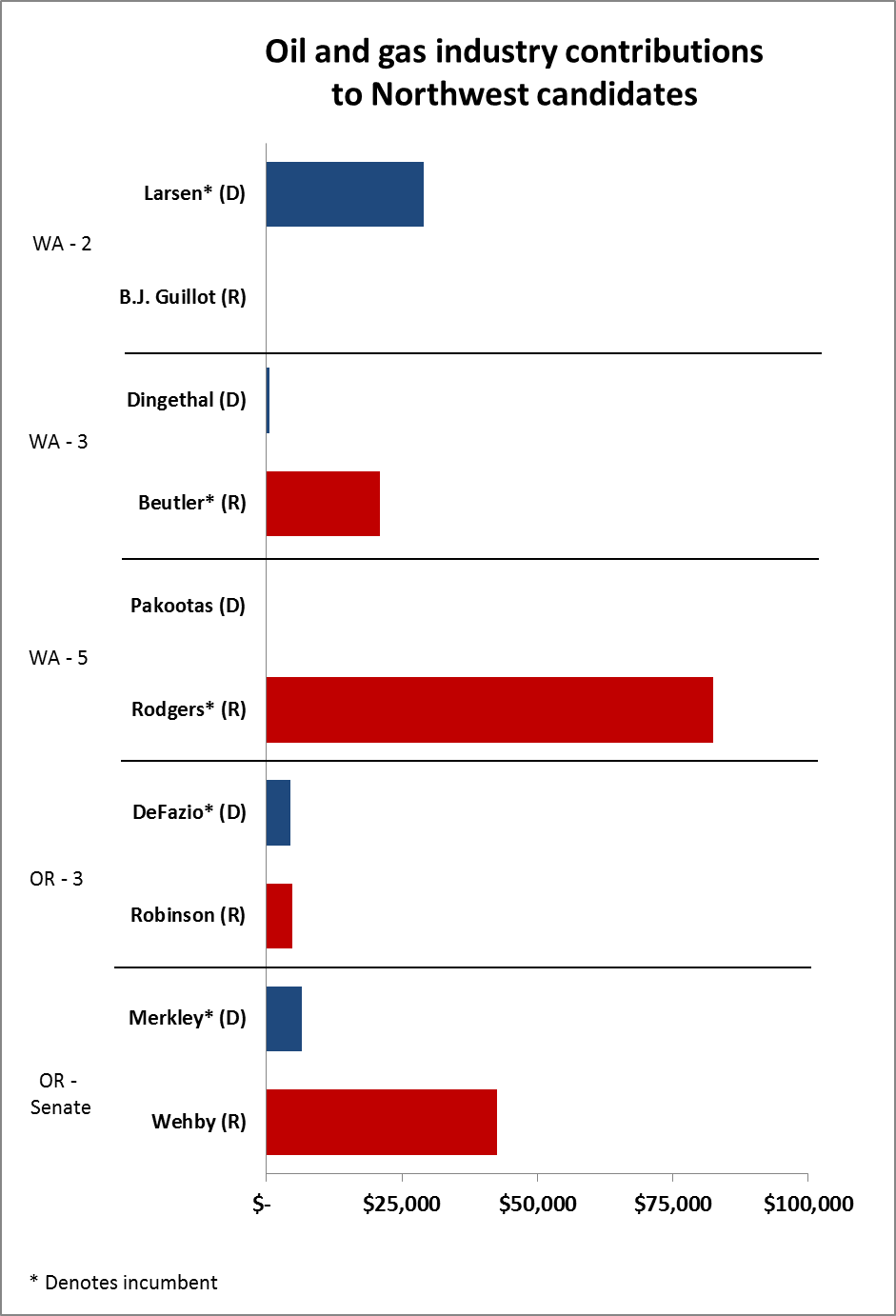
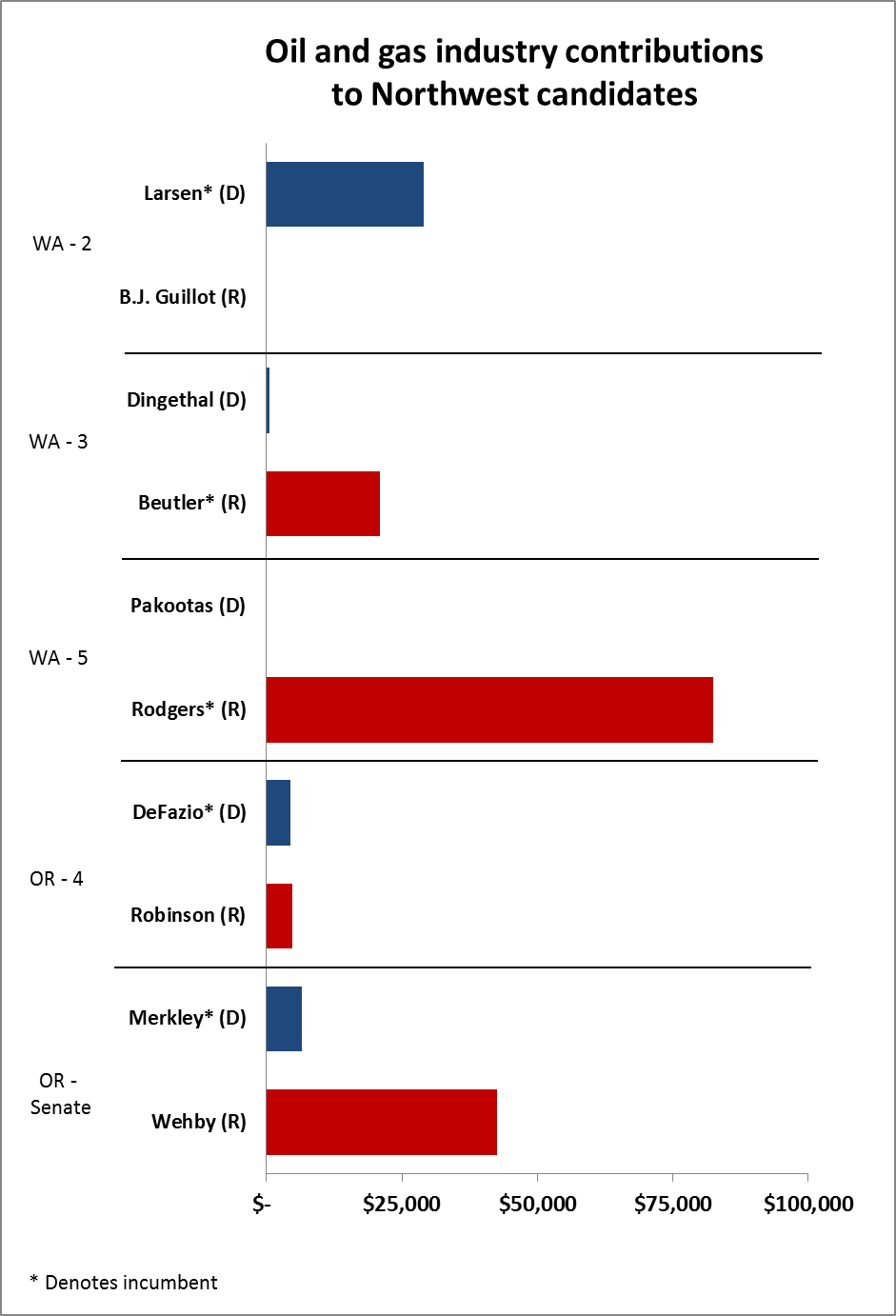
So to get a better sense for how these companies are playing the political game, we combed through campaign contribution data published by the Center for Responsive Politics in the OpenSecrets’ online database. To our surprise, we could identify very little money coming from the coal companies with a stake in Northwest export proposals. Yet we did find that the well-heeled oil and gas industry pumps plenty of money in the coffers of the region’s candidates for federal office.

We picked five electoral contests that we believe illustrate the breadth and depth of fossil fuel money in Northwest politics. Whether in highly contentious well-publicized races or predictable landslides, fossil fuel interests can be major players.

Original Sightline Institute graphic, available under our Free Use Policy.
Original Sightline Institute graphic, available under our Free Use Policy. fossil fuel money (Data from OpenSecrets.org.)

Here’s a closer look at how fossil fuel interests spent money on each of these races.

Read more

×