Donate Newsletters

Recent Coal Export Trends: Q2 2013

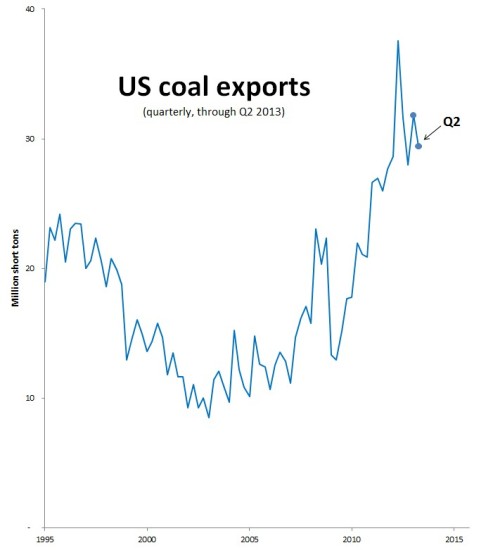
The government shutdown did not prevent the EIA from releasing new energy data yesterday. The figures in the latest coal report take us up through the end of June 2013:

v2_Sightline_national coal exports 2013-Q2

Nationally, coal exports tailed off a bit. The US shipped nearly 29.4 million tons of coal in the second quarter of 2013. By historical standards, that’s a lot.

Read more

The Hidden Export Bombshell in Cloud Peak’s Financials

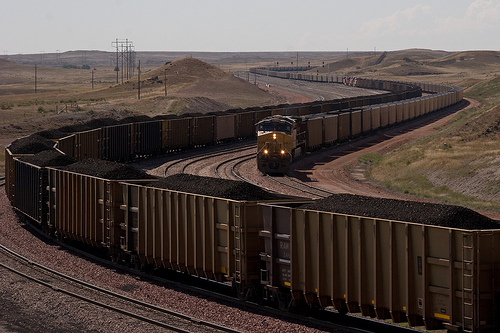
Powder River Basin coal train

Cloud Peak Energy, one of the major coal producers in the Powder River Basin, is doing its very best to sound upbeat about coal exports. In an investor conference call this past July, the company declared that, even though falling international coal prices had eaten into their earnings, their exports were “still profitable overall.”

But a close look at Cloud Peak’s second quarter financial statements suggests a far stranger story: the company’s export division actually made most of its profits from derivatives trading rather than coal. Stripping away the financial-speak, the implications are striking: Cloud Peak’s export arm made at least 10 times more money betting against coal than it did selling coal.

For those who are interested, here are the details…

Read more

Wall Street Worries About Kinder Morgan’s Safety Record

Kinder Morgan is a titan in the North American energy sector and a major player in Northwest fossil fuel shipments. The firm was the author of a failed scheme to export huge volumes of coal on the Columbia River in Oregon, and it is lobbying heavily to triple its oil pipeline through British Columbia in a bid to move more tar sands oil to Washington refineries and Asian markets.

It is also, as Sightline has documented, a dangerous and irresponsible company with a clear history of law breaking, deceit, and pollution.

Last week, a financial research firm, Hedgeye, released a scathing report on Kinder Morgan that supports many of Sightline’s conclusions. Aptly titled Is Kinder Morgan Maintaining its Stock Prices Instead of its Assets? (no longer available online), the report is mainly concerned with Kinder Morgan’s books, but it includes a few bombshells that should worry the public.

Consider just this sampling from the summary section:

We believe that Kinder Morgan’s high-level business strategy is to starve its pipelines and related infrastructure of routine maintenance spending in order to maximize Distributable Cash Flow…

And:

Read more

The Methodology Behind “The Wrong Side of the Tracks” Series

To calculate street closure times, we estimate that trains are an average of 7,000 feet long, and that an average train carries 13,750 tons of coal with 110 tons of coal in each of 125 rail cars. In the case of coal trains bound for Cherry Point only, we estimate a smaller number of long … Read more

Sightline on Coal and Oil Schemes in the Northwest

If you’re following Sightline’s work on Northwest fossil fuel exports and oil train projects, you may enjoy listening to this radio segment I did this morning on KBOO, a community radio station based in Portland. The piece is around 45 minutes long, which I think is a nice length for digging into issues in a more … Read more

More Bad News for Ambre Energy

The financial woes of would-be coal exporter Ambre Energy continue.

Yesterday, in a blandly worded press release, the company made a bombshell announcement: Ambre had failed to secure financing to settle its lawsuit with its rival/partner Cloud Peak Energy, with which it co-owns the struggling Decker mine in southern Montana. That means that the two companies will now have to limp along, managing the mine in tandem—even though their last attempt at co-management led to a serious dispute and a pair of lawsuits a mere seven months after the two companies started working together.

The initial lawsuit, filed by Cloud Peak just over a year ago, centered on Ambre’s management decisions at Decker. Cloud Peak wanted to move forward with long-standing plans to shut down the mine, since it was losing money and costs were on the rise. Ambre wanted to keep Decker going, in part (as Ambre’s counter-suit revealed) because shutting the mine down would be even more expensive than keeping it running.

Last December, both parties agreed to a tentative settlement to the two lawsuits: Ambre would buy Cloud Peak’s interest in the mine, and run it as it saw fit. But to finalize the settlement, Ambre would need to replace a $71 million “reclamation” (i.e., cleanup) bond that Cloud Peak had already put up, and also pay somewhere between $57 million and $64 million for the mine itself.  Once Ambre came up with the money, the lawsuit would be officially settled.

Well, the first settlement deadline came and went, and Ambre didn’t come up with the money. The court set a new deadline—and Ambre fumbled again. Ultimately, the presiding judge set a firm cutoff date of August 30: if Ambre didn’t fulfill the settlement terms, the lawsuit would proceed, and the two parties would have to start duking things out in court.

Yesterday, with the clock ticking down, both parties announced that they were voluntarily dropping their lawsuits. The reason: Ambre simply has no hope of raising the money it needs to buy Decker.

Read more

Coal Dust in Communities

If you want more evidence that coal operations equate to uncontrolled coal dust, take a gander at this new collection of stories about what it’s like to live near a coal terminal. In communities near big terminals in Maryland and Virginia, coal dust is commonplace. As one Baltimore resident tells it: Coal dust and soot … Read more

What Coal Trains Would Cost Seattle

It must be election season because this morning the Seattle Times managed to contort the publication of a small-scale economic analysis into a Shocking Scandal in the Mayor’s Race! The issue, as near as I can tell, is that about five weeks elapsed between the City receiving the first draft from a consultant and actually … Read more

A Gateway for Petcoke

You often hear it said that coal is the world’s dirtiest fuel, which isn’t quite right. There’s actually an even dirtier fuel out there, petroleum coke. Often called “petcoke,” it’s a dense coal-like and carbon-intense fuel that is the byproduct of refining certain kinds of oils. It figures into the Northwest’s fossil fuel debate in a way that links coal exports to the region’s changing oil supplies.

The clearest link is perhaps at Cherry Point in northwest Washington, where a large refinery owned by BP sits practically next door to the site of the proposed Gateway Pacific export terminal. Although Gateway Pacific is usually, and correctly, referred to as a coal export terminal, the site’s plans clearly call for handling petcoke in the initial phases of operations. (In fact, calcined petroleum coke is one of the non-coal “dry bulk commodities” the project supporters refer to when they are trying to draw attention away from coal.)

Conveniently, the BP refinery at Cherry Point annually produces 800,000 tons of calcined coke as a salable byproduct of its refining process. BP currently ships its petcoke out by rail to industrial users in North America and beyond, but having a petcoke-ready export terminal in the neighborhood would surely add a financial incentive for BP to dial up its petcoke production. The same goes for the Shell Refinery at Anacortes, Washington, which also produces petcoke that it now ships by rail to a smelter in Kitimat, British Columbia.

Read more

×