


In January, Kinder Morgan—a giant energy conglomerate—announced plans to use an Oregon port on the Columbia River to export 30 million tons of coal annually to China and other Asian markets. Many in the Northwest worry about the health risks, pollution, and economic risks that are entailed by the plans. Already tribes and environmental organizations are raising serious concernsabout handling large volumes of coal on the Columbia.
A look at Kinder Morgan’s track record in communities where the company already exports coal reveals that these worries may be well-founded.
Many of Kinder Morgan’s coal export operations blight neighborhoods and foul rivers. The company’s track record in the Northwest and beyond is one of pollution, law-breaking, and cover-ups. Moreover, the proposed Oregon terminal would be the company’s biggest yet.
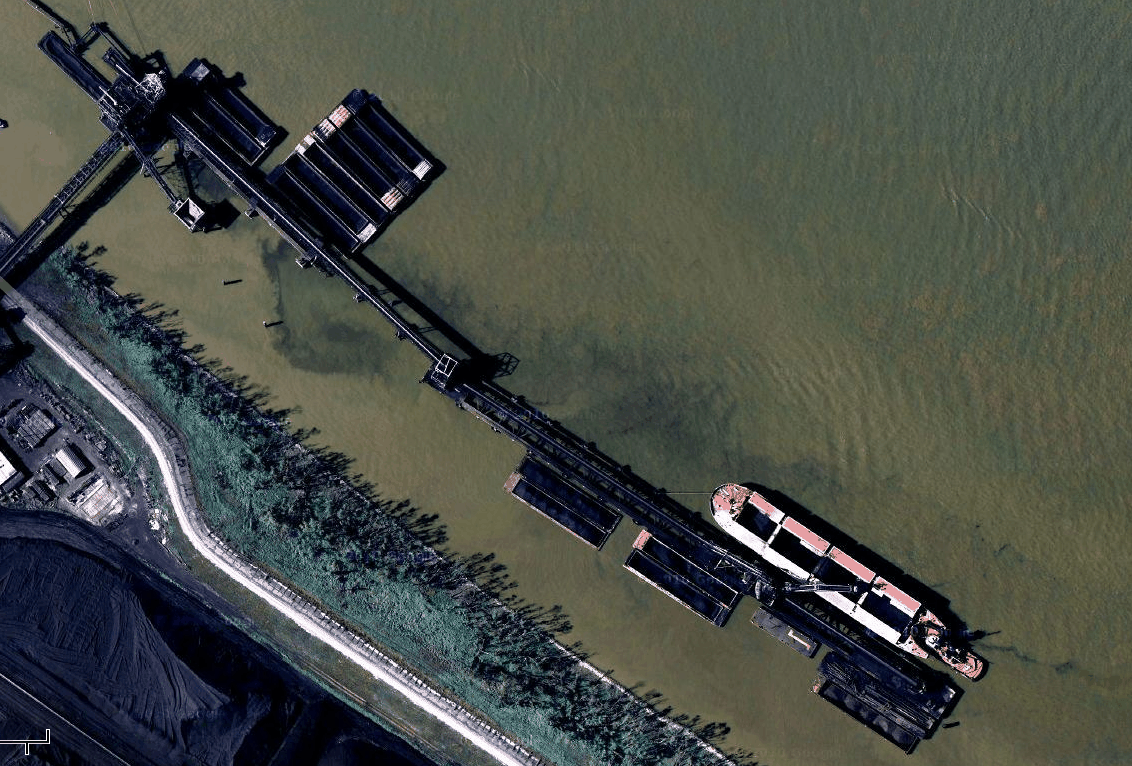
- In Louisiana, Kinder Morgan’s coal export facilities are so dirty that satellite photos clearly show coal dust pollution spewing into the Mississippi River.
- In South Carolina, coal dust from Kinder Morgan’s terminal contaminates oysters, pilings, and boats. Locals have even caught the company on video washing coal directly into sensitive waterways.
- In Virginia, Kinder Morgan’s coal export terminal is an open sore on the neighborhood, coating nearby homes in dust so frequently that even the mayor is speaking out about the problem.
- In Portland, Kinder Morgan officials bribed a ship captain to illegally dump contaminated material at sea, and their operations have repeatedly polluted the Willamette River.
- Kinder Morgan has been fined by the US government for stealing coal from customers’ stockpiles, lying to air pollution regulators, illegally mixing hazardous waste into gasoline, and many other crimes.
- Kinder Morgan’s pipelines are plagued by leaks and explosions, including two large and dangerous spills in residential neighborhoods in British Columbia.
In public, Kinder Morgan likes to point out that the firm already operates coal export facilities in Virginia, South Carolina, and Louisiana. “It’s just a location,” a company’s spokesperson told the Portland Business Journal about the planned site near Clatskanie.
“What we’re proposing is not something we don’t already do.”
And that’s exactly the problem.
In “The Facts about Kinder Morgan,” Sightline Institute explores the company’s misbehavior so that Northwest residents can decide for themselves whether Kinder Morgan’s coal export plans belong in the region.
Read more here.


Eric, have you reported on where the coal they want to export from Cascadia comes from? Isn’t it from public lands in Wyoming that Salazar opened up to help with our domestic “energy crisis?” If so, how could export to China even be an option? Are we now a resource colony for larger economies?
Brett,
You’ve put your finger on a key issue.
I’ve written a little about it here: https://sightline.wpenginepowered.com/2011/03/23/winning-the-future-by-destroying-it/, and I strongly agree that the public lands dimension is a big piece of the puzzle.
The folks at the Western Organization of Resource Councils are doing important work on the issue: https://www.worc.org/coalmining/.
I don’t think it’s entirely accurate to blame Salazar for low-cost leasing of public lands for rampant coal mining. Ultimately, the responsibility rests squarely on President Obama, and I’d argue his administration’s aggressive support for coal mining gives lie to much of his rhetoric about clean energy. But that’s a rant for another day, I suppose…
Fun Fact: Goldman Sachs has a $4 billion stake in Kinder Morgan. So, Goldman has significant investments in two companies determined on pushing coal through the Northwest; Carrix (SSA Marine) and Kinder Morgan.
I live in the small community of Conway in the Skagit Valley of northwest Washington. My home is located between the Burlington Northern railroad tracks and the Skagit River. A week or so ago I experienced a small earthquake while in the house and thought it interesting that my house moves significantly more with the vibrations created by the passing freight and coal trains than with the earthquake. The high water level due to the proximity to the river creates excellent transmission of vibration. I’m wondering if you are aware of any studies done on the impact on houses and other structures, particularly those located where the water table is high, of the significant seismic movements caused by passing coal trains?
Rich Kinder made his grubstake at Enron.
This is the same company that is already exporting tar sands dilbit (Diluted Bitumen) from Burrard Inlet in Vancouver BC (which is more toxic and harder to clean up than oil). Spills are already a fairly regular occurrence, so far just onto land. . . But they want to more than double the capacity of the old pipeline and move far more tankers.
A true example of Enron economics at work.
This was a great piece, unfortunately I’m sure the number of ruptures on Kinder Morgan owned pipelines will grow. With the purchase of El Paso Corp. the first thing he did was cancel close to $200 million dollars worth of pipeline safety projects. His attitude is let it blow and we’ll pay the fines. It’s cheaper. The majority of employee time is spend counting doing accounting (on spreadsheets no less) and figuring out how to scrape together a few dollars to make critical repairs. It’s a very sad state of affairs. Send duct tape and bubble gum because that’s how the systems are being maintained now. He should NOT be allowed to purchase anymore pipeline systems to run into the ground.