Donate Newsletters

Belly-Up Fish and Other Stormwater Mayhem

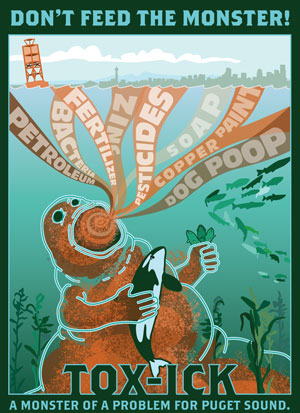
Tox-Ick poster

It’s a challenge to drive home the importance of controlling polluted runoff. After all, what is stormwater but rain that’s hit the ground?

The trouble is, the ground isn’t always such a clean place, particularly in urban areas with lots of roads, rooftops, and parking lots that repel the rain and send it gushing through gutters, picking up pollutants and trash along the way.

Still, it’s tough to imagine how much toxic muck can be swept up by runoff — until now.

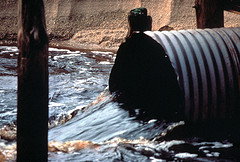
A video shot by scuba diver Laura James features time-lapse, underwater footage of a stormwater outfall in West Seattle off Alki Beach, a popular spot for beachgoers. The video opens with fish flitting past a gaping concrete outfall as seaweed and white anemones sway in the current. Then a smoggy haze starts clouding the water. More time passes, and a constant plume of blackened runoff gushes out of the pipe, looking like someone is pouring black paint straight into the other end of it. The minutes whiz by and the filthy stormwater spews for hours.

https://vimeo.com/51456008

James has nicknamed the West Seattle outfall “The Monster” and is promoting an educational campaign called “Don’t Feed the Tox-Ick Monster” that’s aimed at reducing stormwater pollution.
Read more

A Green Stormwater Lesson from the Other Washington

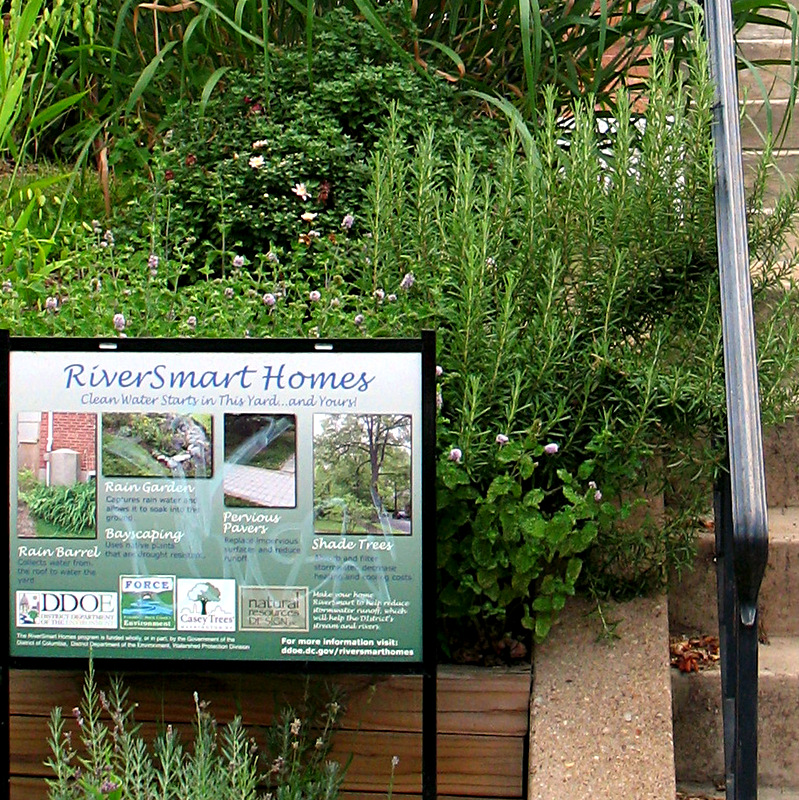
RiverSmart Homes sign

Northwest homeowners can take advantage of numerous incentives meant to encourage them to hook a rain barrel to their downspout or channel their roof runoff into a rain garden. Local governments provide residents and businesses cash rebates, do-gooder bragging rights, and discounts on utility bills.

But one of the most interesting incentive programs I’ve heard about so far comes from Washington, DC. The RiverSmart Homes program, which is run by the District of Columbia Department of the Environment, works like the energy audit programs that Northwesterners might be familiar with.

The program’s steps are easy:

  • A homeowner fills out an application online.
  • An expert from the DC Department of Environment visits the applicant’s home and conducts an audit identifying where the runoff is coming from.
  • The homeowner gets a report suggesting stormwater solutions that could include rain barrels, rain gardens, trees and other vegetation, and permeable pavement, plus the approximate costs of the work.
  • The homeowner contacts the department and tells them which items they want.
  • The department appoints a certified contractor to schedule a time with the homeowner to do the work.

It’s so blissfully simple!

Homeowners are required to pay approximately 10 percent of the costs and the DC Department of Environment covers up to $1,200 for total stormwater installations per home. For example, a homeowner has to pay $30 of the cost of a rain barrel installation, and the department picks up the rest, which can be up to $300. A homeowner’s co-payment for a rain garden is $75, with the remainder — or up to $1,200 — paid by the department.

Read more

Blessed Are the Rain Gardens…

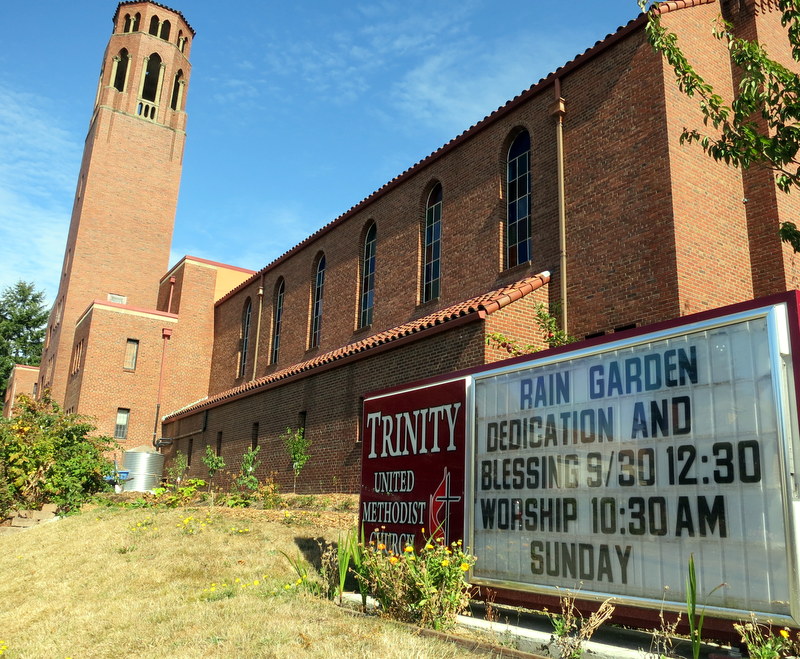
Trinity United Methodist rain garden sign

Seattle has elevated rain gardens to a higher calling with an announcement I recently noticed on the reader board for the Trinity United Methodist Church. The Ballard neighborhood church not only has turned to a green solution for its polluted runoff salvation, but it has officially “blessed” its stormwater treatment system.

And holy moly, this is a rain garden worth blessing. A story from Ballard KOMO News reports that the installation at the church is Seattle’s largest non-residential rain garden, based on how much roof area the garden will treat.

Trinity reportedly will handle rain from a 5,000 square-foot roof, while the largest residential rain garden apparently treats runoff from a 2,700 square-foot roof, the article explains, though I have to wonder about other green developments — the Bullitt Foundation building and the Bertschi School come to mind. Regardless, it has to be one of the biggest rain gardens in the city. The garden was built with support from Seattle’s RainWise program, which works with private property owners to get more rain gardens and cisterns installed in areas that have problems with sewage and stormwater spills. It was designed by Back To Nature Design.

Read more

Six Tips for Selling Green Stormwater Solutions

Seattle roadside rain garden

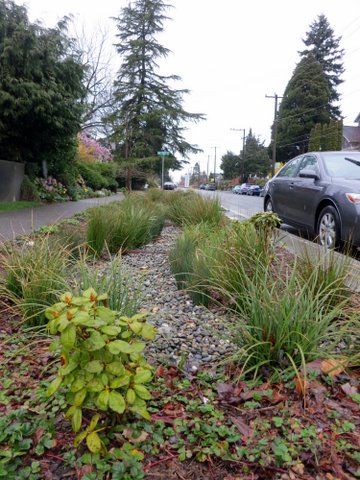
Congratulations! You’ve come up with a great idea for an affordable, attractive, environmentally sound solution for the polluted runoff that’s fouling Northwest rivers, lakes, and inland seas. But before you dig up that first shovel full of weedy grass to install your roadside rain garden, take heed: You must get the public (or in the case of a private development, your client) on board first!

Puget Sound area governments have been swimming against a small but vocal opposition to rain garden projects on public property that abuts private homes. The most effective way to resolve this backlash is through communication, education, transparency, and lots of dialogue well before a spade hits the soil.

Sightline recently convened a group of city and county representatives and some private individuals to talk about how best to earn support for rain gardens and other low-impact development projects built for treating polluted stormwater.

We distilled the conversation down to six tips for making the case for green stormwater solutions. Here they are:

Read more

A New Era for Stormwater Management

One of the best policy opportunities to restore Puget Sound will be unveiled this week. It’s incredibly important but, unfortunately, it also sounds incredibly boring. And that means it’s likely to be overlooked by a whole boatload of people who should care.

Here’s the scoop: on August 1, the Washington Department of Ecology is scheduled to issue its National Pollutant Discharge Elimination System (NPDES) final Phase I Municipal Stormwater General Permit. We’ll also get to see the new SWMMWW, whatever that is.

Are you still with me?

Because that’s not the half of it. Ecology will also release the Phase II municipal permits for both eastern and western Washington.

I told you it sounded boring.

But it is important. In fact, Chris Wilke, executive director of Puget Soundkeeper Alliance says, “These new permits represent our best chance to address the single largest source of toxic pollution to Puget Sound. If done right, we will see a notable change in the way our land is developed to implement widespread use of green infrastructure.”

So as a sort of guide for the perplexed, here’s what all this permit business is about – and why you should care.

Read more

Promise of Permeable Pavement

Permeable sidewalk

Editor’s note: This post is also available as a pdf.

Permeable pavement is one of the most promising green solutions that can help reduce and clean up polluted stormwater runoff. Like conventional pavement, it can be made of asphalt or concrete that’s either poured in place or sold as pavers, and it can be used in a variety of settings, including on parking lots, low-traffic roadways, driveways, and sidewalks.

Permeable technology has been used successfully in countless Northwest paving projects, though its use has been limited by a few persistent myths.

Let’s examine some of the most common concerns.

Read more

Competitive Rain Gardening

Low Impact Development Design Competition

Green stormwater engineers have joined the ranks of fashion designers, Donald Trump wannabes, and gourmet chefs. That’s right, there are now contests for designing the best environmentally friendly stormwater solutions.

The practice appears to have gotten its start in Houston with a contest that drew 230 design professionals, offered $45,000 in cash prizes, and even has videos on YouTube. It’s not exactly American Idol, but c’mon, polluted runoff is a tougher sell than pop songs.

Like its flashier counterparts, the Houston contest is being lauded as a great success, spawning a free, three-part webcast that instructs other cities and communities eager to create their own competitions. The first web installment rolls out June 21, with the other two coming in July and August. The webcasts are being offered through the nonprofit Water Environment Federation.

Why host a contest to see who can design the best rain gardens and permeable pavement? The Water Environment Federation puts it like this:

… the Houston (Low Impact Development) Design competition, which took place in 2010 … effectively moved LID from a virtually unknown methodology to a rapidly growing mainstream tool in local development.

It accomplished this by demonstrating that green stormwater infrastructure can be cheaper than conventional approaches. And it gave contest participants and observers a real-life chance to see how low-impact development is done. It created excitement and buzz around an environmentally and economically sustainable alternative to handling polluted runoff. It inspired people.

Read more

Saving Cash with Green Stormwater Solutions

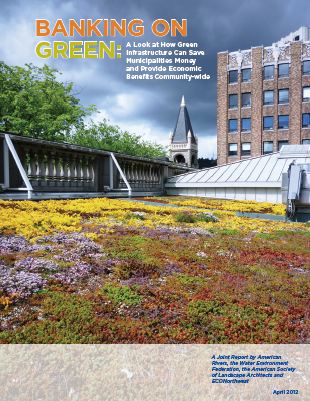
Here’s a good reason to build rain gardens and green roofs, and to plant and protect trees: It’ll save you money. That’s the conclusion of a new report from the American Association of Landscape Architects called “Banking on Green.”

The study surveyed green stormwater projects from across the US, plus a handful from Canada, and determined that in 41 percent of the cases, the environmentally friendly approach was cheaper than if a conventional solution for runoff was used.

The work builds on previous research by the US Environmental Protection Agency, ECONorthwest, the University of New Hampshire, Seattle Public Utilities, and others who have come to similar conclusions about cost savings.

The “Banking on Green” report also provides a list of 479 green infrastructure case studies organized by state. It does a nice job compiling current research that explains and quantifies the many problems caused by polluted runoff, and it offers the most effective solutions for addressing these problems. But it’s not everything I could hope for.

Read more

Rain Garden Reality Check

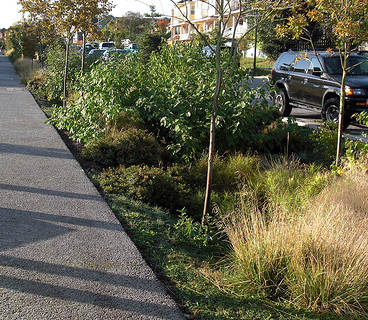
Roadside rain gardens are, for the most part, enormously popular. Yet after a recent faulty installation in Ballard, which was later corrected, some folks have begun loudly criticizing them as a threat to health, safety, and quality of life. Check out the comments section on Lisa Stiffler’s recent blog post, Rain Garden Backlash is All Wet, for a good example of the controversy.

I don’t want to minimize the concerns that some neighbors have. That said, I do think it’s useful to remind ourselves that the status quo isn’t exactly wine and roses. The system we have now is aging, challenging to maintain, prone to frequent failure—and fixing it with conventional technology will be extremely expensive.

For example, it never seems quite fair to me that people grouse about the mere possibility that a rain garden might contain standing water for a day or two after a heavy downpour when the system we have now looks like this:

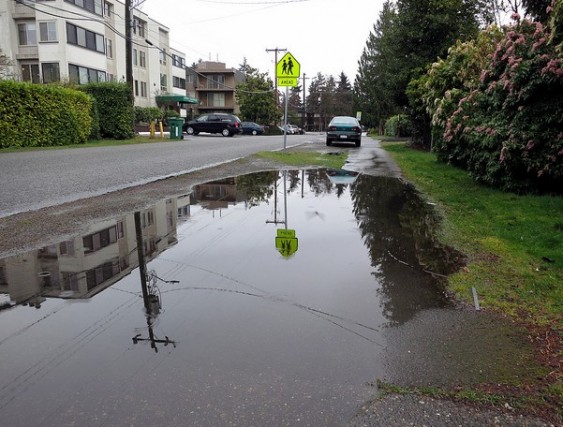
After the rain, standing water covers a sidewalk and parking strip in north Seattle. (Photo by Lisa Stiffler)

And this:

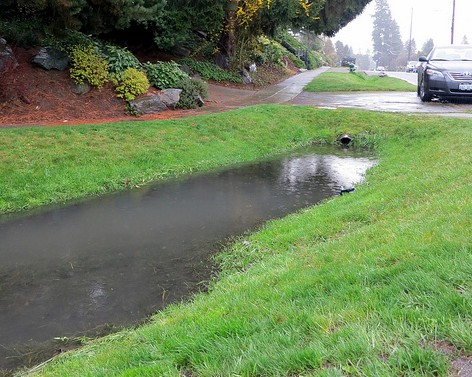
During a rainy period, open water exceeds a foot in depth in a north Seattle drainage ditch. (Photo by Lisa Stiffler)


Now, I’m not saying that deep standing water is what we should aspire to—far from it—but it’s useful to remind ourselves that the existing system is much worse than even the worst rain garden installation.

Read more

Rain Garden Backlash Is All Wet

Ballard rain garden in March

Rain gardens are suffering from an identity crisis.

On one hand, there are homeowners who love rain gardens composed of feathery grasses and bushy native shrubs. They even hire landscapers to install them and post signs to let others know that their yard is helping solve the problem of polluted runoff. There are Puget Sound databases and maps packed with examples of the water-sponging plantings. Walking tours in Portland and elsewhere showcase the green landscaping approach.

On the other hand, there are some small, but vocal, clusters of residents opposed to rain gardens that have been proposed for public spaces adjacent to their homes. They invoke the “Ballard rain gardens” — a local shorthand referring to some rain gardens that the city of Seattle installed in parking strips that failed to drain properly and filled with water. (It’s worth noting that the infamous gardens have now either been rebuilt or removed to the apparent satisfaction of residents: The blog Ballard Raingardengue launched to track the offending gardens went quiet a year ago.)

So what is the true nature of Northwest rain gardens? Are they an attractive, affordable tool to shrink the amount of fouled stormwater runoff that damages local lakes and streams? Or are they an infrastructure folly that doesn’t deliver? 

Read more

×
Privacy Overview
Sightline Institute

More information about our privacy notice

Strictly Necessary Cookies

Strictly Necessary Cookie should be enabled at all times so that we can save your preferences for cookie settings.

3rd Party Cookies

This website uses Google Analytics to collect anonymous information such as the number of visitors to the site, and the most popular pages.

Keeping this cookie enabled helps us to improve our website.

Additional Cookies

This website uses social media to collect anonymous information such as which platform are our users coming from.

Keeping this cookie enabled helps us better reach our audiences.