
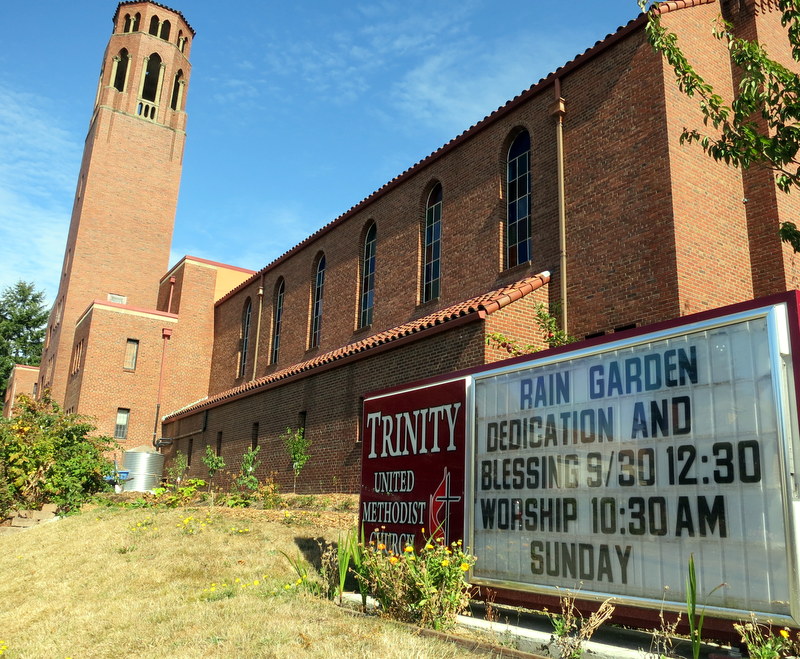


Seattle has elevated rain gardens to a higher calling with an announcement I recently noticed on the reader board for the Trinity United Methodist Church. The Ballard neighborhood church not only has turned to a green solution for its polluted runoff salvation, but it has officially “blessed” its stormwater treatment system.
And holy moly, this is a rain garden worth blessing. A story from Ballard KOMO News reports that the installation at the church is Seattle’s largest non-residential rain garden, based on how much roof area the garden will treat.
Trinity reportedly will handle rain from a 5,000 square-foot roof, while the largest residential rain garden apparently treats runoff from a 2,700 square-foot roof, the article explains, though I have to wonder about other green developments — the Bullitt Foundation building and the Bertschi School come to mind. Regardless, it has to be one of the biggest rain gardens in the city. The garden was built with support from Seattle’s RainWise program, which works with private property owners to get more rain gardens and cisterns installed in areas that have problems with sewage and stormwater spills. It was designed by Back To Nature Design.
Why is a church installing a green system for treating polluted stormwater? Ballard KOMO News put the question to Trinity’s pastor.
“Our Judeo-Christian tradition teaches us to be caretakers of the earth and in Seattle that means caring for our streams and Puget Sound,” said Pastor Kathleen Weber. “Installing a rain garden is the perfect reminder of our commitment to environmental justice and sustainability.”

Trinity United Methodist Church is one of Earth Ministry’s Greening Congregations – churches that have gone above and beyond in implementing creation care and environmental stewardship activities in worship, education, building & grounds, individual stewardship, and faithful advocacy. Trinity also happens to be the location of the Earth Ministry offices.
Congratulations again to Pastor Kathleen and everyone at Trinity UMC for all their great work on environmental justice and sustainability!
Not to be picky, but I think you meant “for they (rain gardens) shall FILTER runoff.” There is some fascinating new research from WSU where salmon placed in unfiltered highway runoff died almost immediately, whereas salmon exposed to runoff filtered through soil (as in a rain garden) survived. Obviously much work needs to be done, but the initial empirical results are promising. See https://earthfix.opb.org/water/article/drained-how-we-got-into-such-a-mess-with-stormwate/
I love that research! I was just speaking to WSU’s Curtis Hinman at a Sightline event and he said that even the scientists working on the project were shocked at how toxic the stormwater proved to be to the salmon. While it’s horrible that the runoff is so deadly, it is a really helpful illustration to use when educating the public about the importance of curbing stormwater.
Thanks also for the suggestion on filter vs. infiltrate. I’m sticking with my word choice given that a rain garden needs to infiltrate before it can filter. And I liked the prose-y match between infiltrate and inherit, given the biblical blessing that I was riffing on in the headline and subhead!
If I recall correctly, the Bullitt Center doesn’t have a rain garden, but is going to store, treat and re-use rain water on-site. (Super cool!)