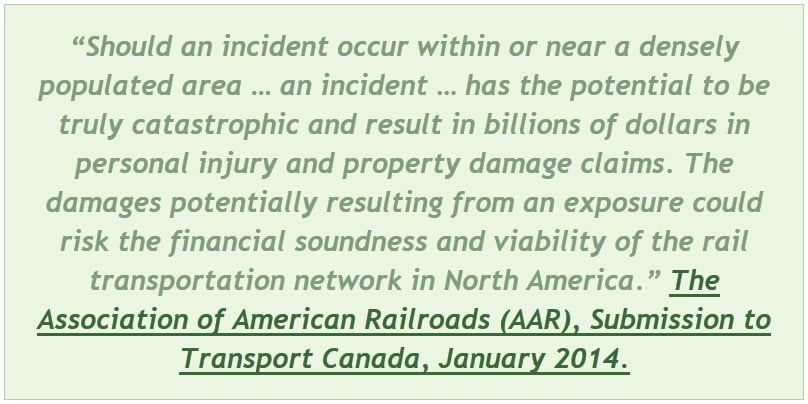
[prettyquote]“Should an incident occur within or near a densely populated area … an incident … has the potential to be truly catastrophic and result in billions of dollars in personal injury and property damage claims. The damages potentially resulting from an exposure could risk the financial soundness and viability of the rail transportation network in North America.” The Association of American Railroads (AAR), Submission to Transport Canada, January 2014. [/prettyquote]
Bakken crude oil production has many of the classic characteristics of an economic bubble. It looks likely that, as with every bubble before, it will end. Whether it ends catastrophically or just badly depends on how regulators act.
Some of the primary features of a bubble include a very rapid market expansion based on an unrealistic assessment of underlying risk, lax regulation, and an overly optimistic belief in continued rapid growth. In hindsight, it should have been obvious that hundreds of billions of dollars of poorly hedged sub-prime loans that depended on ever-rising housing prices were a huge risk. When the sub-prime mortgage bubble burst, the entire financial system was so distressed that a government bailout was required to save it. On a smaller scale, the same might be said for shipping huge amounts of explosive shale oil in unsafe, poorly insured tank cars through hundreds of populated areas: the risks are obvious but poorly hedged, and the enterprise can result in tremendous negative consequences for communities. In a realistic worst-case scenario, the Bakken oil train bubble bursting catastrophically could jeopardize the viability of the North American rail transportation network.