


As we near the anniversary of the Lac-Megantic oil train derailment and explosion that killed 47 people in Quebec last summer, communities across Washington State are wondering what the dramatic increase in regional oil train traffic means for them.
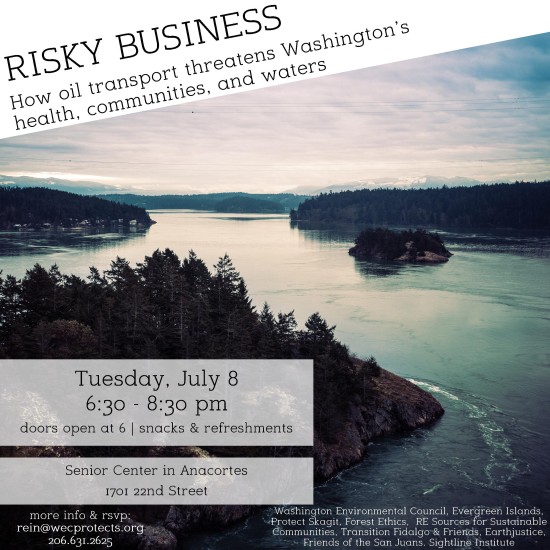
Next week, some of our northern Washington neighbors will have an opportunity to find out. As part of the National Week of Action commemorating the tragedy, I’ll be speaking at a community forum in Anacortes on Tuesday, along with representatives from Earthjustice, Forest Ethics, Friends of the San Juans, RE-Sources, and the Anacortes City Council.
Time and location details are below. The event is open to the public, but an RSVP is recommended. And if you’re wanting to study up a bit on oil trains before the event, see my ongoing series “The Northwest’s Pipeline on Rails.”


Eric,
Can you direct me to an article that shows the TOTAL path of Bakken crude to refineries to gas stations?
Hello Steve,
I am not sure there is one map that answers your questions, although I have found maps on the web that address parts of it.
Overall, crude is shipped by rail from the Bakken formation, which straddles the borders of North Dakota, Montana, and Canada. The BNSF main line runs through Williston, ND in a central area of the formation, although other rail systems can purchase track rights on BNSF rails. From Williston, crude travels by rail to refineries and ports on each coast (East, West, and Gulf). Other refineries are also located in the U.S. interior. Once the oil is refined into gasoline, I expect that the most efficient transport system is by highway, since one tanker truck can supply several gas stations in an area with one run. Gasoline may also be transported by rail to distribution points, where tanker trucks can pick up their hauls.
With regard to the Pacific Northwest, you may be aware of Eric’s report and video, showing the rail routes to WA and OR refineries and ports, at https://sightline.wpenginepowered.com/research/the-northwests-pipeline-on-rails/
To get to Eastern Washington, Bakken crude is transported on a main BNSF line across northern Montana, then across Idaho into Spokane.
A first approximation of the Montana line can be found at our map of derailments, at https://sightline.wpenginepowered.com/2014/05/13/northwest-region-averaging-nine-freight-train-derailments-per-month/
One can zoom into Williston, ND on that map, near the MT border, and the derailments near the Canada border indicate the BNSF main line.
I have found other maps on the web showing the U.S. rail system, and the U.S. Energy Information Administration issues maps showing U.S. refineries. But if that is more than you need, I can stop here. Otherwise, please let me know if you want those links as well.
Thanks for your question and for your interest in Sightline.
John Abbotts