Donate Newsletters
Home » Economy + Jobs » The Problem With Inequality

The Problem With Inequality

Sightline Editor

February 25, 2011

The problem with income inequality—apart from the fact that it’s unfair and perhaps shredding the fabric of American democracy—is that it’s devilishly hard to talk about clearly. Any subject matter that relies heavily on a concept like “quintiles” is going to result in a certain number of glazed-over eyes.

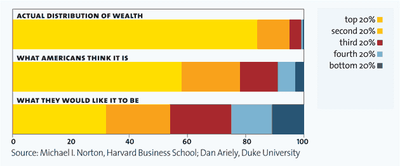
I’ve longed for some clear and compelling visual depictions of income inequality trends—something that could bypass the econo-speak. So I was delighted to discover a recent graphics-rich portrayal of income inequality in Mother Jones. I’m not sure it’s the final word on the subject, but it does include some informative portrayals like this one:
mother jones_income distribution

The whole thing is worth checking out.

I still feel like there must be a simpler and clearer way to depict this stuff, but MJ’s efforts are undoubtedly a big step in the right direction.

Talk to the Author

Sightline Editor

Talk to the Author

Sightline Editor

Fuel progress in Cascadia

Your gift directly fuels the smart, independent research that removes barriers to abundant housing, accelerates the clean energy transition, and strengthens democracy across Cascadia. We are a nonpartisan think tank providing the rigorous policy analysis and sophisticated arguments needed to deliver real-world change for our communities. 

Help Sightline reach our $90,000 goal before Dec. 2

Loading donation form...

About Sightline

Sightline Institute is an independent, nonpartisan, nonprofit think tank providing leading original analysis of democracy, energy, and housing policy in the Pacific Northwest, Alaska, British Columbia, and beyond.

1 thought on “The Problem With Inequality”

  1. Another great image illustrating this is the income parade image. An example of it is in Google images at income-parade.jpg. I think Harper’s did a similar image for the US.

Comments are closed.

For press inquiries and interview requests, please contact Martina Pansze.

Sightline Institute is a 501(c)3 non-profit organization and does not support, endorse, or oppose any candidate or political party.

You can power us forward on sustainable solutions.

See an error? Have a question?

Find the author's contact information on our staff page to reach out to them, or send a message to editor@sightline.org.

Thanks to Laura Hirschfield for supporting a sustainable Cascadia.

Our work is made possible by the generosity of people like you.

×