


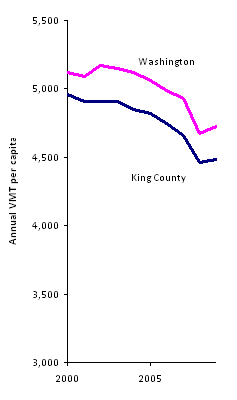
 Following up on the post on declining traffic volumes from a few days back, I looked a bit more closely at the traffic figures for Washington state, comparing them with the brand new Census population counts for Washington counties. And I also did my best to adjust for a methodology change that the state DOT made in 2004 to measure traffic more accurately.
The end result is the same: in the largest Washington counties, traffic volumes are either at or below their peaks earlier in the decade. And the per capita demand for vehicle travel fell by about 8% statewide between 2000 and 2009.
In King County—home to Seattle—total traffic volumes on state highways seem to have peaked in 2003. But per capita vehicle travel declined steadily through the entire decade, for a total decline of about 10%.
Here are some numbers since 2000 for the largest urban counties in Washington:
TABLE 1. Peaks and declines in per-capita VMT on state highways
| Region | Year of peak VMT per capita |
Decline in per capita VMT from peak to 2009 |
|---|
Entire State20029%King County2000 (or earlier)10%Pierce County200211%Snohomish County 2000 (or earlier)11%Spokane County20027%Clark County2000 (or earlier)18%Kitsap County20037%Thurston County200311%
TABLE 2. Peaks and declines in total VMT on state highways
| Region | Year of peak total VMT |
Decline in total VMT from peak to 2009 |
|---|
Entire State
2007
2%King County20032%Pierce County20022%Snohomish County 20072%Spokane County20072%Clark County20064%Kitsap County20062%Thurston County20071%
A few quick points about the numbers. First, Clark County—home to Vancouver, WA, just north of Portland, OR—is definitely an outlier in per capita VMT declines. In addition, it looks like the county has far fewer VMT per capita on state highways than the other counties I considered. I don’t know if this is because lots of people in Vancouver do lots of their driving in Oregon—thereby racking up VMT that aren’t captured by the state figures—or if there’s some other explanation. Regardless, I’d hesitate to read too much into Clark County’s declines. In any set of data there are always a few anomalies that are hard to explain, so people reading this should check into the trends more closely before assuming that driving in Clark County has cratered.
Second, it’s clear that VMT per capita have been headed south for some time—but that peaking of total VMT is a much more recent phenomenon. Overall traffic volumes didn’t really peak until 2007—just before gas prices skyrocketed and the economy faltered.
Yet in the Seattle metro area, total traffic volumes on state highways clearly started to plateau in the early part of the decade—when the economy was still humming along, and gas prices hadn’t yet started to soar.
I’m usually a cautious type, and hesitate to read too much into a limited set of data (especially one with a mid-series change in methods). And it’s certainly too soon to say with certainty what might happen if gas prices fall, or if the economy picks up. But it sure looks to me like some of the more urban parts of the state—particularly King, Snohomish, and Clark counties—are where appetites for car trips are being sated first.

While VMT may trending down regionally or statewide, daily vehicle volumes on some routes are trending up, for example, Alaskan Way Viaduct over the past decade, as shown in this graphic made from data reported by City of Seattle DOT.