
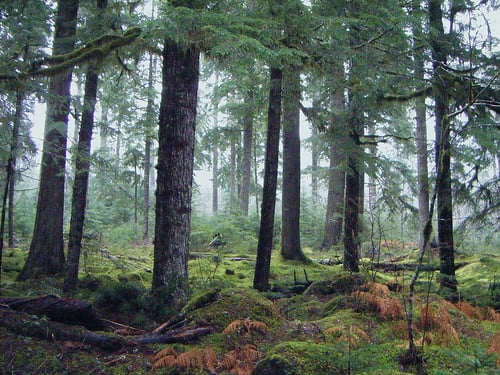


As anyone who’s spent some time in the woods out here might guess, the coastal forests of the Pacific Northwest store an awful lot of carbon. Yet for many years, a combination of rapid logging and occasional forest fires meant that the region’s “net ecosystem carbon balance”—the scientific term for how much carbon the forests contain—was on the decline.
But a new study (pdf link) out of Oregon State University shows that, on public lands at least, carbon sequestration in Northwest forests has shot up since 1995. After the Northwest Forest Plan took effect, timber harvests from publicly-owned forests fell, leading to rapid and dramatic increases in carbon storage. (Note that harvests on privately owned woodlands remained high, so increases in carbon storage on private lands weren’t nearly as dramatic.)
Yet even as carbon storage in Northwest forests increased, the human residents of the Northwest continued to burn fossil fuels at a prodigious clip. Today, for example, folks in Washington and Oregon burn about 4 billion gallons of gasoline each year—or more than a gallon each day for every man, woman, and child in the two states combined.
Which led me to wonder about forest sequestration vs. gasoline emissions. How do the two stack up? Let’s run the numbers…
Let’s start with a few facts.
- The OSU study estimates that each square meter of public forest in western Washington and Oregon soaks up about 140g of carbon each year. That’s about 500g, or 1.1 pounds of carbon dioxide.
- Coincidentally, driving a mile also emits about 1.1 pounds of CO2, on average. (More if you drive a hummer, and less if you drive a subcompact.) More generally, burning a gallon of gas emits somewhere around 25 pounds of CO2, after including the emissions from extracting, transporting, and refining petroleum.
- Annual gas consumption of 387 gallons per person in Washington and Oregon works out to 9,675 pounds of CO2 from gasoline. At recent rates of carbon storage, that’s roughly the amount of CO2 that’s captured by each year on 2.2 acres of public forest in Western Washington and Oregon.
- Since there are about 10.6 million people in the two states, it would take about 23 million acres of coastal forestland to soak up the two states’ carbon emissions from gasoline.
- As far as I can tell from state sources, there’s not nearly enough public forestland west of the Cascades to soak up all the CO2 from our gasoline habit. Western Washington has about 3.8 million acres of state and federal forest land west of the Cascades. I couldn’t dig up a precise figure for Western Oregon, but from this map and this spreadsheet I estimate that there are about 8 million acres of public forest in Western Oregon.
- That means that, since the Northwest Forest Plan was put in place, forests in Western Oregon and Washington have been soaking up about half of the two state’s CO2 emissions from gasoline.
So there you have it: the public forests in coastal Oregon and Washington are soaking up a lot of CO2, but not nearly enough to offset the tremendous volumes of CO2 that our fossil fuel habit generates.


The fact that NW forests sequester a lot of carbon is no excuse to perpetuate our use of fossil fuels.
AND
The fact that NW forests sequester less than half of our fossil carbon emissions is no excuse to stop protecting our forests.
“That means that, since the Northwest Forest Plan was put in place, forests in Western Oregon and Washington have been soaking up about half of the two state’s CO2 emissions from gasoline.”
That’s a lot!!
Interesting numbers. So what about carbon sequestration in other systems besides forests, e.g. the ocean, wetlands, organic farm soils, chubby babies?