
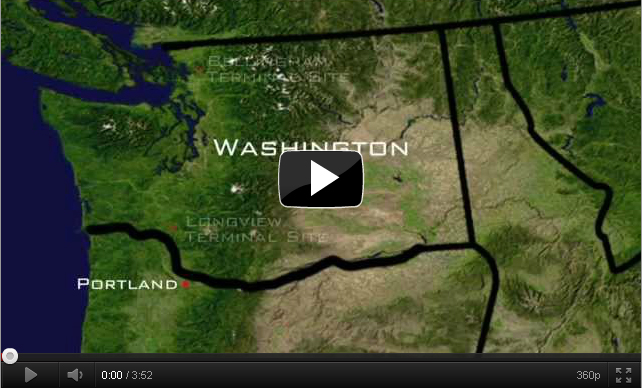


Columbia Riverkeeper has a new video out showing the impacts of proposed coal export terminals in Oregon and Washington. It’s definitely worth four minutes of your time:
The video looks at the affected communities, the health impacts of coal dust, and the other impacts in the Northwest.
Here at Sightline, we’ve created a new repository for our work on the issue. And while you’re at it, check out the new Power Past Coal website that just debuted—chock full of info on coal exports and things you can do to prevent the region from becoming a new dealer for China’s coal habit.


If half of what was said on this video was true I could maybe take a different at the amount of coal being proposed for export. But, as usual the enviro side are misleading the facts. First the videos of the trains aren’t even the BNSF coal trains, one is a Norfolk Southern “met” coal train on the former Conrail in west Pennsylvania. Met coal does blow off a train like that but none of these planned facilities will ship met coal. The other train video is a CP Rail coal train in western BC. If coal is such a 19th century fuel than why is it over 55% of the fuel used to produce electricity in this country and the largest fuel used around the world? Second, this whole health BS and using doctor to blow up your point is also wrong. People living along any railroad right-of-way that handles a lot of coal DO NOT have anymore health effects cause a coal train goes by!! And lastly, I work for one of the railroads that would be hauling the coal, let me make it clear, if these facilities are built there won’t be anymore waiting for a train than there is now, probably less. With the capacity improvements the railroads will have to do, there will be grade crossing done away with.
sigh……I guess facts are not important in this video.
What facts?? If your going to stretch the truth on the videos than why should you believe the other things being said? That’s right, most people who see the video wouldn’t know that the railroad video part was local or not.
We’re lucky that railroad shot wasn’t local — let’s keep it that way. It’s a sneak preview of what could be in store for the Northwest if we start exporting coal. We can’t say it will definitely look like that, but the burden of proof must rest squarely on the coal companies.
It’ll look just like it does now. Like I said before met coal won’t be exported from any of the proposed facilities. So I’d say its already proven.
When you say it will look just like it looks now, do you mean “coating people’s homes with coal dust”?
That seems to be what Arch’s PRB coal is already doing in Missoula: https://www.youtube.com/watch?v=H6TCqb-ec_Y
Well another interesting video. The funny thing is Arch Coal’s coal trains don’t use the MRL.. They use the BNSF Hi-Line through Whitefish Mt.. And what is even funnier, if its that cold when this was filmed, your not going have coal dust blowing anywhere, its frozen in the car!! Next…
Sounds like the student videographers named the wrong coal company. But I think you’re missing the point: coal runs through town and there’s coal dust (or some very similar black grit) coating houses. The point is, however much you may insist coal’s not a problem, local residents semm to disagree.
So you want no trains? WoW…… I guess you want everything built and moved overseas…because guess what? Nearly everything moves by rail! A prosperous society means busy rail freight lines. If you don’t like trains do not move by the tracks! If you want a prosperous society, applaud busy freight lines! They mean jobs and a good economy!
The video of the power plants is mostly steam, the normal person doesn’t know the difference between steam and smoke in a picture or video…perhaps you do not either?
The video of the coal train is the most dust I have ever seen, and that is after watching coal trains my whole life! You probably couldn’t take pictures of a coal train rolling thru Bellingham rite now to use in your video because; there likely was NO coal dust!
Cleaner Western US Coal means a Cleaner Environment! You can try every angle you want to somehow discredit that. The fact that cannot ever change is if you burn cleaner coal, than environment will be cleaner!
Build the Ports!
Build the Ports!
Build the Ports!
Finally, you make my argument for me when you write, “Nearly everything moves by rail! A prosperous society means busy rail freight lines.”
That has got to be one of the very best reasons to say no to coal. The Northwest’s economy depends on moving high-value freight — everything from containerized cargo to agricultural products to specialized freight. It is almost impossible to find anything that provides the region with less economic value than coal, and it is almost impossible to find anything that would so thoroughly clog the region’s valuable freight rail capacity as coal. In short, it’s a terrible economic strategy for the Northwest.
Who does benefit from coal exports? A few big coal companies and the related investors like Goldman Sachs and Berkshire Hathaway. I don’t think they really care about the Northwest’s economic health and I certainly don’t think we need to be looking out for them.
When rail lines get busy, railroads add capacity. The examples are far too numerous to list but here is a couple.
The BNSF has completed double tracking all of its ex Santa Fe transcontinental line allowing the the smooth operation of of upwards of 100 trains a day.
When the PRB started shipping lots of coal in the 1970s, the BN rebuilt exCB&W granger lines into heavy haul railroads.
In the Tehachapi Mountains of California the BNSF is about to begin a massive double tracking project. These huge infrastructure projects add jobs and money to local economies.
If the big coal ports are built the money will be spent in the PNW and you will get the added benefit of more rail capacity for all cargos.
I’ll be taking up this subject in a post soon. In particular, we’ll look at what the public pays and what BNSF pays.
If you have anything you think I should be aware of, please send it my way. Otherwise, hang tight — I’m sure we’ll have lots to discuss about rail funding.
Eric if your going to take this up in another post I can’t wait. Considering that two of us work for the railroad. But let’s be clear, if two major export facilities are built the BNSF and UP will be spending a lot of capital to move the traffic. And in turn the other rail traffic will benefit from those improvements. What I also mentioned before is the state of Washington’s economy has always been built around its ports, and if this was anything but coal exports there wouldn’t be any complaining about the additional trains. In fact the rail traffic has increased 150% over the last ten years between Everett and the Canadian boarder and there hasn’t been any complaining about train traffic… So when you do the post on railroads and how much money they spend, you’d better be will take some criticism
“If you burn cleaner coal, than the environment will be cleaner!” WHAT??? ALL coal is dirty, no matter if it has less sulfur or not. It’s not a renewable source and just because the world uses coal for power does not mean its a clean, safe and sustainable source of energy. And yes, a prosperous economy is great…but do we really need all of that crap that is being trained and shipped around our country? Half of that stuff wasn’t even made by skilled laborers in the United States. An economy based on cheap goods that do not benefit our society will crumble..and we are seeing that right now. NO COAL PORTS TODAY, TOMORROW, EVER!
There is more to cleaner coal than just Sulfur content. There is also less mercury and other toxins depending on the mine and geographic location. Some high quality coal has virtually no mercury.
There is such a thing as cleaner coal. If you burn coal with less pollutants, you get less pollution. I am not exactly sure how this can be argued….
do u hate the coal or trains? i can see hating the coal. it’s time to move on to clean energy, so stopping the coal port will help encourage the inevitable transition to clean energy. however, hating trains is environmental hypocrisy at it’s worst! its obvious that the difference between environmentalist and NIMBY is too subtle for the average green bigot to understand.
oscar,
In case it’s not obvious: no one hates trains. Rather, people are worried about trains carrying coal. There’s a difference! Why? Because they spread pollution, destabilize tracks, block intersections, and delay the high value freight and passenger rail that powers the region’s economy.
Here’s an analogy. I love bicycles. But if there were such a thing as Coal Bicycles that transported staggering quantities of global warming pollution, fouled local communities, and made congestion worse then I would not like Coal Bicycles. (I would still like bicycles, though, and that wouldn’t be hypocritical.)
I really don’t think it’s all that confusing.
High Value Passenger Trains? Most passenger rail systems make little or no money…..
At an export price of $100 dollars a ton, you can hardly say a export coal train is low value.
That was actually a very well done video. The arguments against these terminals really doesn’t come down to trains, which are awesome. It comes down to the entire lifecycle associated with these terminals – mining, shipping, and burning US coal to power other countries. Sure, we’ll make a little money on it, but we’re also harming our own land and neighbors in the process. Tar sands, coal, fracking – they’re all being exposed for their false promises.
PRB mines leave very little scar on the environment after mining is complete. This is not mountaintop removal. If you visit the reclaimed mines in the PRB, you cant even tell they were ever there…..
Remind me how many of those PRB mines have been reclaimed?
Because the last time I checked it I think was somewhere between 1% and 4%.
In other words, after decades of mining, nearly all of them remains vast open and polluted scars on the landscape.
Most of mines are still operational. As the mine moves forward it reclaims the ground behind it.
How many of the of un-active portions have not been reclaimed? I will have to look into that.
I have seen the reclamation with my own eyes. Have You?
Time to create a “special” double high B&O tax to cover rail transport, terminal operation, handling and shipping. We also need to apply sales tax to all services associate with coal. Perhaps the state will be unable to stop this, but it can sure tax this toxic sludge to recover at least a small part cost to repair the environmental and health damage. Too bad these facilities will mark their communities as toxic dumps for generations, drive away clean jobs and result in economic ruin.
Coal dust. Lets pretend coal dust is as big of a problem as you conclude. BNSF has already taken steps within the last few weeks to make plans to spray the cars to nearly eliminate dust, similar to what the CP rail does. So if the dust is nearly eliminated in the next few weeks? doesn’t it make all these supposed coal dust problems obsolete.
Remember, where BNSF was having coal dust problems was near the mines and load-outs, not 900 miles away in Washington.
Here we go again. I’ll just repeat my previous post from
https://sightline.wpenginepowered.com/2011/08/10/at-least-the-website-is-clean/
The background here is that regulations regarding escapement MAY be tightened. The calculations below are based on the maximum amount that these regulations may be tightened. Also note that tests performed for Puget Soundkeeper detected coal along RR tracks along Puget Sound. Puget Sound is a long ways from the mines. If all of this crap that blows out of the rail cars did so only near the mines, then where did this coal come from? Bryan, Bert, and Canyonguy don’t like to answer questions like this.
All right! Lets do the numbers:
3.0% (maximum proportion of coal that may escape in shipment according to now scrubbed BNSF website)
85.0% (maximum reduction that MAY be required)
=0.45% (minimum escape rate)
Washington: current proposed coal export facility capacity in million tons per year:
80 [Longview]
48 [Bellingham]
5 [Grays Harbor]
=113 million tons per year
=226,000,000,000 pounds per year
x 0.45% (minimum escape rate)
= 1,017,000,000 [with rounding] pounds per year lost during shipment
So, each year there may be somewhere in the neighborhood of over 1 billion pounds of coal escaping during shipment.
Next question: how long is the route? What is the average projected loss per mile of rail line? What is the average loss per mile along major and minor waterways (the Columbia, Puget Sound, etc.)?
Here’s another analogy for coal escape during shipment:
Supposing you are driving down the road and there’s a gravel truck in front of you. If some gravel escapes and dings your windshield, the trucker is liable for the damage. Keep that note pad and pencil handy for writing down license plates!
Lets say its a 10 cubic yard truck without any trailers. 10 cubic yards of gravel weighs about 27,000 pounds. With rounding, an escape rate no less than 0.45% (the minimum that may be required for coal dust) means that the truck is going to lose 121.5 pounds of gravel during its trip up the highway in front of you. How many individual pieces of gravel is that? I just weighed and counted a sample of gravel out of my driveway. 121.5 pounds of gravel would be about 162,200 individual pieces of gravel. I nominate Bryan, Bert, and Canyonguy to follow this truck.
Now, do you think a gravel hauling business that let this much gravel escape could stay in business after it got done paying for all the dinged windshields it caused? But the coal companies and railroads don’t have to pay anything for the damage they do to air quality, people’s health, water quality, and the climate. That’s not right. Its corporate welfare. It distorts the market. Its a free ride. Its everything that the free marketeers claim to be against. So, lets have some tough love for the coal and railroad corporados and make them stand on their two feet without mooching off of our lungs, water, and air any longer. Its for their own good.