


In a recent advocacy piece, a spokesman for a prominent railroad union made the following rather astonishing claim:
Trains carrying coal have been traveling through Western Washington on their way to Canadian ports for decades, yet the Northwest Clean Air Agency and the Puget Sound Clean Air Agency have no record of coal dust complaints.
For decades, really? In the context it’s made—in support of plans to export huge volumes of coal—that’s a claim so deceptive it’s about an inch away from a lie.
The federal government closely tracks cross-border coal shipments of coal. Here’s what the past 15 years looks like:
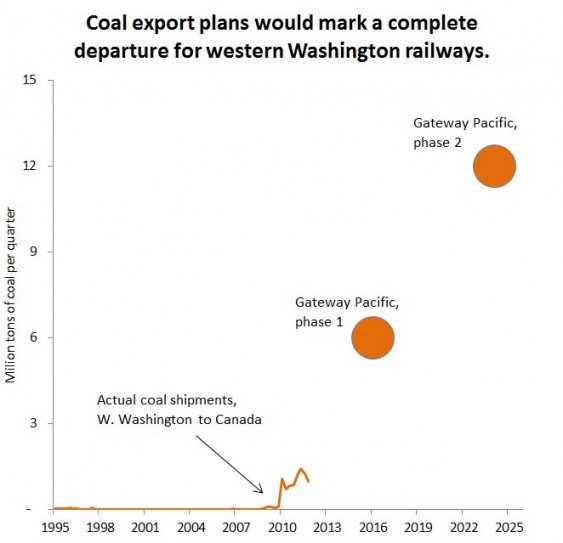
The coal plans for the Cherry Point facility alone are so huge that they render the past decades of coal shipments virtually unidentifiable.
Now, strictly speaking, it is true that the trains have been carrying coal through western Washington to Canada. But until the last couple of years, the volumes have been positively tiny. When I say “tiny” I mean that for many years just a few dozen rail cars with coal passed that way, or maybe a single short coal train. Not more.
To compare the recent “decades” of coal shipments in western Washington to the plans afoot for Cherry Point is disingenuous at best. The truth is that if the Gateway Pacific Terminal gets built, the region will be shipping roughly as much coal every 5 months as it has in all of the last 16 years combined.
Given the minute amount of coal that’s historically been transported, it’s no wonder that local air agencies have no record of complaints so far. It is worrisome, however, that as shipments have climbed in the last few years, so have complaints about the coal trains.
In fact, as King 5 News has documented, coal is finding its way off the trains that travel along Puget Sound’s beaches. And contrary to the assertions of railroad interests, the Northwest public is right to ask hard questions.
Notes: My previous reporting on quarterly coal export volumes can be found here, here, here, and here. All data come from the US EIA’s latest quarterly coal report, covering the entire Western Customs Region.


Decades? Coal has been carried by trains around here since the days of steam. Well, that’s because they were powered by coal. But still…
Our high-energy way of life is pitting us against each other. Coal vs hydro vs nuclear vs oil. It does not help that many of the problems are marginalized. To one energy consumer, coal dust is a marginal problem. To another energy consumer, river ecology is a marginal problem — so stated here at Sightline. “We must, indeed, all hang together, or most assuredly we shall all hang separately.”
There has been 80-120 plus car coal trains moving coal to the northwest for over 40 years. That is just the modern unit train days! Coal was moving is solid trains before that going back to the steam days. Not too sure where you get your information…..
Yikes, I see I omitted my sources in the original. I’ve updated the post to include them now. The data come from US Customs via the EIA.
I believe one could piece together the same picture from industry sources. Fact is, until 2010 coal moved through western Washington only in extremely small volumes. It’s certainly nothing comparable to the last couple of years nor to the huge volumes that the coal industry hopes for.
The reality is that we do not know the effects. Short term or long term effects of shipping more coal via rail are unknown. We can do a lot of speculation. Also, what type of plants is the coal going to be burned in? If they are the modern clean burning plants, then let them burn it. Better than damming more rivers or more nuclear plants.