
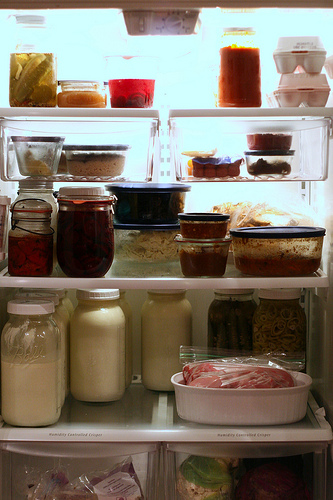

We’ve been cleaning out the fridge for nearly a year now, and we’ve compiled our list of moldy, past-their-prime laws into a handy new report.
It’s all in there, from freeing taxis and food carts to legalizing car sharing and clotheslines. Plus, we’ve cataloged three success stories, where outdated rules have been brought into the modern age.
Download the full report, or get the two-page summary to take to your next cocktail party.
There’s lots more work to be done. We’ve made it through the crisper and cheese drawers, but there are plenty more shelves to inspect. Know of a regulation that stinks to high-heaven? Sent a note to Eric de Place, eric@sightline.org.


Loving the report. You are widely off the mark where “allowing cities to slow traffic” is concerned (reasons cited elsewhere on this blog, but essentially unleashing the “create speed traps anywhere” instinct of municipalities will not contribute to safety; more bike-lanes, wider roads, roundabout-green light settings and better lighting would), but kudos for pushing on the other issues. Hope this gets some action.
I surely wish that the term “sustainable” or “sustainability” was used in proper context and definition. The ad-hoc definitions so widely used are misleading and dangerously inaccurate.
In years to come, it will matter a lot more then it does now, because it has lead to practices that aren’t even remotely “sustainable”, yet will have been long adopted under the illusion that we’ve been “practicing sustainability”.
No resource ripped out of the ground (versus locally GROWN) is sustainable. Even lumber transported long distances is not sustainable.
If its creation depends on anything other then sunshine for energy, it is not sustainable.
It is not even truly “recyclable” if it requires energy other then sunshine to reprocess. It may be reusable, but reusable’s are rarely sustainable.
It is also not sustainable if we consume a resource faster then it can be naturally replenished.
Sustainable also means within limits of consumption. Nothing modern humans do now is within limits of consumption, we simply devour the next resource available.
Since most raw resources all highly depend on mechanized industry to build and maintain equipment used in their extraction and manufacture, with a correspondingly massive mechanized transportation networks and so forth, then none of these raw resources we use are actually “sustainable” either.
Modern humanity simply won’t ever be sustainable, not ever (and never was). The reasons are simple: we won’t revert if “we don’t have to”. Much easier to bandy our words and illusions about how “sustainable” we really are, ignoring all the long-term and downstream effects.
I read the report. You’re missing the forest for the few trees you’ve identified.
Example is “car insurance”. Instead of promoting the car (and by default all that must go with it), ride a bike instead. Or walk. The latter is the closest to “sustainable” as it will ever get.
Sustainability will only be ‘legal’ when we:
a) stop overcrowding the planet;
b) move away from economy / economics (monetary based value system) to sustainable (its true definition);
c) revert living standards to pre-industrial development levels;
d) stop industry, reverting to localized cottage development for community needs.
Of course, none of these things will happen either, not a single one.
All the “sustainable communities” can do now is to live on the dregs (cast-offs and production) of the existing civilization, convincing themselves that they’re “sustainable” only because they’re choosing to ignore the actual reality of where all those resources came from, even the “recycled” ones.
This will indeed be an improvement, but it should not be mistaken as the ‘solution’.
The solution would require a complete and total abandonment of the present paradigm of civilization. Nobody is ready for that.
Huge free resource library for sustainability. Over 2500 free pdf educational documents and videos. https://www.jubilee101.com