


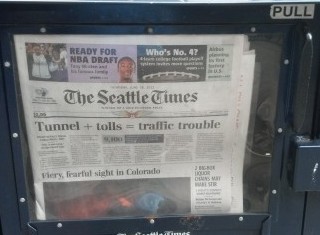
 For Seattle traffic-watchers, Mike Lindblom at the Seattle Times has the most important story of the month: the news that a new state traffic study predicts that high rush hour tolls on the Alaskan Way Viaduct tunnel will divert 9,100 cars into downtown Seattle during the afternoon commute. For those of you who are counting, that’s a diversion rate of about 42 percent.
The Times editors considered it a bombshell. It was the day’s top story, above the fold, with a huge headline.
But here’s the thing: it’s not really news. Well, it’s only sort of news. I mean, there really was a new tolling study on the Viaduct, and it really did predict that lots of drivers would avoid the tolls by driving on surface streets. Yet the new study reached almost exactly the same conclusion that WSDOT itself reached last year. Here’s a quote from the transportation technical report appended to WSDOT’s 2011 Final Environmental Impact Statement:
Tolling would cause vehicles to divert from SR 99 to other nearby roadways…the bored tunnel is expected to result in a daily diversion rate of about 40 percent for all vehicle classes.
When the EIS first came out, I tried to draw attention to what the numbers showed: that the state’s own traffic models predicted that a tolled tunnel would lead to a traffic morass. Yet there were no bombshell headlines back then. Look for yourself in the Seattle Times online archives: the closest story was this, which only reported on the issue as if it were a “he-said-she-said” story.
I have to wonder why the Times editors consider today’s news a revelation worthy of the front page, while the same news last year got buried. I suspect it’s part of a regrettable human foible: in context of a political campaign or a hotly contested public policy controversy, people view facts as weapons for winning arguments, rather than as a means for discovering the truth. When emotions run hot, the press tends to evaluate factual claims for how they’ll affect each side’s political fortunes, not for whether they’re important or true.
Now that the the political controversy has subsided, the press can once again cover the facts about the Viaduct a little more rationally: weighing their validity and exploring the implications. Better late than never I suppose. Still it’s a shame: just when the public was in greatest need of solid facts, the press seemed more focused on the politics than the substance.

Looks like bad news for McGinn’s arena deal.
Possibly. But this sort of demonstrates my point: we tend to fit facts into a political narrative (“How does this affect McGinn?”) rather than a substantive one (“What, as a city and a state, can/should we do to deal with the potentially severe traffic impacts of a tolled tunnel?”)
Regardless: I love the user name!
Decisions about wars, city and neighborhood planning and most everything involving society have been male dominated. If we women controlled things we hopefully would be mounting huge family centers all throughout the city,decentralizing the city and making life more family oriented.
Both men and women might then find jobs with schedules allowing them to be with children and there would be child care at every work site.
Stadium talk, which is male oriented mostly, would not be center stage. How could any city allow still another stadium within the city limits?
It harks back to old Rome when the big Coliseum was built so the masses could be entertained by the fights to the death while the powers that be creamed off the goodies and finally brought Rome to its knees.
Good point: “I suspect it’s part of a regrettable human foible: in context of a political campaign or a hotly contested public policy controversy, people view facts as weapons for winning arguments, rather than as a means for discovering the truth.”
There’s lots to say about this, but for the moment I’m just finding it amusing that some of the same people who wanted to remove SR 99 capacity altogether (no matter what effect it would have on city streets) are in stitches about the tunnel only carrying 60% of the trips it could handle if tolls weren’t implemented. And anti-freeway activists fretting about putting a price on driving! In this context I think your point above is exceptionally well supported.
I think we *all* do it: motivated reasoning is probably a deeply human trait, and not limited to any particular group. All we can do is try to be aware of it and guard against it.
The ‘stacked’ 6-lane Cut/cover tunnel in the FEIS is the only sensible tunnel option. Its study was mostly finished by 2007, but not reviewed for public consideration until after the vote in 2009. It’s the only cut/cover that could be constructed while leaving the AWV in place. It uses half the concrete and recycles more than the bored tunnel. It makes a well-anchored dam-like seawall, solidly cast instead of sealed & bolted along ‘miles’ of seams; removes 80′ of soft fill and stabilizes the remaining soil east; does not disrupt underground hydrology nor pose dire threat to vulnerable buildings in an earthquake. It’s 6-lanes displaces the least traffic and manages it best. It’s south portal is near identical to the bored tunnel setup.
Yet, Wsdot chose a construction process that increased disruption dramaticly: build huge 6-block trench between Spring & Main Streets in 1st Phase, followed by similar huge trenches to the portals at King and Pike; all soils lifted to surface and trucked out. The sensible process would start at the south portal and works north in 1 or 2-block segments that return to semi-normal use segment after segment. All excavation removed via completed segments.
Mercer West is another horror. Hey Queen Anne! How’d you like 20,000 more cars and trucks roaring through to access the bored tunnel north portal and I-5? Wouldn’t that be just peachy keen? And FYI, Aurora could be cut and covered from Denny to Repukelican Street to reconnect John, Taylor and Harrison Streets exactly as proposed with the deep bore. Access to the Battery Street Tunnel from Mercer westbound is actually simpler and safer by keeping the Broad Street Underpass (rebuilt to add the on-ramp and exit to 6th Ave). Oh really? Yes really. I’ve had it with Wsdot. Those people are up to no good. I mean it. They know they’re screwing things up.
Isn’t it generally true that “traffic nightmare” predictions tend not to materialize? Here in Seattle people other ways to get around when nightmares loom. Some of those toll-shy people will be diverted to transit, carpools and bikes. Let’s make it happen!
Excellent point!
Yes, I do think that drivers and employers will adjust to the new realities. But I’m not sure how they’ll adjust.
What worries me is that one way to adjust to a rough commute is to find a new job that’s not in downtown — and one way for employers to adjust to difficult commutes is to choose other places for new (or existing) jobs. Maintaining a fairly strong job core strikes me as pretty important for successful transit in a metropolis as spread out as greater Seattle. But if rush hour to West Seattle & points south of the city gets too crummy, I’m concerned that we’ll “adjust” by finding other places than downtown to put jobs.
Over 50% of downtown workers are already choosing to leave cars at home. The numbers are moving in the right direction. https://www.commuteseattle.com/wp-content/uploads/2011/06/2010-Commute-Seattle-Center-City-Mode-Split-Report-FINAL.RELEASE-6.141.pdf