


Sightline has updated a research memo, “Coal Exports From Canada,” that documents the facts about Canada’s coal exporting capacity. The truth is that ports in British Columbia do not have sufficient capacity to handle the volumes of coal planned for Washington ports.
It’s not even close.
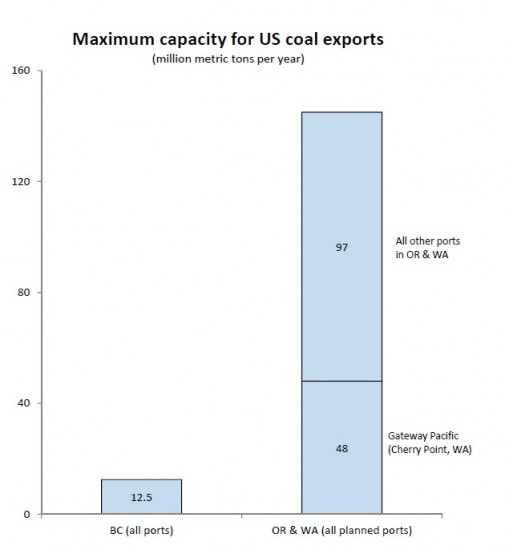
The state coal lobby continues to claim that US coal exports will simply shift to BC if Washington doesn’t build its own export facilities. But it’s simply not true.
The full details and analysis are here.
If Canadian ports actually did have available capacity for American coal, US coal interests would already be using it. But, in fact, coal terminal space in BC is tightly limited, and very little US coal is leaving by way of Canada. So now US coal companies are betting on big new export terminals in the Northwest states—projects that are expensive, time-consuming, and highly uncertain.


Canadian ports are all expanding capacity, but that’s just to handle all the increased Canadian coal shipments. There’s simply no room for US thermal coal.
P.S. The data used is old. Westshore’s expanded capacity is 33 not 29 (the article itself says so). Meanwhile, Neptune is expanding again–by another 6 million–to a total of 18 mt by 2014.
At any rate, it’s all for Canadian coal.
[Bleep!] It looks like we put the wrong figure in the table for Westshore. It should, indeed, say 33 (not 29). We got it right in the text.
I haven’t seen an expansion figure for Neptune at 18 mt/yr. Can you provide a reference?
The Westshore figure is fixed now. Thanks for the catch.
US sourced coal trains pass through Bellingham “every” day right now, headed north. Best I know, the only destination they could have for such volumes, is the port near Tsawassen, BC. Thus, US coal IS being shipped through Canada.
As I note in the report and elsewhere, roughly 4 to 5 million tons of US coal per year is being shipped out of the Westshore Terminal near Tswassen. (See here for more: https://sightline.wpenginepowered.com/2012/06/28/recent-coal-export-trends-q1-2012/.)
The point is that the coal export plans for Oregon and Washington are calling for about 30 times as much coal. There’s simply nowhere in BC to move that kind of volume.
Just like the energy producers are willing to pour money into the Oregon and Washington economies to develop the most efficient transportation route, why would they not just develop the same resources in Canada if they are denied access here?
AS you noted, coal transport to Canada is more expensive (with resulting greater environmental impacts). The Canadians also seem to be more amenable to allowing expanded facilities but your study does not address the physical feasibility of further expansion of the Canadian ports. Currently the expansions are planned in the US, why could those not just be moved north? It is just more money and much more environmental impacts up there.
Will denying Coal access to NW ports really stop coal shipments? Or will it just force rerouting and more expensive Coal on the far end which will have gotten there with more environmental impacts.
Is not the most efficient routing with the lowest environmental impact those that go through Oregon and Washington ports on the Columbia? The Port Marrow – Port Westward concept seems to be a particularly efficient and at least somewhat environmentally sensitive. Does keeping it local at least ensure that it done in the spotlight with a high level of oversight? Can the same be said of port expansions and shipping constraints up in Canada?
Eric, the reference for Neptune’s latest expansion plan is on Port Metro Vancouver’s website:
https://www.portmetrovancouver.com/en/projects/ongoing_projects/NeptuneTerminalsUpgrades.aspx
It says “Combined, the project proposal will increase the terminal’s coal handling capacity to 18 million metric tonnes per year–an increase of six million tonnes.”
Given all that has been discussed in the coal export issue, it is interesting to note that according to the web page, this 6 million tonnes a year involves only “approximately one additional train per day.”
Sheesh, thanks. (It looks like the Neptune announcement fell into the gap between when we did our research and when we published this report.) We’re fixing it now.
Neptune’s capacity for US coal is still zero, however, because Canadian coal giant Teck maintains exclusive access to that terminal.
Roughly one train a day is consistent with my calculations for coal trains. If you assume 110 tons of coal per railcar with 125 railcars per train times 365 days per year you’d need 1.2 trains per day to move 6 million tons.
Yes you’re right. And Teck is busy with expansions to its southeast BC coal mines–to be shipped through Neptune and Westshore–as well as reopening the Quintette mine in Tumbler Ridge, which will probably go to Ridley. There are other met coal mines planned for the Peace coal fields, as well as a large thermal coal mine just east of Jasper. And the Mount Klappan anthracite coal mine is in the works in northwestern BC. All of these would ship through Ridley
It’s obvious that all Canadian port expansions are needed just to handle expanded Canadian shipments, there’s no room for US coal. And the economics make it certain that far more valuable met coal (for which the railways and ports can charge higher rates for handling) won’t be displaced by low value US thermal coal.
So, it’s either build US terminals to export US coal…or don’t export at all.
The shipments through the Port of Morrow present insurmountable environmental problems. Wintertime inversions in the Columbia Basin would capture tons of coal dust and trap that dust in the inversion layer. Everyone who lives in the Basin understands this intuitively since they regularly experience weeks-long episodes of stagnant air in winter. There is no mixing with the air above that layer by definition. What’s expelled into the air will stay there.
Signed contracts are guarantees of delivery. Any abrogation of the contracts would be cause for legal action. This means that once the trains start, they will keep going day and night, during all seasons. Anyone with any economic interest in the Basin needs to understand this. Residents, travellers, farms, and businesses will all feel the impact. Public health will be at serious risk. My estimate is that there will be somewhere between 500,000 and 1.2 million pounds a day expelled into the waterways, onto the ground, and in the air once the system is completely built out.
These US coal shipments should be “compelled” to be hard top covered over!