


I’ve been monkeying around with US Census data to develop this comparison of foot-powered commuting in the Northwest:
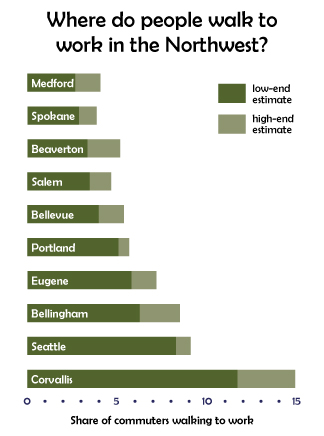
Corvallis cleans up. That’s not too surprising given its relative compactness, its large university, its moderate topography, and its overall awesomeness for getting around without a car. [Full disclosure: I have a huge crush on Corvallis.]
Other college towns, like Bellingham and Eugene, also do relatively well.
The other standout is Seattle.
With an estimated 8.7 percent of residents hoofing it to work, Seattle outshines every place in the Northwest that’s not named Corvallis. It beats the college towns and it does substantially better on walking than the region’s other big cities, including Portland (5.4 percent), Bellevue (4.7 percent), Spokane (3.4 percent), Tacoma (not shown, 3 percent), and Vancouver, Washington (not shown, 2.1 percent).
To be fair, this chart doesn’t include every city in the Northwest; it depicts only the most walking-friendly that also have roughly 50,000 or more workers. As it turns out, the places with the greatest share off commute-by-walking include none of the cities shown here, but many that are at or near military installations. Yet data for these and a few other locations that reported high rates of walking to work have very big margins of error and also represent relatively few workers, so I omitted them.

I lived in Medford from 1988 to 2001, and now I’ve been living in Corvallis for just over 10 years, and I’d say your chart is absolutely true. In Corn Valley, people are all about alternate forms of transportation. They walk, bicycle, skateboard, use the fareless bus system. Even the elderly will get out there on bicycles. In Medford, most adults won’t walk or take the bus, they’re all about their cars. It must be a holdover from when they came from SoCal lol. Seriously, though, I think what makes Medford less walker-friendly is because it’s so spread and it’s an older demographic out whereas Corvallis is much more centralized and there’s more college students.
Corvallis PROUD here!!! It is so true! I would be so interested in knowing the BIKE to work compared to other cities. On our street alone, practically every other household has a bike to work person (including my husband). This town ROCKS when it comes to bike lanes and trails. I can go anywhere in relative safety (some roads are tricky, but I avoid them).
I wonder where Vancouver BC fits in this chart? I know it’s not listed in the US Census, but I bet it would be pretty high.
According the City of Vancouver’s website, walking mode share for commute to work for all Vancouver increased from 10.7% to 12.2% between 1996 and 2006 (2006 Census). That was 6 years ago, and I suspect that number is closer to 15% now. We’ll find out when they release the new 2011 census numbers in September. Another fun Vancouver walking stat: in some neighbourhoods, over 40% of commuting trips are made on foot. More info on walking in Vancouver can be found at: https://vancouver.ca/engsvcs/transport/cleanGreen/walking/stats.htm
Just wanted to add: that means that Vancouver does indeed beat out all those other cities, as suspected by those of us who live here. 🙂
Recently-released commuter study of Victoria region shows no significant change of commuter travel mode in last 10 years, still 78% car, 20% walk/bus/cycle, 2% taxi, harbour ferry, school bus:
https://www.crd.bc.ca/transportation/analysis/origin-study.htm
The City of Victoria walk mode share for journey to work in 2006 was 23%, with more info on sustainable modes of travel in the city at this link: https://www.shapeyourfuturevictoria.ca/wp-content/uploads/2010/01/3.1-Transportation-Overview.pdf
Seattle is NOT a city that caters to pedestrians. Driving is the travel mode that gets most SDOT attention though this does NOT translate into well-regulated traffic. Seattle is a money-centric city exploiting high-density development to serve upper-class landlords and demean the majority who will walk decrepit sidewalks, risk life & limb to cross streets and give up on transit service because as inexcusably complicated and ineffective. Seattle numbers look good but numbers here are a deception.
Sure would be nice to know *what kind* of work these people are walking to; and *how far* they are willing to walk to get there.
Thanks for mentioning Tacoma. Does the data include (walkable) University Place, Fir Crest, and Lakewood as *part* of Tacoma? Or are U.P., Fir Crest, and Lakewood all considered *separately* from Tacoma? …Or, are these 3 walkable mini-cities the 3 percent that actually do the walking in “Tacoma”? 😉
Hey, Tacoma, you gonna chime in?
Proctor District?
6th Ave?
Central?
Or are y’all just gonna sit this one out?