


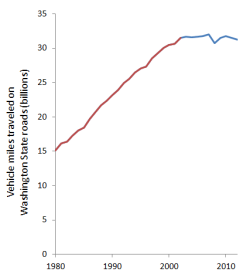
Vehicle travel on Washington’s state roads fell again last year. It was a modest decline—just 0.8 percent—but as the chart to the right shows, it was a continuation of a full decade of essentially flat traffic. In fact, WSDOT estimates that total traffic on state roads was slightly lower in 2012 than it was in 2002.
There’s really not much to say about the trends that I haven’t said before. The flat-lining of traffic is due not to one single factor, but to many. Higher fuel prices are discouraging driving. Baby boomers have aged past their peak driving years. The “millennial” generation is driving less. Mobile and internet technologies make transit more convenient and rewarding. And the popularity of compact neighborhoods lets more people live in places where they don’t need to drive much.
And of course, I should mention a key fact that is getting overlooked in today’s transportation debates: the flat-lining of vehicle travel has occurred during a period when the state has done little to expand the urban highway network. And as a growing body of research suggests, driving in major metropolitan areas grows roughly in lock step with road space. Which makes me despair about the latest proposals for highway megaprojects in Washington’s major cities.

Looks more like a 3 year low to me; the rate of incease took a nose dive in 2000 then around 2008 it actually started to decline. What would be interesting is to compare leisure driving miles with commuting driving miles. Regardless, I really don’t look forward to flying to Seattle, renting a car and having to drive the highways there, its horrible. But I compare that to Anchorage. But there are worse places, i.e. Los Angeles, Houstin, Atlanta…I think gas prices get overrated as a behavior changer though sometimes, when you compare that to other things, that cost is very minor. How much does the average person spend on gas? Food, housing, and the need for technology (new ipods, new iphones, mobile service costs, etc) far exceed those costs attributed to gas, but maybe its psycological.
You’re absolutely right, it’s not a low for the decade (though apparently it was mis-reported that way). Nominally, the peak year was 2007, but only by a hair. An in my opinion, there’s some inherent error in the estimates — error that may exceed the year-to-year change in recent years. That’s why I typically describe recent traffic trends as “roughly flat” even when there are minor ups and downs in the figures that WSDOT report.
Agreed, fighting through Seattle traffic isn’t fun — but that there are definitely worse places to drive. But do remember that these are statewide trends: you see similar patterns in other parts of the state, even rural areas!
how about number of vehicles registered? driving less is good, but do we have places to put them when idle…