


In the US, the ideal of opportunity for all is deeply embedded in our national consciousness. Think: “Land of Opportunity” and the “American Dream.” The American promise that everyone should have a fair shot to succeed has shaped our national identity—and has informed our proudest moments and most righteous laws.
But our core belief in opportunity has been living through some dark decades—times when individualistic narratives such as “family values” and “big government” and “personal responsibility” have drowned out the community-minded themes of equal opportunity that helped spawn the New Deal and the civil rights movement.
To help get public discourse—as well as public policy—back on the right track, an organization called The Opportunity Agenda has issued a new toolkit for elevating a narrative about opportunity, addressing issues ranging from civil and human rights, racial and economic justice, housing, employment, and criminal justice, to education, immigration, and health, safety, and environmental protection.
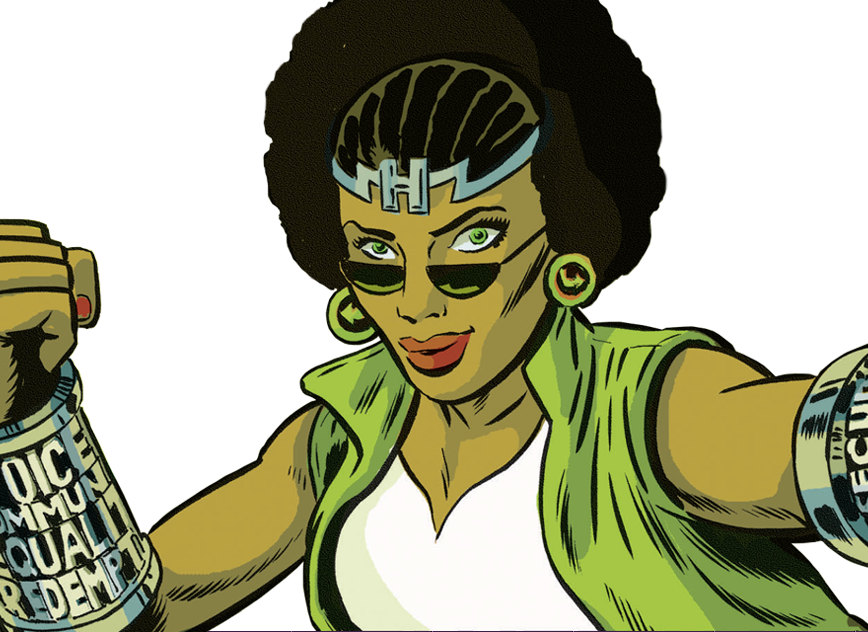
Rooted in a large body of opinion and media research, the toolkit is chock-full of solid communications strategies, from the big-picture to the smallest of brass tacks. (There’s also a kick-ass comic-style “social justice superhero”—Helvetika Bold, developed by New York Times artist Gan Golan—who guides you through the material.)
One key takeaway from the toolkit is the importance of leading with values. This is how we change hearts, then minds, and then policy. Research has shown time and again that audiences are more receptive to new or unfamiliar arguments when they are framed by shared values. The folks behind The Opportunity Agenda remind us that “if we present only a litany of facts and rhetoric that conflict, or appear to conflict, with an audience’s core values, they will often disregard the facts.” It’s not just important to connect policy solutions to the values that we all care about, it’s imperative if we want to make a difference.
Here’s a cheat sheet for talking about the shared values that underpin the proud American ideal of opportunity for all:
[flashcard]
Talking Opportunity for All
Equality: We all gain by celebrating differences and breaking down barriers to opportunity.
Mobility: Where you start in life shouldn’t determine where you end up. We should all have access to ladders of opportunity.
Redemption: Sometimes things go wrong. We all deserve a second chance.
Security: We should all have the tools we need to meet our family’s basic needs. Real freedom is the security to thrive and participate.
Voice: Each of us—We the People—should have a say in community decisions.
Community: We’re in this together. We’re all stronger when we share responsibility for each other and work together for the common good.
[/flashcard]
Leading with values helps us tap the better angels of our audiences’ nature. As the toolkit suggests, “using the value of opportunity connects people quickly to the long-held notion of America as…a place where anyone can reach his or her full potential.” Absent proper framing, they warn, “audiences often default to unhelpful themes such as extreme individualism or ineffective government,” defaults that are counterproductive to our efforts to craft a fair, equitable, and sustainable society.


This is not accurate: Equality is not about “celebrating differences”. Perhaps the authors are thinking of diversity or multi-culturalism. The values toolbox is nice, but there’s no particular evidence that it works on conservatives, or beyond preaching to the converted.
I tend to agree that a better statement of equality could be made, such as:
We all gain by honoring individual dignity and worth and breaking down barriers to opportunity.
“Celebrating differences” is a happy thought, but can also be construed as promoting identification with our own particular kind of “difference” rather than directly hitting the nail of equality on the head.
In my experience, including succeeding in major reform of regional transportation policy and investment, speaking from shared values does succeed in bringing together most perspectives. Our work with a wide range of constituents, from business to poor people, identified values including economic security, safety, choice, accountability, and environmental protection that all groups shared. We used these (at Metro, Portland’s regional government) to develop goals as well as criteria for choosing transportation investments.
I’d like more than just a second chance. I suggest “We all deserve another chance.”