


As a raft of oil-by-rail projects in the Northwest has gotten underway, I’ve been asked by any number of folks about the source of Washington’s oil. So as a reference point, here are three snapshots of the state’s oil flow, circa 2011. All of the charts below are taken directly from a report from the Washington Department of Ecology.
Here’s a map—click to enlarge it—of the routes taken by refined products in Washington.
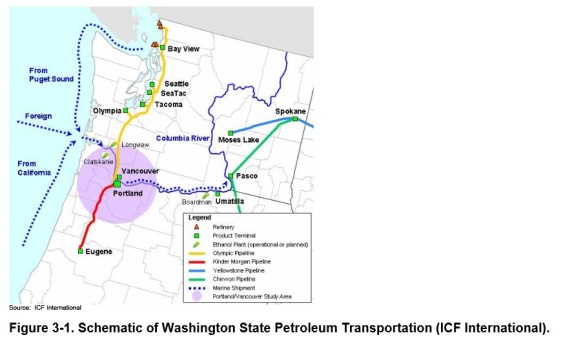 As the Ecology report explains, fuels refined in Washington—mainly at the four refineries indicated by red triangles in north Puget Sound—travel along the Olympic Pipeline to terminals located nearby and to Portland. From Portland, some of the fuel is barged to a terminal in Pasco. Eastern Washington gets the balance of its gasoline and diesel from Montana and Utah via pipeline.
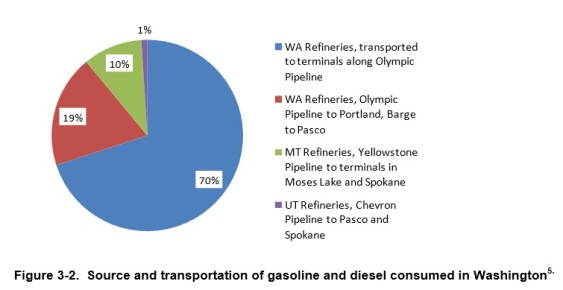
Of the fuels consumed within Washington, the vast majority—about 89 percent—originate from refineries within the state.
The crude oil itself comes mostly from Alaska and is delivered by tanker vessel to Puget Sound refineries.
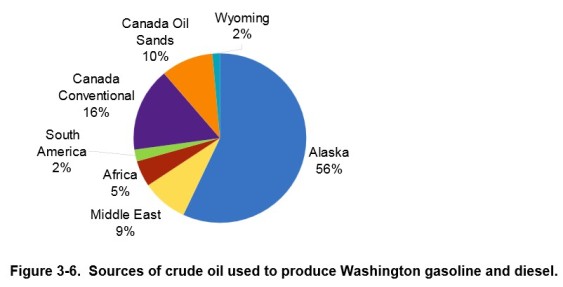 A sizable share, about 26 percent, comes from Canada. About 10 percent of Washington’s crude oil came from the Alberta oil sands.
My understanding is that, since 2011, the share of oil sands has increased and the share of Alaskan oil has decreased. Starting in late 2012, oil began arriving by rail from the Bakken formation in North Dakota. Since then, all five of Washington’s refineries have either begun receiving oil trains from North Dakota or have plans to do so. In addition, port terminals at Grays Harbor and Vancouver, Washington have begun evaluating proposals for oil-by-rail transshipment facilities. Together, these refinery and port projects would be capable of handling roughly 800,000 barrels of oil per day, a figure that vastly exceeds Washington’s refining capacity.
For more on oil train developments in the Northwest, please see Sightline’s report and blog series on the topic.
Notes. In 2011, Ecology hired TIAX, an energy research firm, to evaluate the state’s oil supply in order to inform decision-making about a low carbon fuel standard. They published a report that, as far as I know, is the clearest public account of the state’s petroleum supply. Please see the Ecology/ TIAX report for more detail and fuller explanation of the charts above.

