


Everyone’s talking about how fast crude oil-by-rail shipments have increased, but what does that really mean?
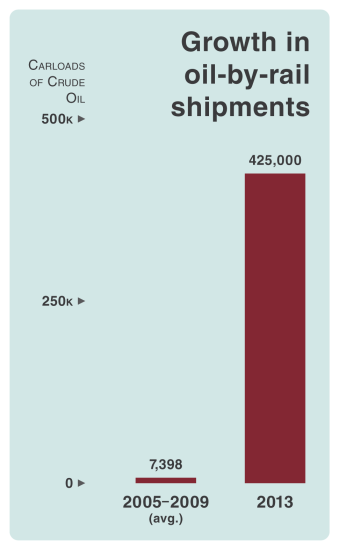
The increase has been staggering:
- In 2013, US railroads moved 11 times more crude oil than all the oil moved by train from 2005 to 2009, the five-year period before oil train shipments began to increase from historical levels.
- Railroads are now moving roughly 57 times more oil annually than they were during the period from 2005 to 2009.
- In 2013, railroads shipped an estimated 425,000 carloads of crude oil—that’s roughly 815,000 barrels per day, about the same volume as would be moved by the controversial Keystone XL Pipeline.
All data come from the American Association of Railroads report, Moving Crude Oil By Rail, published December 2013. The figures refer to carloads of crude oil that ended their journey on class 1 railroads in the US, which means that the numbers exclude oil tank cars that traveled to Canada or to destinations served by minor railroads. The figure for 2013 is the AAR’s estimate based on the first three quarters of data.


BNSF announced last week that they are buying a fleet of 5,000 new oil cars, ones that exceed industry safety standards — https://www.reuters.com/article/2014/02/20/us-bnsf-crude-rail-idUSBREA1J1BE20140220.
So if the choice is oil via rail or oil via pipeline, which is better (or less worse…) environmentally speaking?
Nether, Both methods of transport enables this dirty fuel to destroy our climate.
There is no safe or better way to ship tar sands. Both methods are dangerous and both methods will produce more oil to burn and increase climate change. We have to stop putting money and energy into a limited and dirty resource and concentrate on finding clean ways to produce energy.
How about natural gas powered vehicles, as proposed by Bob Brinker and Dr. Bill Wattenburg?
https://wattenburg.us/natgas.html
Tom,
Natural gas is fracked fossil fuel. It is not cheap nor clean and it is definitely not safe.
Kathy,
Natural gas doesn’t have to be fracked in order to obtain it, but I agree, it is still a fossil fuel that pollutes. However the emissions are less than burning regular liquid gasoline.