
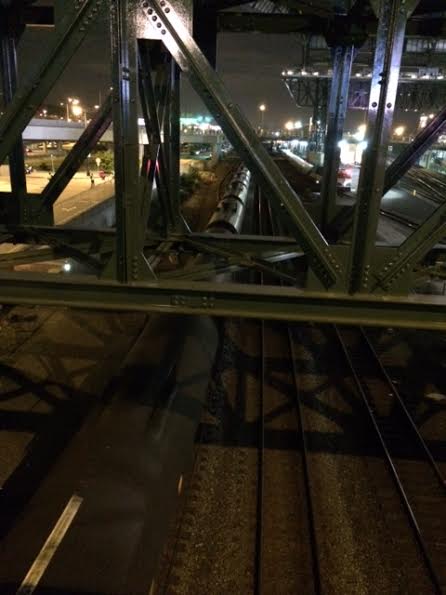


It was still the ninth inning when fans began filtering out of the stadium. The Seattle Mariners were wrapping up a 3-2 win over Detroit on a warm, spring Saturday night. It was a perfect day at the ballpark.
Yet there was chance—unlikely but entirely possible—that it could have been an epic disaster. With perhaps 40,000 people heading out into the city, this train came barreling past within just a few yards of Safeco Field.
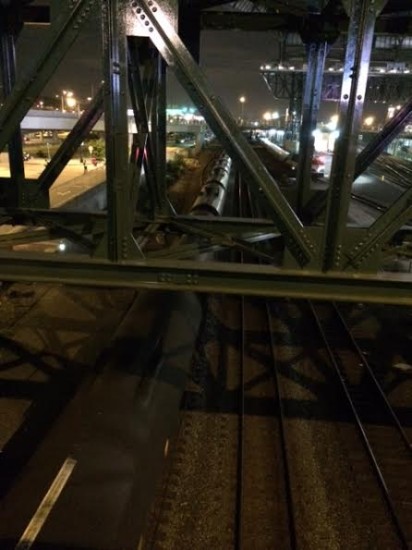
In case you’re wondering, that is almost certainly a loaded oil train. It’s a hundred or so tank cars each carrying roughly 30,000 gallons of a notoriously explosive type of shale oil. It’s exactly the same kind of train—loaded up with exactly the same kind of fuel—that resulted in a deadly disaster in a small town in Quebec. That led to this explosion in Alabama. And this fireball just outside Fargo, North Dakota. And this conflagration in New Brunswick. And this inferno in downtown Lynchburg, Virginia.
All within the last 12 months.
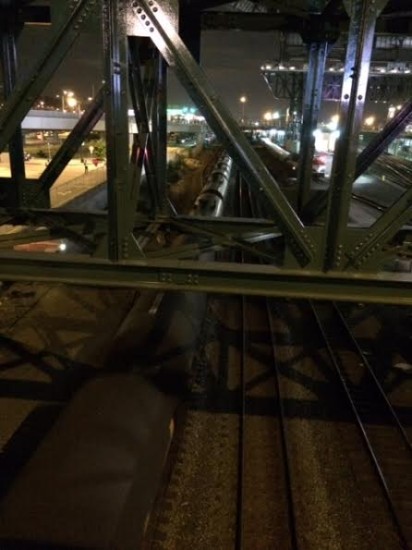
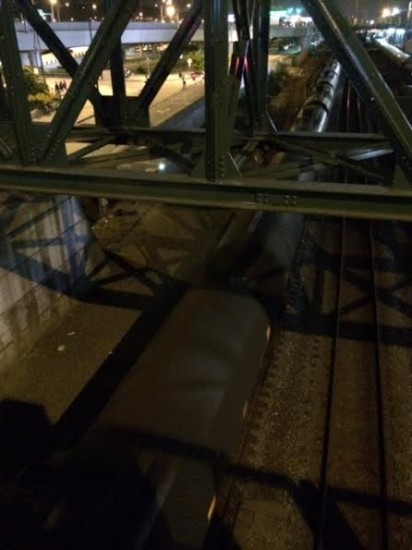
If the Safeco Field oil train had derailed and exploded, the damage would have been almost too horrific to imagine. For those not familiar with the local area, those steel girders in the foreground are actually part of the stadium’s retractable roof. That’s how close by the trains pass.
For the safety of others, officials search every bag fans bring to the game for bottles and other nuisances. But BNSF has the prerogative to make a potentially lethal run within a (literal) stone’s throw of tens of thousands of folks just enjoying a night in the stands. It ought to be illegal.
A couple additional points to bear in mind:
- Freight trains have derailed within a few hundred yards of that location in the last couple of years.
- Oil trains are radically under-insured against the risk of catastrophic explosion, and the costs would fall overwhelmingly on taxpayers.
- The oil-by-rail industry is refusing to phase out older and obviously unsafe tank cars; the industry routinely lobbies against safety regulations; and even the newer-model tank cars can burst into flames while carrying shale oil.


I believe it’s time to challenge the system with a pre-emptive class action suit seeking damages for the inevitable ‘disaster’ to come (human, environmental or most likely, both) and the judicial havoc that will ensure ending in bankruptcy(s) and bailouts/ins by said class.
I volunteer to file as my life has already been ‘harmed’, every time I hear sirens at home I wonder what my be coming my way (chlorine gas cloud/fireball/petro vapors) and I know for a fact that my community is not prepared for it, leaving us all to fend for ourselves.
Anyone interested?
PS – If you want a good look at what rolls through Seattle check out the Auburn rail yard where on any given day you can see miles of tanker and coal trains side by side (I think 17 tracks worth) as well as the daily garbage train (looks like a container train) which loads in south Seattle and heads south to a landfill overlooking the Columbia River. Kinda puts things in perspective.
Hello Living by the Tracks,
Thank you for your comment. I do not know if Sightline is allowed by its charter to connect potential plaintiffs with law firms.
So I should make clear that what follows reflects my own opinions only.
You may know that Earthjustice, “lawyers for the earth,” is also in one of its cases representing a community group and other organizations in challenging a public agency over the shipment by rail of Bakken crude oil into the City of Richmond, located in the SF Bay Area. Details of the case can be found on Earthjustice’s web pages, link at: https://earthjustice.org/cases/2014/challenging-crude-by-rail-shipments-to-california-s-bay-area
This is a bit different from the pre-emptive suit for damages that you envision, but you may be interested that one of the lawyers for the case, Kristen Boyles, is based in the firm’s Seattle office. You may want to contact Earthjustice about joining the case and/or joining a group to serve as plaintiffs in a similar case in the NW. On the other hand, Earthjustice is highly active, and has to keep its case load manageable within its limited budget.
So no promises, but it may be worth your while to make inquiries.
Best wishes,
Could someone explain why there is a rush to export oil when we are approaching “Peak Oil”.
The difficulties of maintaining security of supply would seem to favour orderly safe expansion of the new technologies without the need to rush as the value of the product will grow with shortage.
It would seem prudent to leave supplies in for our children’s generation in case they need them rather than exploit them all now and make the lives of our children more difficult.
Yo,
It is now illeagl to export crude oil. The Scabs: Club for Growth, Business Round Table, and Chamber of Commerce want to export oil and jobs to other countries. Right now, crappy as it is, we process the oil here in the West Coast Refineries and provide, not milktoast family wage jobs but real union wage jobs and value adde exports in the form of gasoline. Last year’s largest export from the U.S. A UNION MADE EXPORT.
I do not like oil or fossil fuels but I really resent the Scab Culture in this country trying to export our resource to line the pockets of the Scab big businesses and slimball speculators.
Speak up agaist the Scab non-union pillagers now.
How do we do something about this? It’s horrifying.
Have you also read Chip and Dan Heath’s book Switch? We need an emotional kick in the gut, a clear direction, and to make the change easy.
It is frightening to have those trains coming through Seattle at all, but pure insanity to have them going past a stadium full of people.
What’s something with a powerful emotional punch? What about 40,000 pairs of shoes, for people of all ages and types, all scuffed up like they’ve been through a war. The relics of a scene of genocide. Deliver those to the door of the leaders of all the big, powerful organizations along the train route. Deliver them to BNSF. Deliver it to the mayor and council. Get the media. This is an entirely preventable catastrophe of shocking proportions.
The clear direction could be absolutely no trains when fans are in the area for games. There should also be additional safety requirements (speed, type of train, etc) for all times. Unfortunately even common sense safety enhancements might get push back, but not sending trains through when there is a game should be a no brainer.
The stadiums could provide the times not to run trains, making it an easy change.
if we had signage to post the warnings or in lieu of official city signs, then public service “protests” with people holding signs or handing out flyers to the sports fans, informing them of present risks & increasing frequency of combustable oil as well as coal trains passing by so closely, could help raise awareness. And, although I think there are many more reasons why the trains with oil should not pass there at all, it certainly would help to increase the number of people willing to speak up about this, even if it’s primarily with self
interest in mind.
“In case you’re wondering, that is almost certainly a loaded oil train.” I’m a little disappointed in Sightline/Eric de Place for this scaremongering. I totally support the premise but do not like that the evidence is based on “almost certainly” rather than a train known to be hauling “a hundred or so tank cars each carrying roughly 30,000 gallons of a notoriously explosive type of shale oil.” I get that we don’t necessarily always know what’s exactly in those ominous black tanker cars, but we don’t need to make up stories about it – it only hurts the credibility of our cause.
Let’s not stoop to the low level of those who would have us believe it is game-over if we dare to move away from a fossil fuel-based economy.
Respectfully,
Faith in Kirkland
Energy Efficiency Engineer and Bike Commuter
Sorry to hear you’re disappointed, but I’m not sure I understand exactly why. In no sense am I “making up a story” about that train. To the contrary, there is ample visual and contextual evidence to support the conclusion that the train is a Bakken oil-bearing unit train.
I added the qualifier “almost certainly” out of a desire to maintain Sightline’s high standards of precision. (We do not have photographs of the hazmat placards on the sides of the tank cars. These would confirm our conclusion, though it is likely these placards would not be legible in the dark, especially on a train at speed.)
+1 for Faith.
I prefer the straightforward approach and depth of reporting that journalism brings to the subject, as in here: https://www.sacbee.com/2014/06/07/6465172/crude-oil-rail-transports-to-run.html
I wish Sightline would do more of that and less of this. Maybe one or more of Sightline’s 36 other posts on the topic are more investigative and less sensational. But I am not inclined to read on to the others since I found good information elsewhere and because of the tenor of this Sightline post makes me think such exploration won’t be fruitful.
Thanks for sharing your perspective.
You’ll find dozens of Sightline’s long-form analytical and investigative pieces on the subject here.
And allowed to go through tunnels!?!
Unlike the KXL pipeline and the coal export farce, little effort seems to have gone to slowing the Bakken fracking. The Bakken fields in N Dakota flare huge amounts of natural gas and use huge amounts of water in a arid region. It should be regulated and developed slowly capturing the gas and cleaning the water.
Nice catch! Also goes right by Costco a little south from there.
I study rail stuff and you are 99% correct that is a unit train of crude oil, very likely from the Bakken formation. However, the scaremongering of unsafe cars, under insured companies, and barreling through Seattle is a bit much.
The older DOT 111 cars are safe, if the train doesn’t derail what ever the cause. Derailment is the culprit and not the oil or the cars. Once derailed though, the older cars are easier to puncture than the newer cars – 1/8th inch less steel, no extra end protection, and valve/manway protection is less so they are easier to leak. These tank cars weigh over 250,000 lbs. That is a lot of energy when to dissipate in a crash. Something that could help is a concrete barrier to limit the puncture opportunities near public forums like the stadium and slow the speed down to reduce crash energy. Read “Train Wreck” by Bibel to get the idea of the forces and what can be done to make trains safer.
Most of the crude unit trains are of the newer more protective cars. Those tank cars carry about 26-28,000 gallons each with about 100-120 cars per unit. The newer cars are about 60% less likely to puncture but it will still happen.
The train routing through downtown Seattle is not good, I agree but who built stadiums in an industrial area?????? Right, politicians and the people who wanted them. Like building houses next to chemical plants – something is gonna happen…..
BNSF is a pretty responsible company compared to others and they want safe cars for their employees as well. It is their name that gets flashed when something happens and they are trying to do the right thing but the outcry is so heavy they want something reasonable to work with.
Bakken crude is much like gasoline in flammability with some other constituents that hamper spill response efforts. Also seems to offgas some in transit which makes it more likely to release light ends during transit. Seen some cars that have stains from the vents. I think PHMSA is wrong about the packing group and this stuff should always be considered PG I and treat it to the highest standard.
Also, has Safeco/Seattle approached BNSF to talk about scheduling, mitigation of risk, response planning, extra prevention inspections in city limits, etc….? That is how you protect people not the bloviating I read in the comments.Soap boxes don’t help when they are made of hype.
Thanks for weighing in, but I take issue with the idea that what I wrote is “scare mongering.” In fact, each of the claims I make here has a solid research basis.
Unsafe older tank cars here
Newer tank cars still risky here
Radically under-insured industry here
I don’t agree that oil is not the culprit. Although derailments are rare, they are an unavoidable feature of active rail networks. A derailment with containerized cargo or grain is annoying; a derailment with coal or garbage is nasty; but a derailment with shale oil can result in a horrific catastrophe.
From the way Faith and Reality Check are reacting to your story you’d think that you wrote about how easy it would be for a terrorist (foreign or ‘home grown’ ) to blow the thing up as it went by the stadium