
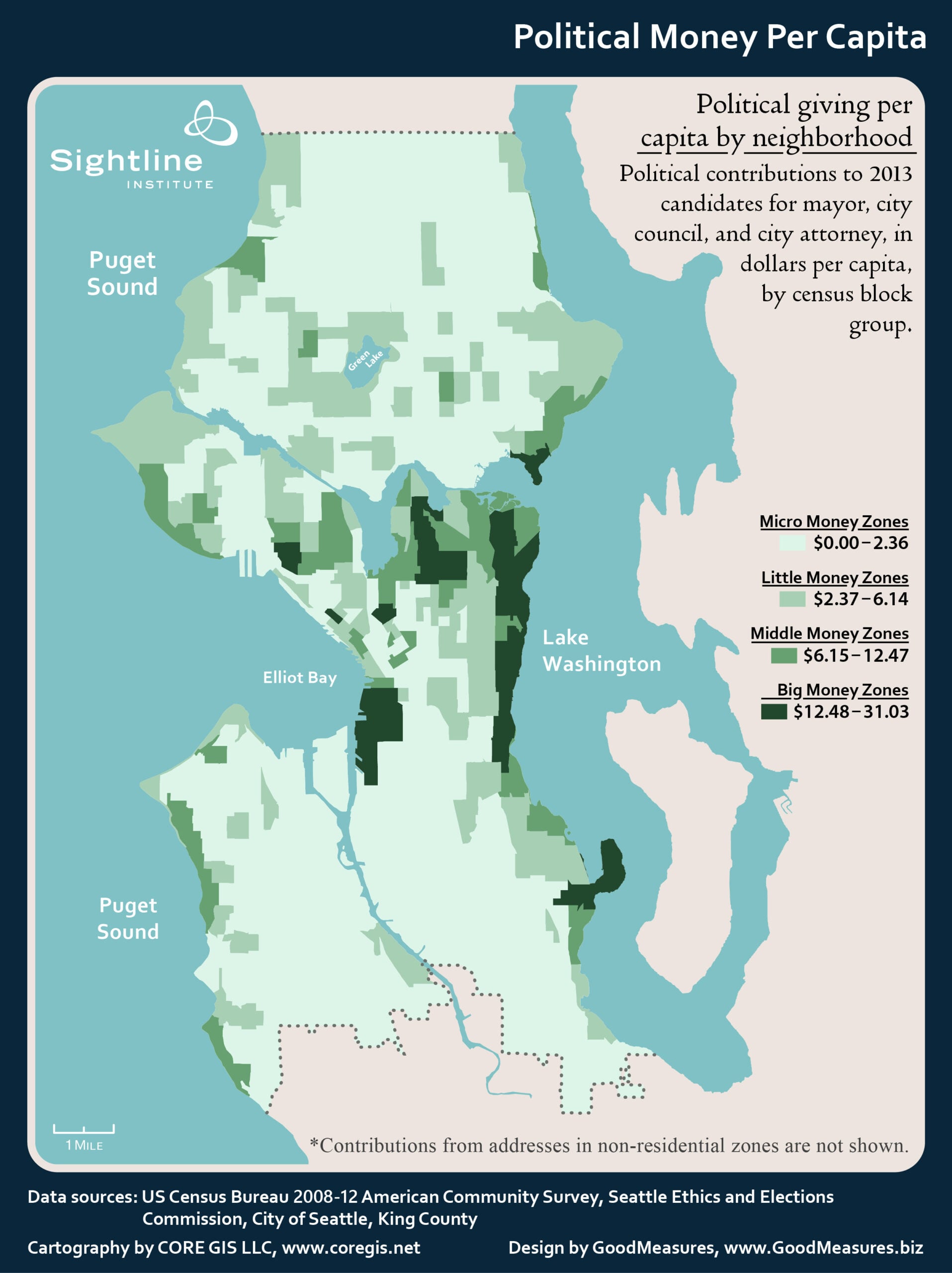


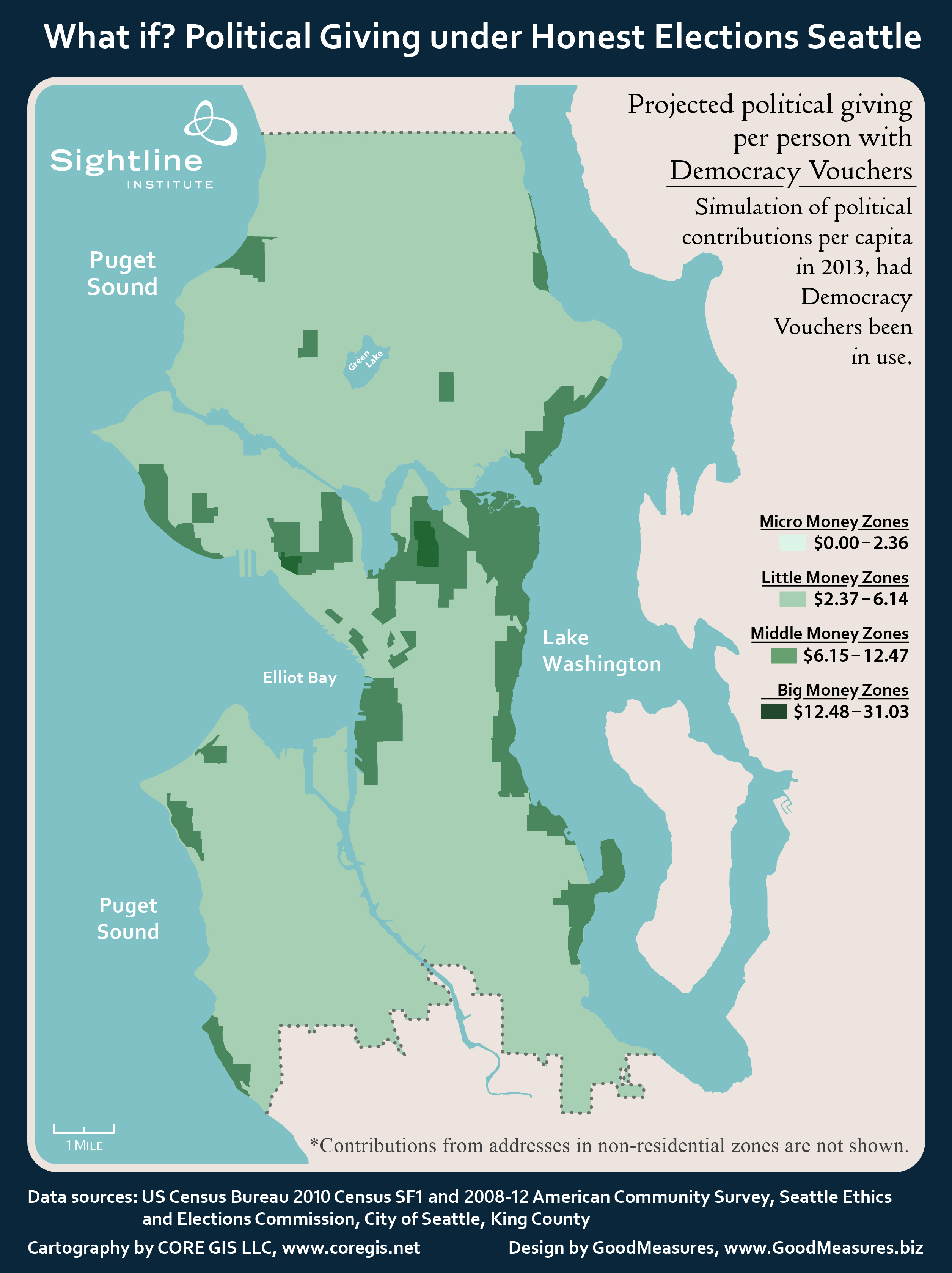
Overwhelmingly, rich, white people who live in Seattle’s waterfront and view homes fund Seattle’s political candidates. That’s the picture that emerges from a new Sightline Institute study released today. If enacted by voters in November, Honest Elections Seattle (Initiative 122) could spread the funding of campaigns from elite neighborhoods to the whole city.
The report analyzes the pattern of political contributions in the 2013 city elections to explore how Honest Elections Seattle might affect giving. The city’s most-giving neighborhoods (dubbed “Big Money Zones”) hold just 4 percent of the population, but they gave as much political money as the least-giving neighborhoods that house 64 percent of the city. Per person, the Big Money Zones gave more than 18 times as much as the least-giving ones.
Furthermore, the Big Money Zones are the city’s most privileged. Compared with the least-giving zones, they are 31 percent whiter and 85 percent richer. Homes in the Big Money Zones are two-and-a-half times pricier and four-and-a-half times more likely to have a mountain or water view.
The Honest Elections Seattle Initiative (I-122) would, among other things, distribute $100 of Democracy Vouchers to each registered voter in the city. Voters would be able to donate their vouchers to candidates who agree to limit their spending and forgo large contributions.
The full report is here.


Wow! It looks like Tracy Newman has recruited all her neighbors to host fundraisers overlooking Lake Washington. No wonder she’s campaigning against this initiative.
Honest Elections or Tracy Newman is not what this I -122 is
all about. First off it will cost the city a ton of money
defending in court. It was no dream taem that wrote this
I- 122. Parts of It violate my Free Speech Rights. I hate it
when these so called good government types dont do the homeowork
any more on things they want the voters to pass. If Seattle
wanted this it they would not have to go out of the City to raise
the campaign funds to hire paid signature gathers,that lied to get
this on the ballot.
On HES, I love the idea. I don’t love all unintended consequences. Has this been tried, in a demographically similar area, and if so, how did it work out? What could go wrong?
(Akin to land value taxation, where the “workaround” (to the fix) is 99 year leases, right? My understanding is hazy, so I might not be right)
According to Alan During, the Honest Elections Seattle initiative promoted by Sightline Institute that will now be on the November ballot has two aims: 1) to “lower the limit on contributions to candidates from $700 to $500”; and 2) to “ban contributions to candidates from entities with city contracts of $250.000. or more and from people spending at least $5,000. to lobby the city.” Further, the measure would “give every voter in the city four $25 ‘democracy vouchers’ to spend on qualifying candidates’ campaigns,” and would be “funded by a 10-year, $3 million per year property tax levy” (Seattle Times, B 1 + 9 7/22/15).
While Sightline’s motives may be laudable, its proposal is both ludicrous and illegal. First, During implies that being white and wealthy and exercising one’s political will in accordance with one’s economic status is somehow immoral and contrary to democracy, despite the existence of the first amendment to the US Constitution which guarantees freedom to express one’s political preferences as one pleases.
Second, During asserts that “vouchers would work better than matching funds because people wouldn’t need to take money out of their wallets in order to take part in the political process.” Nonsense! if During’s proposal were implemented via a property tax, money from every home owner in Seattle would be taken from their wallets and given to others who might very well donate it to candidates one does not support, thus completely undermining each individual’s right to vote only for candidates of their choice. No sane person should ever accept such a ridiculous fleecing of their wallet or their political preferences.
Third, while I agree that the infamous “Citizen’s United” Supreme Court decision was unfortunate, one cannot simply ignore that decision because one does not like it. Caps on political contributions are for now illegal, and no initiative in Seattle can change that fact.
Voters in November should bury Sightline’s offensive and illegal proposal.
Our country is Lesterland.
Well, this turned out to be the dumbest idea since Kennedy decided to invade Cuba.