

“Cascadia voters could steer clear of the perils of district-only voting by choosing the safe harbor of proportional representation.”
On November’s ballot, Whatcom County voters will see two proposed charter amendments to alter the way they elect county councilors. One would change to district-only voting, and the other would keep countywide voting but switch from three districts to five during primary elections. In my last two articles, I described how district-only voting fails voters while countywide voting serves them better. Despite its abysmal performance, district-only voting lures Cascadian localities with its siren song. Some, like Whatcom, are drawn in when moneyed interests hope to use it to their advantage; others seek it as a supposed cure to an illegal lack of representation (Yakima); while others follow calls for accountability (Seattle) or more geographically diverse representation (Portland). But there is another way.
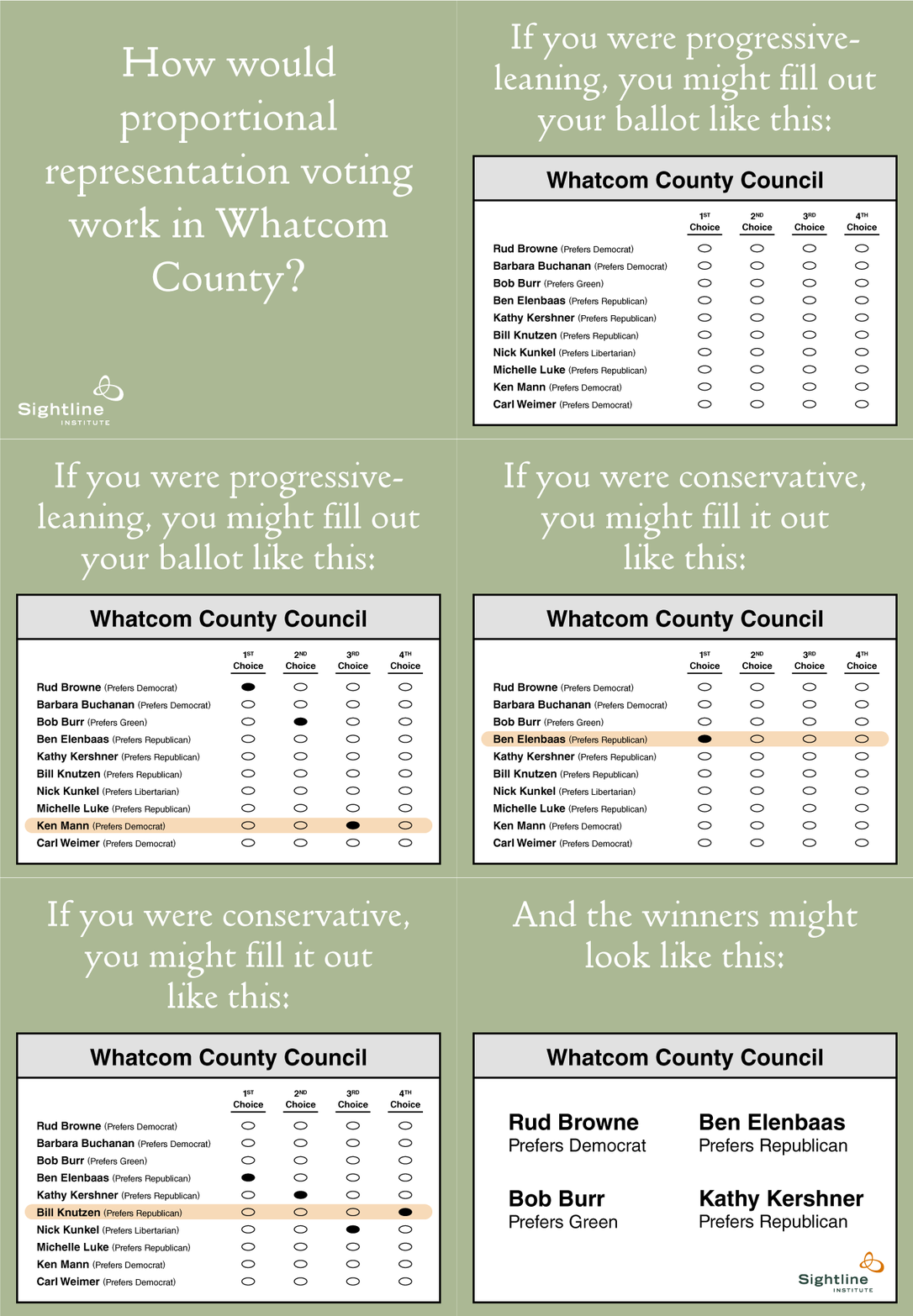
Cascadia voters could steer clear of the perils of district-only voting by choosing the safe harbor of proportional representation. Whatcom voters would have had such an option this fall if conservative members of the Charter Review Commission had not prevented it from reaching the ballot. Localities across Cascadia would do well to pilot towards proportional representation. Voters expect 1) to elect councilors who reflect their views and 2) that the council overall will reflect the views of voters overall. Voters expect 3) councilors to be responsive to concerned citizens and 4) to work together to craft solutions. Finally, voters might hope 5) that regular people, like them, could run for office. Proportional representation delivers.
1. Can I elect one or more councilors who represent my views?
By voting for every council seat and ranking your top candidates, you get the best shot at electing councilors who represent you. Like-minded voters making up 20 to 25 percent of the population can elect a councilor representing their views, so you can get a councilor more closely aligned with your mindset than the watered-down similarities that count as representational when a councilor needs to win 51 percent of the vote, as with winner-take-all voting.
2. Will the council accurately reflect voters?
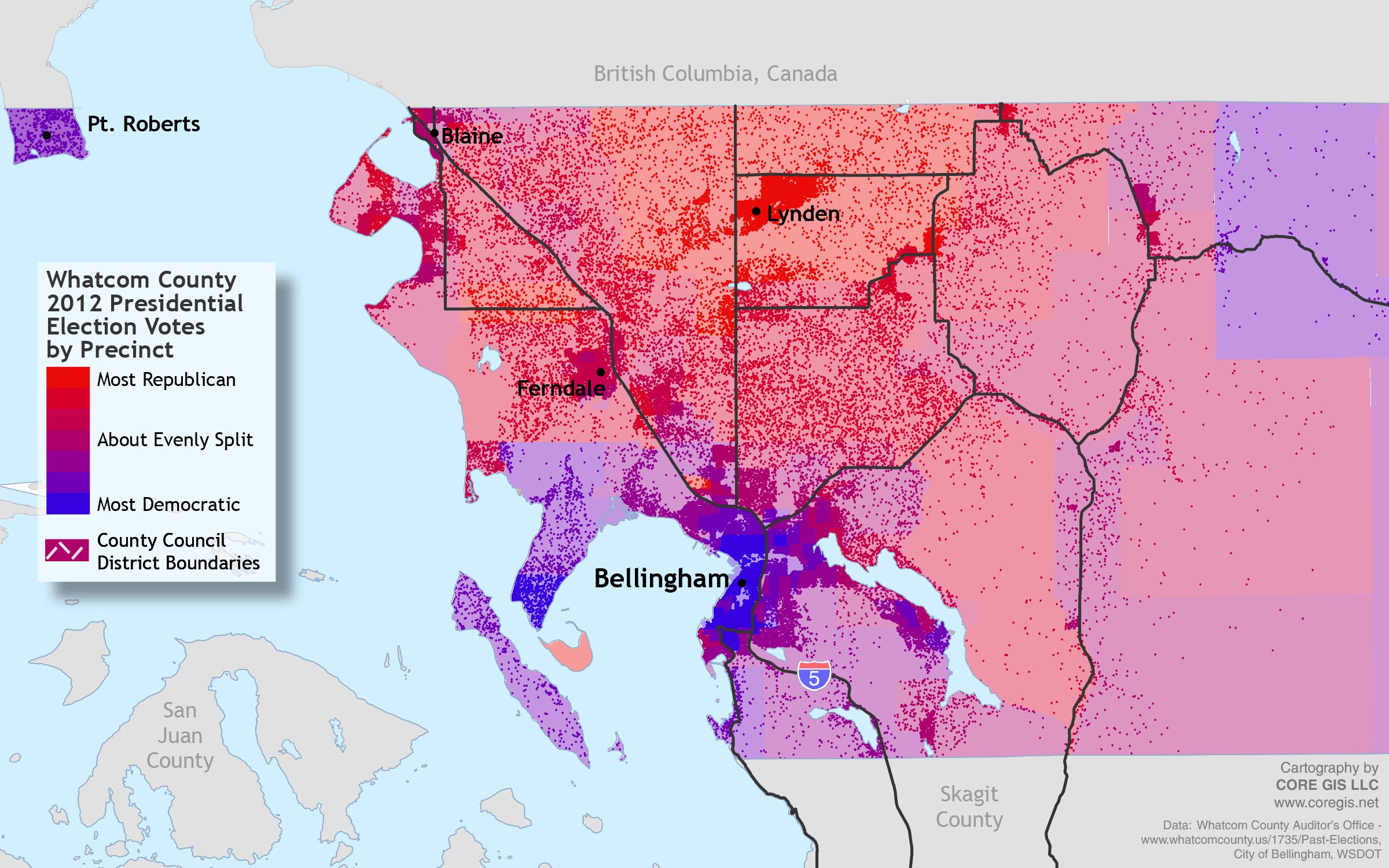
The map below shows the variety of voters across Whatcom County. As in many parts of North America, more liberal (blue) voters are concentrated in urban areas and more conservative (red) voters in rural areas, and many communities include a mix of both (purple). Proportional representation ensures different voters have a voice on the council, no matter where they live. Liberal voters in Bellingham and elsewhere could band together to elect several councilors. There might even be enough progressive voters to elect a Green Party candidate or a particularly progressive Democrat. Conservative voters could unite to elect several conservative representatives. About 45 percent of Whatcom voters live in rural areas or small cities—if most rural voters banded together, they would be able to elect three rural representatives. Moderate or independent voters across the county might unite in support of an independent councilor.
3. Will councilors be responsive to my concerns?
Every councilor would want your vote—whether as your first, second, or third ranked choice—so all would respond to you.
4. Will councilors work together for the good of the county?
Every councilor would represent voters across the county, so they would work together towards countywide solutions.
5. Will regular people be able to run for office?
Campaign costs might be much the same as they are now: lower for noncompetitive races and low-interest years, but higher for competitive races and years when important issues—like the coal export terminal—hang in the balance. However, there is reason to think that proportional representation voting might make money matter less, creating openings for new blood. And proportional representation creates an opportunity for lesser-known candidates. Under the current system, candidates must win more than 50 percent of the votes countywide, so it is only worth running if you have—or can buy—name recognition throughout the county. In a proportional representation election, a candidate needs only 20 to 25 percent of the votes to win a seat. Potential candidates who don’t feel they can pass the winner-take-all 50 percent threshold might find they are known enough to have a shot at winning 20 percent of the vote.
Steer towards proportional representation
If Cascadian localities are dissatisfied with local elections, they should tack towards the friendly shores of proportional representation—instead of drifting onto the rocky shoals of district-only voting.


District voting has one huge advantage: it cuts the cost of campaigning by a factor of three or five. It enables candidates to actually contact their constituents, rather than rely solely on media and mailings.
In a county setting, it also provides for representation that understands local issues.
Now, a shift to instant-runoff voting would both save money and improve representation.
It sounds like you are advocating for the Single Transferable Vote method of electing a multi-member body, a system I don’t believe we’ve ever had in Washington state. They did try instant runoff voting in Pierce County for single-member constituencies, but voters threw it out after only one use. For many years, Cambridge MA was the only city using STV to elect its City Council (and School Committee). STV was used in many cities in the early decades of the last century, up until two Communist Party members got elected to the New York City Council in the 1940’s. Cold War attitudes quickly killed off STV everywhere except Cambridge. Maybe it’s time for an update focused just on STV, unless you did already and I missed it.
RD – Yes, I plan to write a piece about when and where STV, IRV, and cumulative voting have been used in the US, how they started being used, why they stopped, and what the experience was like for voters and legislators!
Yes, not the first time I’ve heard of this. There was some (not too serious) discussion when the Supreme Court threw out the open primary several years ago.
Voters in Pierce County did not know why they voted for RCV in the first place. They only wanted to repeal partisan primaries. The Pro RCV took advantage of this and promoted the change in context of repealing the Pick-A-Party primary. However, when the system was put into place, voters had no idea of what the new system was about. I have a screen shot of the auditors page on WHY RCV? The answer was “Because voters passed it” Most did not have any idea of what or why the change was made. Political elites jumped on this to collude and work towards repeal. In the end many voters repealed it because they thought it elected Dale Washam. This is like blaming Troy Kelley, another Pierce County politician, on Top-Two. Anyway, the two or three people that pushed RCV in the charter review review process were overwhelmed by elites and public perception and RCV went down. RCV in Pierce County is the textbook case on how not to promote this voting reform. The rumors and gossip on RCV in Pierce may persist, however, at least there was a study done on the system and how it actually worked well. Here is the link. https://www.washingtonpoll.org/pdf/rank_choice.pdf