Donate Newsletters
Home » Climate + Energy » Fossil Fuel Transition » The Last and Largest Northwest Coal Export Schemes Would Bury Portland

The Last and Largest Northwest Coal Export Schemes Would Bury Portland

Original Sightline Institute graphic, available under our free use policy.

SwatchJunkies

March 21, 2016

In 2016, the Northwest public will have a chance to voice its views on the two remaining coal export terminals proposed for Washington state. These projects would be the first and second largest coal terminals in North America, weighing in at 48 million tons per year (in Whatcom County) and 44 million tons annually (in Longview).

That sounds like a lot of coal… because it is.

All of that coal would be delivered by trains traveling through the scenic Columbia River Gorge and near Portland, Oregon, on their way to the planned terminals. So for comparison purposes, here’s how one year’s worth of coal would dwarf the biggest buildings in Portland:
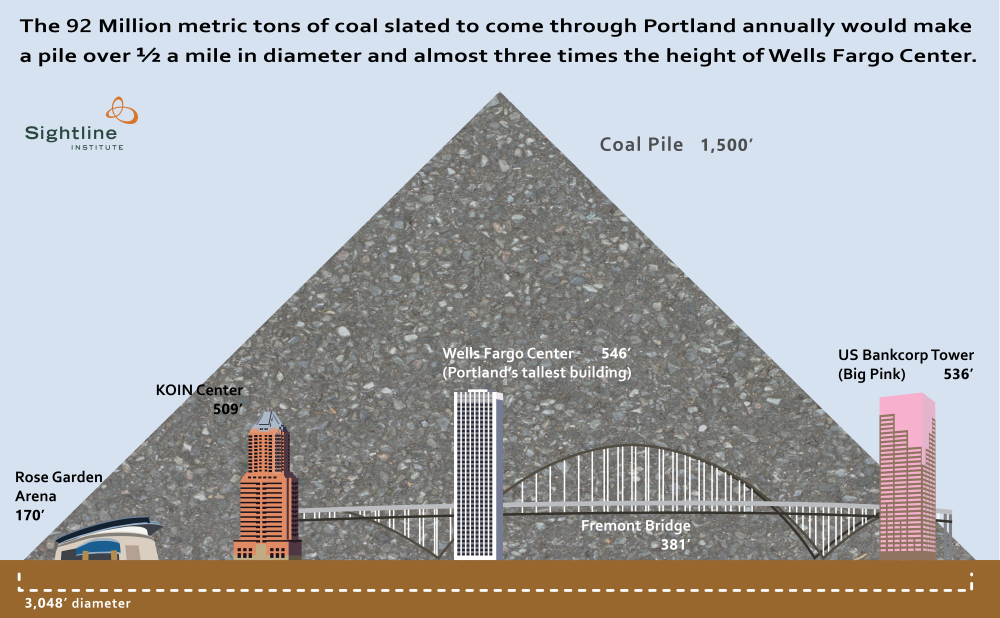
Original Sightline Institute graphic, available under our free use policy.


Even considering just the smaller of the two projects alone, the sheer quantity of coal is staggering:
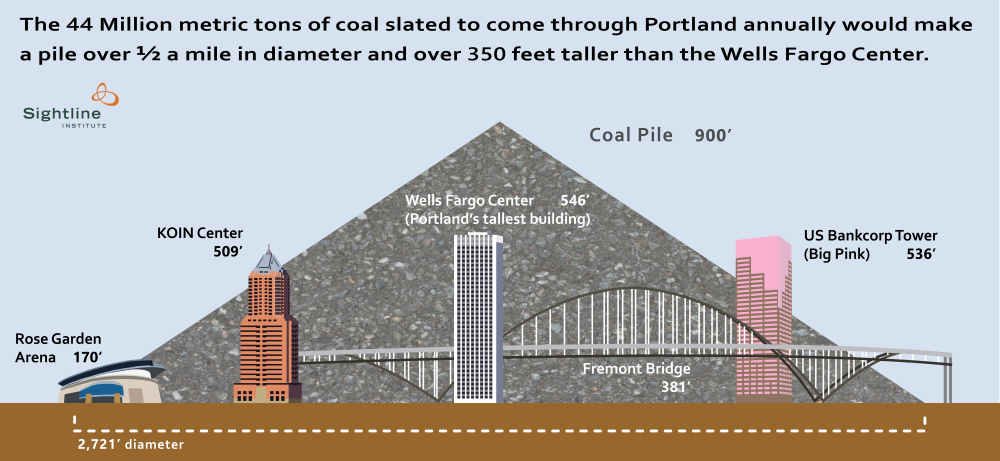
Original Sightline Institute graphic, available under our free use policy.


Here’s how that coal would look stack up in the Columbia River Gorge:
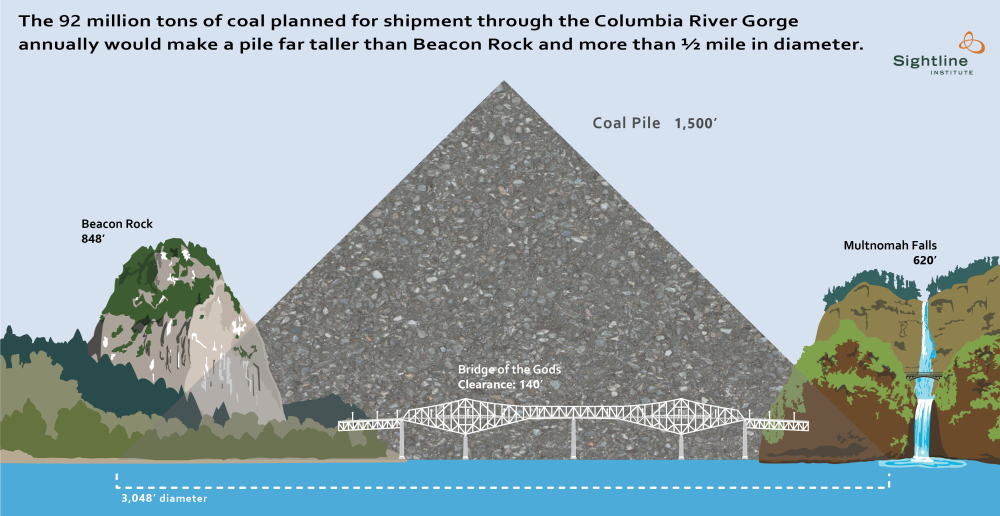
Original Sightline Institute graphic, available under our free use policy.


And here’s how just one of the two projects would look:
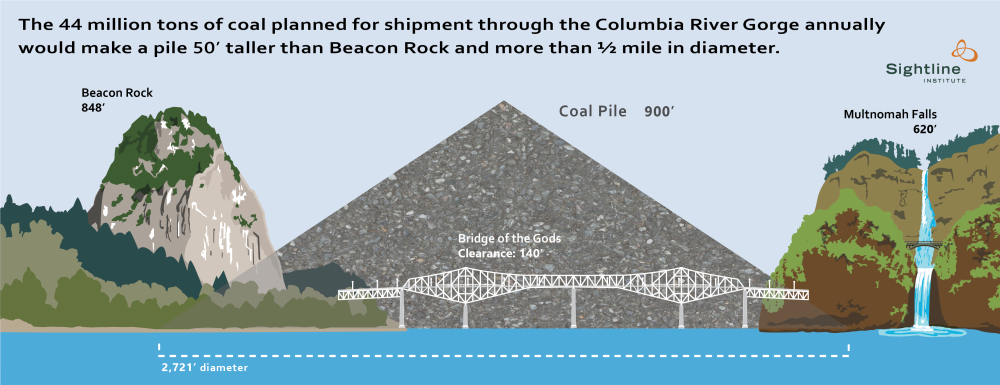
Original Sightline Institute graphic, available under our free use policy.

In the last several years, the Northwest’s “Thin Green Line” of resistance successfully halted four of the six coal export projects originally proposed for the region. As the public evaluates these final—and by far largest—two coal schemes, it’s useful to remember just how big the coal industry’s ambitions are.


Sightline thanks Devin Porter at Goodmeasures.biz for designing these graphics.

Talk to the Author

SwatchJunkies

Talk to the Author

Eric de Place

About Sightline

Sightline Institute is an independent, nonpartisan, nonprofit think tank providing leading original analysis of democracy, forests, energy, and housing policy in the Pacific Northwest, Alaska, British Columbia, and beyond.

2 thoughts on “The Last and Largest Northwest Coal Export Schemes Would Bury Portland”

  1. I lived in Vancouver while the shape/tar sands trains were running heavy traffic and opposed the industry’s desire to build a terminal. That was based on very clear dangers in spillage and it’s high volatility compared to lighter drilled crude as well as documented wrecks/tragedies across the country.
    Other than the sheer volume, what are the specific impact concerns?

Comments are closed.

For press inquiries and interview requests, please contact Martina Pansze.

Sightline Institute is a 501(c)3 non-profit organization and does not support, endorse, or oppose any candidate or political party.

See an error? Have a question?

Find the author's contact information on our staff page to reach out to them, or send a message to editor@sightline.org.

Thanks to David & Janice Yaden for supporting a sustainable Cascadia.

Our work is made possible by the generosity of people like you.

×
Privacy Overview
Sightline Institute

This website uses cookies so that we can provide you with the best user experience possible. Cookie information is stored in your browser and performs functions such as recognizing you when you return to our website and helping our team to understand which sections of the website you find most interesting and useful.

Strictly Necessary Cookies

Strictly Necessary Cookie should be enabled at all times so that we can save your preferences for cookie settings.

3rd Party Cookies

This website uses Google Analytics to collect anonymous information such as the number of visitors to the site, and the most popular pages.

Keeping this cookie enabled helps us to improve our website.

Additional Cookies

This website uses social media to collect anonymous information such as which platform are our users coming from.

Keeping this cookie enabled helps us better reach our audiences.