



Author’s Note: This is the TL;DR version of a longer article that outlines nine options for electing Portland councilors from single-winner or multi-winner districts.
Portland has a problem—the city council is, and always has been, dominated by white men. Unfortunately, the most commonly discussed reform—splitting the city up into council districts or wards—will not actually solve this problem. What would solve it is to switch voting systems rather than district lines. By employing one of two widely used voting methods, where voters rank multiple candidates (ranked-choice voting) or allocate a set number of “dots” among those candidates in any pattern they like (cumulative voting), Portland can elect a council that is representative of its gender balance, racial and ethnic composition, ideological makeup, and geographic spread.
Four single-winner districts could elect four white men
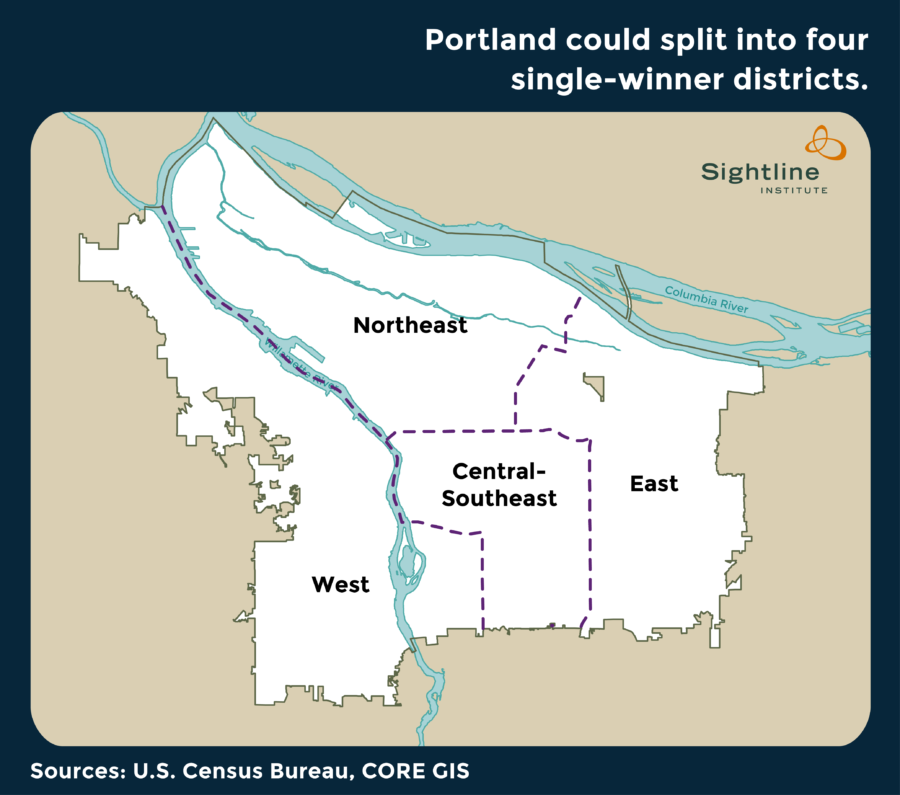
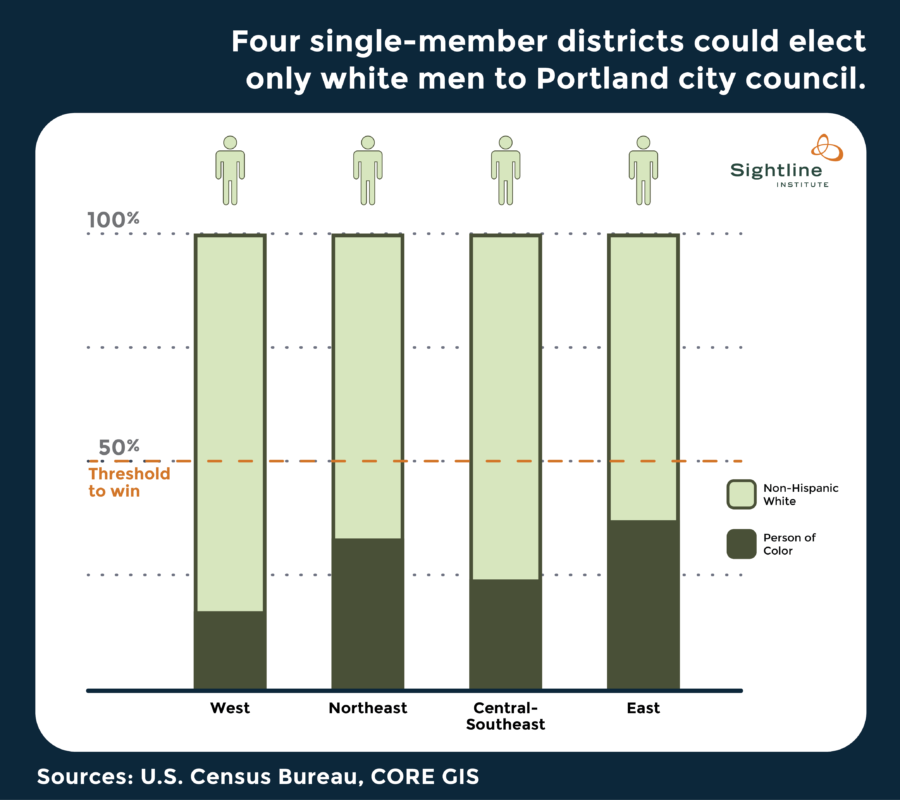
If Portland kept its (unusually small) council of five and elected four councilors from single-member districts and the mayor at-large, it could still end up with an all-white, all-male, ideologically homogenous council. Dividing the city into four equal-population districts might look like the map below; each district would range from 63 to 83 percent white. In each single-winner district, a candidate would have to win a majority. In Portland (as elsewhere in the United States), in majority-white districts, white male candidates most often win.
Six single-winner districts could elect six white men
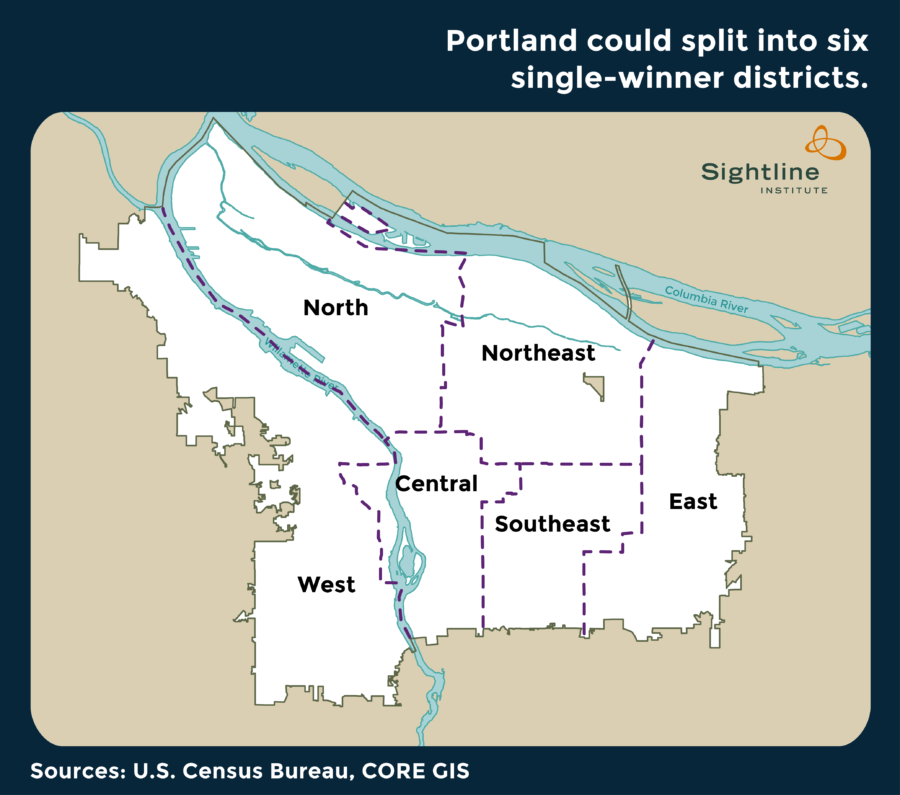
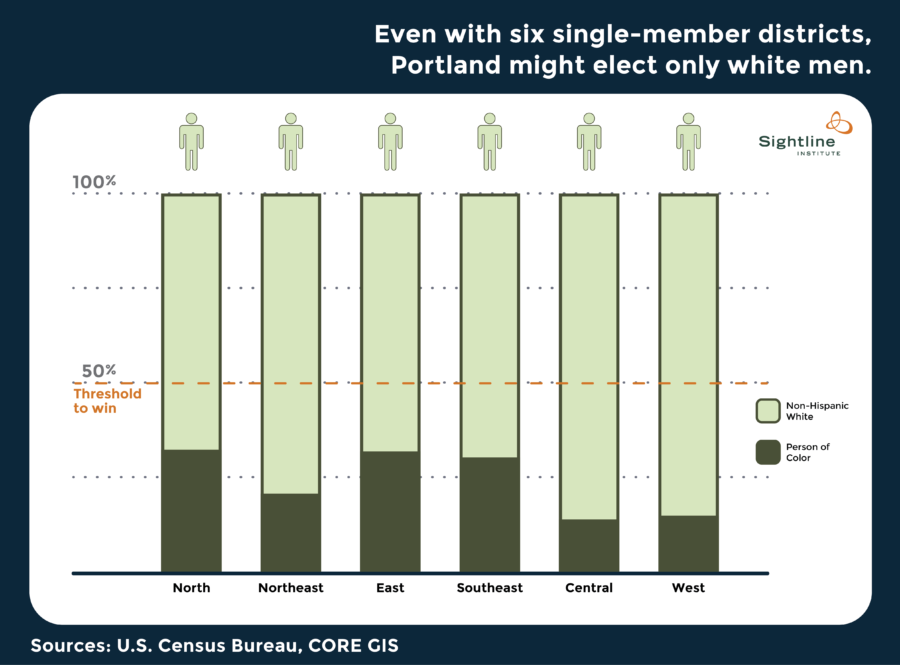
Even if Portland increased the council to seven, electing six councilors from single-member districts and the mayor at-large, the same pattern would likely recur: an all-white, mostly male council. Dividing the city into six equal-population districts might look like the map below. Each district would range from 68 to 86 percent white, and each would have a good chance of electing a white man.
A five-winner district could elect two people of color and two women
A much better way to improve representation would be to change the voting method. With proportional representation, all candidates could run in a five-winner city-wide district and voters would be allowed to rank candidates (ranked-choice voting) or give all their votes to their favorite underdog (cumulative voting). The mayor could simply be the candidate with the most votes. Any candidate could win a seat on the council with as little as 17 percent of the city-wide vote. At least one and likely two candidates of color would probably win a seat on the council. Candidates of color and younger candidates would have a further advantage under this system because all city elections would be conducted in high-turnout presidential elections. Primaries could disappear.
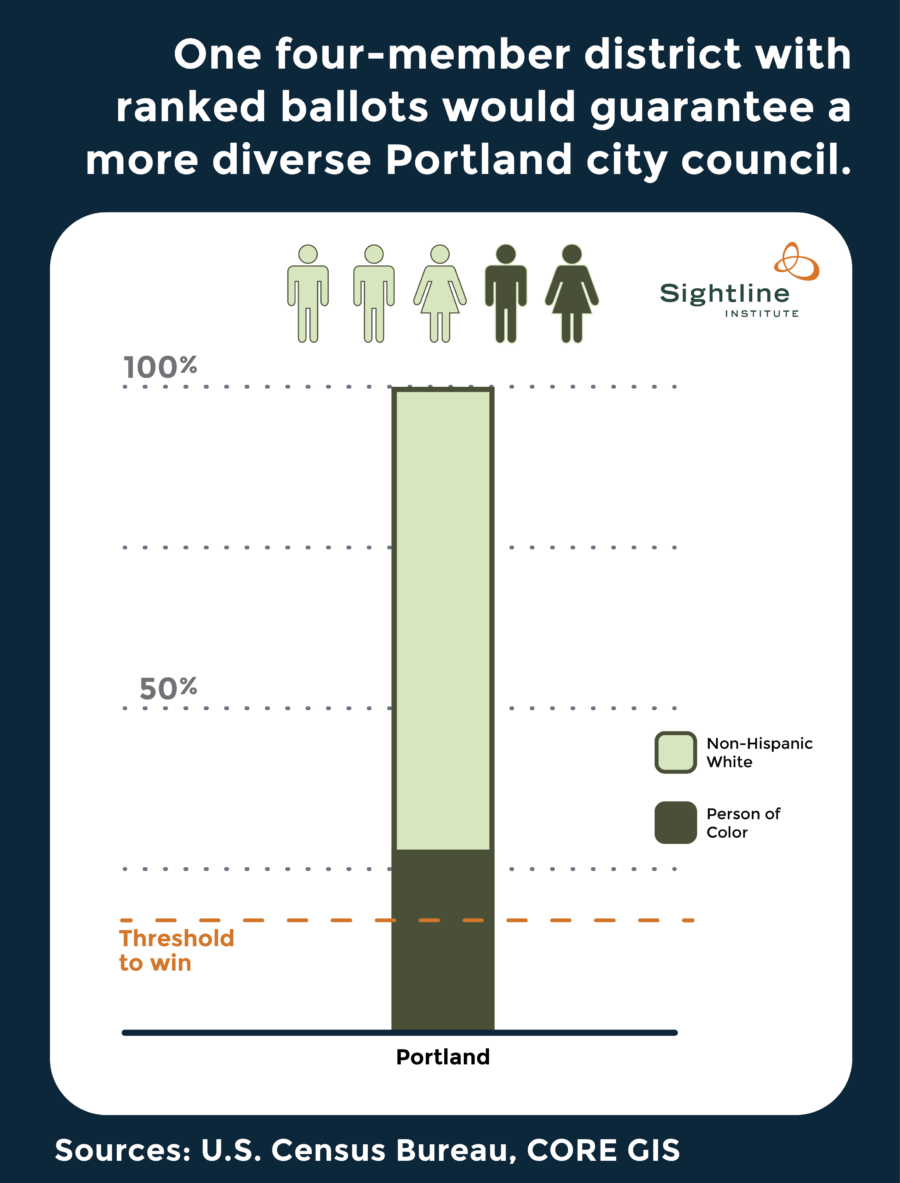
Two three-winner districts could elect two people of color and two women
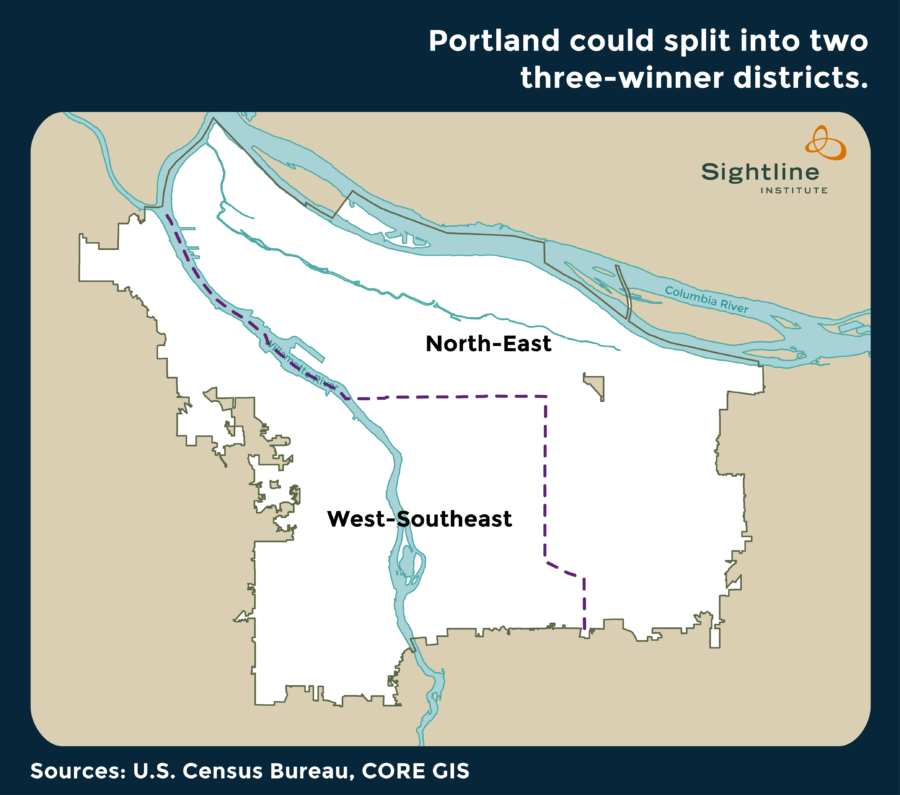
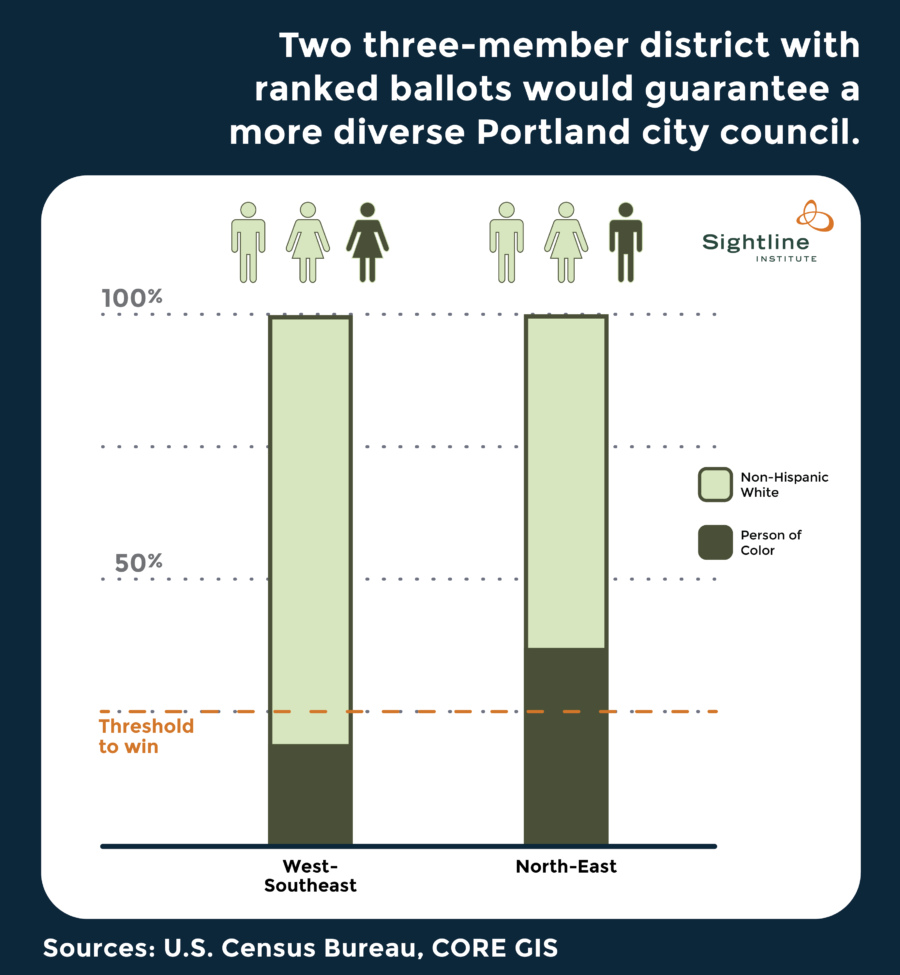
To guarantee geographic diversity as well as gender and racial/ethnic diversity, Portland could split into two districts, as shown below. In each district, voters would have the chance to elect three councilors with ranked or cumulative ballots. The threshold to win would be 25 percent in each district. The North-East district would be 37 percent people of color. If the bulk of those voters generally voted together, a multi-member proportional election there could easily deliver at least one candidate of color. The West-Southeast district would be 19 percent people of color, so a candidate of color could win by gaining support from those voters plus just six percent of white voters.
Proportional representation will give more Portlanders a voice
People of color, women, and East Portlanders all lack a voice in city government. Single-winner districts can give East Portlanders a voice but do little to improve representation for others. Proportional representation—multi-member districts with ranked or cumulative ballots—can give all groups a voice.
[list_signup_button button_text=”Like what you|apos;re reading? Get our latest democracy research right to your inbox.” form_title=”Reclaiming Our Democracy” selected_lists='{“Reclaiming Our Democracy”:”Reclaiming Our Democracy”}’ align=”center”]


Sightline thinks they have the answer for everything. But what you think is
a problem – isnt really a problem. It’s just you think it’s a problem. I have
never seen you solve anything. You have created a big problem a $10
million dollar waste of taxpayer money in Seattle with the voucher plan. Your
Signature gathers lied to the voters – and you bought the election with a
record amount of money from outside the city.
Look at all these Charts – They don’t mean a dam thing., Except someone
wants to waste their time and effort to prove something but not solve it.
More good info on fair voting systems: https://FairVote.org
Wayen Smith,
I strongly contest the notion that FairVote’s info on voting systems is “good”. You can see various experts with math PhD’s and the like, citing numerous false and misleading claims by FairVote here and here.
Wayne Smith,
I strongly contest the notion that FairVote’s info on voting systems is “good”. You can see various experts with math PhD’s and the like, citing numerous false and misleading claims by FairVote here and here.
Sorry, the first link in my previous comment was incorrect. It should have been this.
https://sites.google.com/a/electology.org/www/fact-check
As of 2018, Asheville, North Carolina (with similar demographics) has elected two African Americans (one male, one female), one Indian-American (male), and three white/Northern European Americans (one male, two female) to serve staggered four-year terms on City Council. (Our white female mayor was elected separately. A black female mayor served previously.)
There are no districts. All council members are elected at-large to represent all constituents for four years in staggered terms. Neither rank choice voting nor cumulative voting is involved.
Beyond having excellent candidates, a major mechanism to this racial, ethnic, and gender diversity on Council has been the “Choose three” structure of the elections in which each voter votes for three candidates in the Primary and in the General elections. Having Council Members elected using “first past the post” voting (with the directive to “Choose three”) results in voters picking a more racially, ethnically, and gender balanced personal slate of candidates.
Although the voters voted overwhelmingly to keep this status quo, there is an on-going attack on this diversity coming from the Republican-controlled state legislature which seeks to split the City into districts to improve the chances of a (read “white”) Republican being elected to Council.
Fortunately, the Council can place a referendum on the ballot giving the voters the ability to over-turn the districts, as they did last fall.