

Hey voters of British Columbia, remember 2001? The BC Liberals got 58 percent of the vote and won all but two seats in the Legislative Assembly. Sure, their votes should have given the party a comfortable majority control—but not near-total domination. The BC New Democratic Party (NDP) and BC Greens won more than 40 percent of the votes but together held just two seats. Most people think all voters should have equal power to elect a representative. But in British Columbia in 2001, Liberal votes had 10 times the power of other voters.
Each Liberal Member of the Legislative Assembly (MLA) had, on average, 11,908 votes. Each NDP MLA had, on average, 171,578 votes. And 197,231 votes wasn’t enough to elect even a single Green candidate.
Below: Click to get the (very abbreviated) .gif story of the 2001 British Columbia election
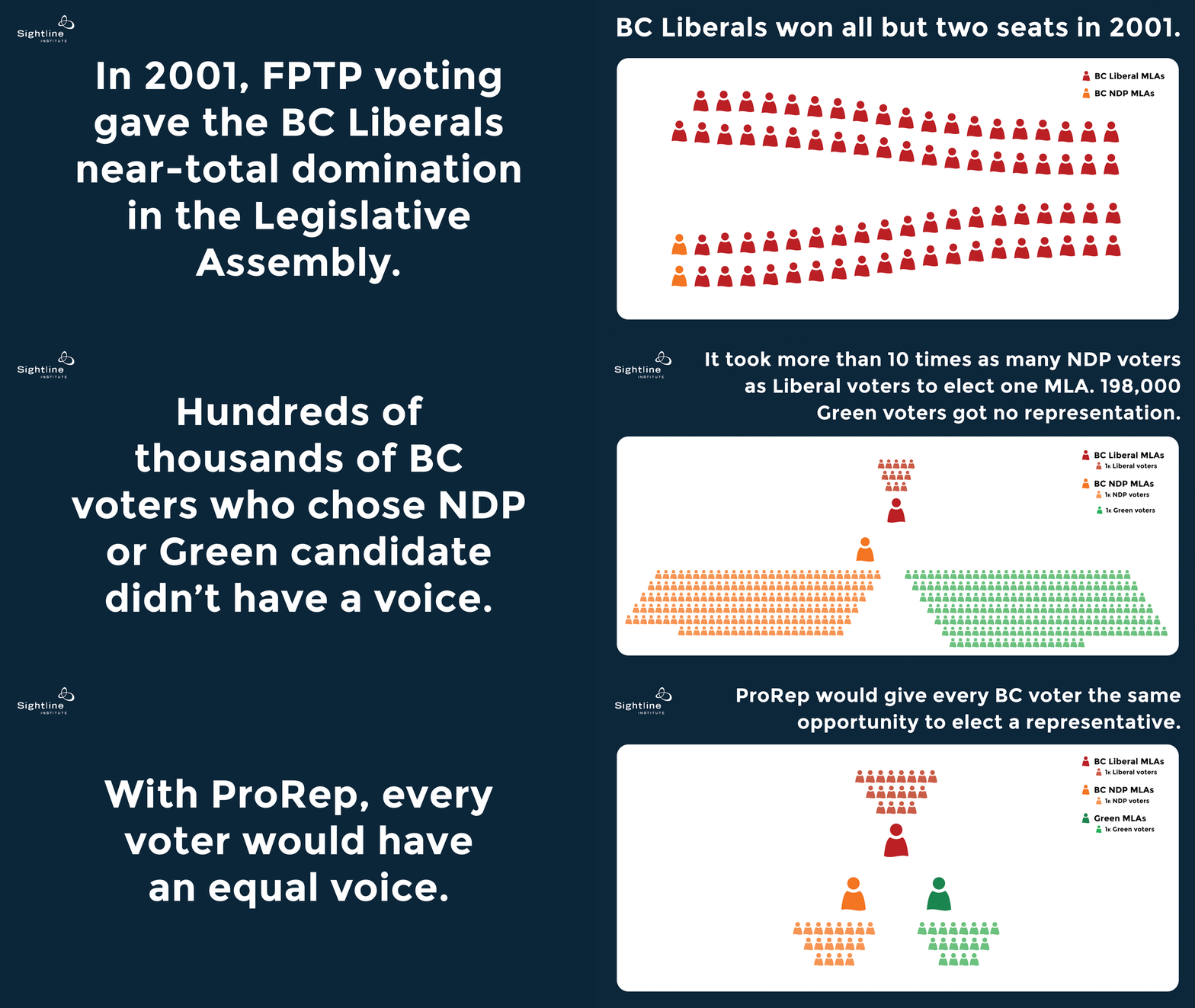
British Columbia’s outdated First-Past-the-Post voting led to that unfair result. It also created “wrong-winner” results, where the ruling party won fewer votes than the opposition party, in five of the past seven elections—1991, 1996, 2005, 2009, 2013. Proportional representation (ProRep) would create fair results. Voters would have equal power and equal representation. If British Columbia had used ProRep in 2001, the Liberals would have won around 58 percent of the seats, and voters could have elected someone who represented them, no matter the preferred party.
READ MORE: BC’s ProRep ballot designed with local representation in mind
British Columbian voters have the chance to put a stop to unfair elections like 2001. They could move past 18th-century democracy and adopt ProRep.


The outcome was the BC Citizens Assembly to arrive at an electoral reform based on independent study with an informed recommendation. They did. The parties revolted against their voter-centred system. In the latest referendum, only a mutilated version is on offer, infiltrated by both monopolistic FPTP and oligarchic party lists Politicians cannot be their own referees.
(Editor:)
John Stuart Mill: Proportional Representation is Personal Representation.
The Angels Weep: H. G. Wells on Electoral Reform.
(Richard Lung:)
Peace-making Power-sharing;
Scientific Method of Elections.
Science is Ethics as Electics.
FAB STV: Four Averages Binomial Single Transferable Vote.
(in French) Modele Scientifique du Proces Electoral.
Despite the Citizens’ Assembly’s strong recommendation, when it came to the practicality of voting the government of the day, a Liberal government under Gordon Campbell, manipulated the process by changing the normal, standard concept of majority from 50% +1 to 60%. As a result the referendum failed because only 58% of the voters approved. Apparently, 58% is not a majority in Liberal Party eyes. Now, I notice, the Liberal Party is complaining that the traditional concept of majority is to be used. Is that because they want to retain FPTP because that is the system which is most likely to benefit themselves? I think so!