
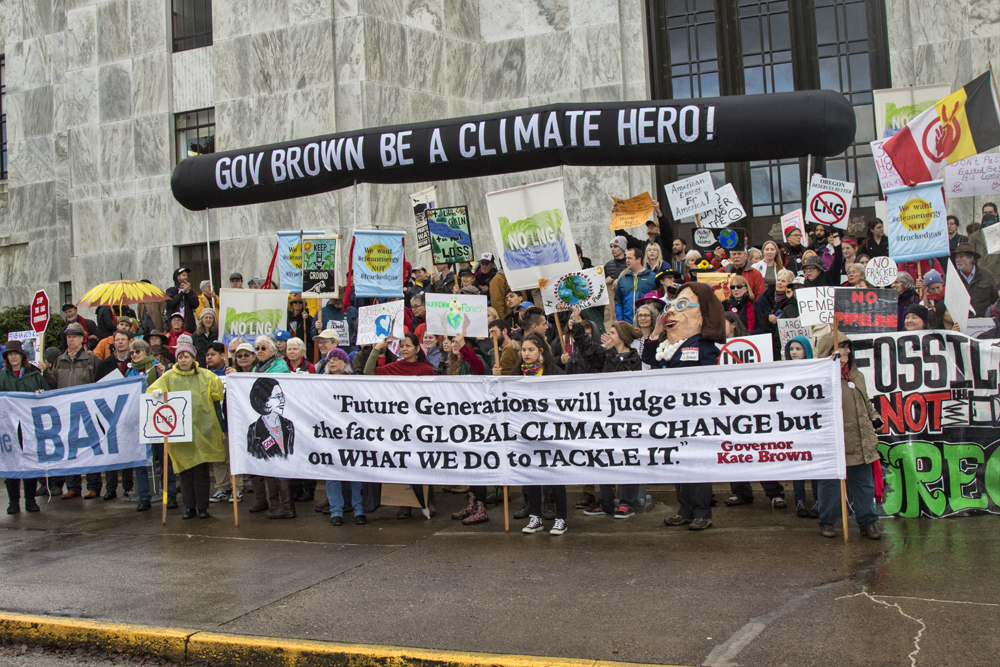


More than a decade ago, Oregon began putting laws on the books to limit global warming pollution. This year, the state legislature will consider a Clean Energy Jobs Bill with the aim of capping carbon emissions and growing the clean economy and job market. Climate hawks have introduced similar bills for years and without success. The text for the “Clean Energy Jobs” bill text isn’t public yet but it already has support from Gov. Kate Brown, House Speaker Tina Kotek, and Senate President Peter Courtney.
Even though the bill looks likely to pass, it could still be significantly weakened during the upcoming legislative session. The state already won’t keep its promise to reduce carbon pollution by 2020 (a goal established in 2007) but it still has time to meet its 2035 goal—if it puts the clean energy economy into high gear. But rather than get the state quickly back on track by including 2035 and 2050 benchmarks in the Clean Energy Jobs Bill, lawmakers and the governor’s office are considering ignoring the interim 2035 goal.
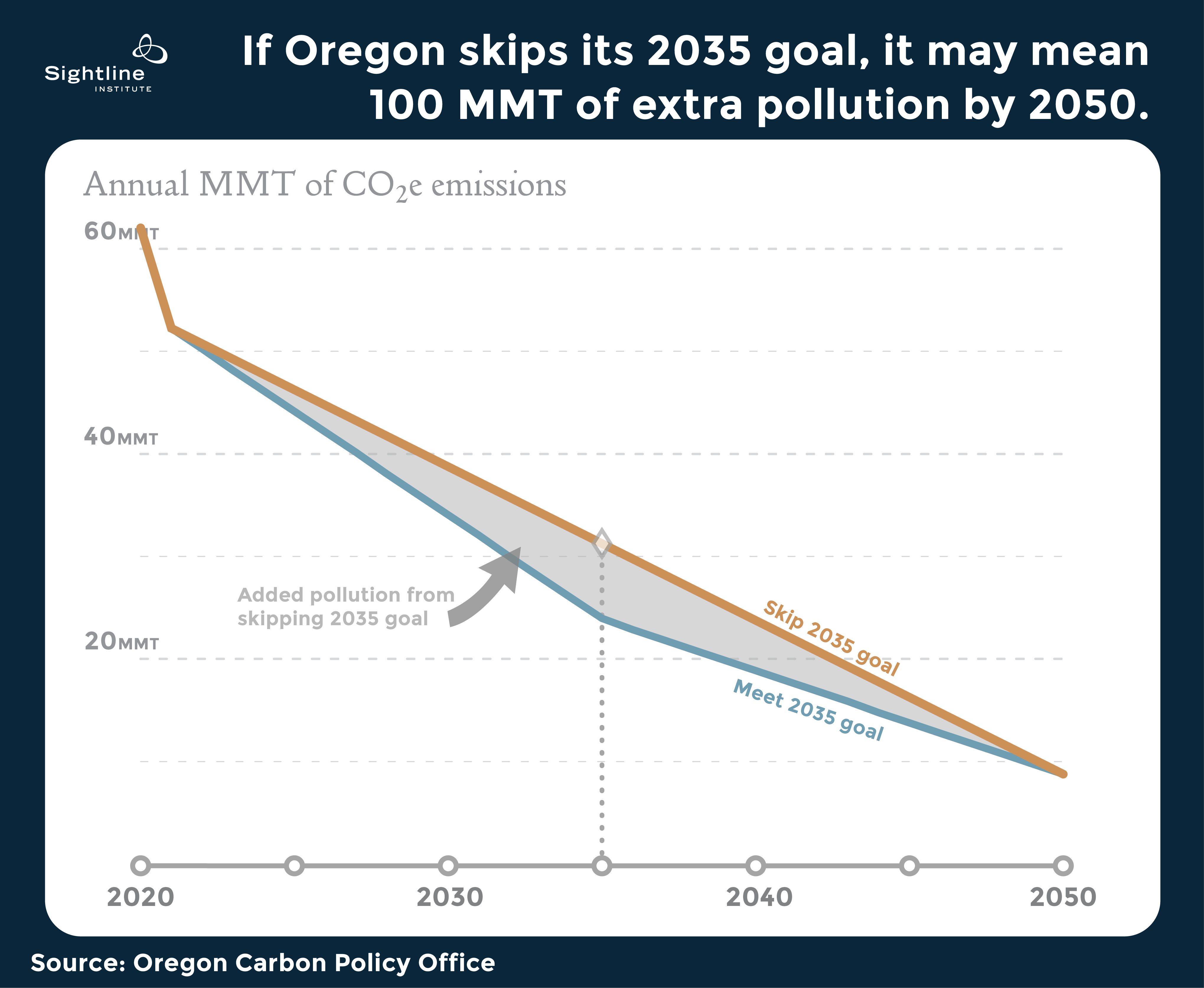
Polluters are whispering in legislators’ ears that the 2035 goal doesn’t matter so long as the bill ensures the state meets its 2050 target. But the 2035 goal does matter. It matters to the tune of more than 100 million metric tons (MMT) of extra pollution. That’s an increase of 13 percent in total pollution from now through 2050.
Laws already on the books
When Oregon lawmakers took a stand back in 2007, they established a series of pollution-slashing goals. They spaced the goals out for 2010, 2020, and 2050. Policymakers knew that a goal set as far away as 2050 could be shouldered aside by more immediate demands, so they set the middle target, in 2020.
Turns out, they were right to be worried. By the time they revisited their original plan a few years later, the state had met its 2010 goal but was not on track for 2020 or 2050. The Oregon Global Warming Commission projected the state would significantly over-pollute in 2020—by 20 percent, or 11 MMT CO2. So, still wary of the “kick the can down the road” trap, the Commission added another intermediate goal, this time for 2035.
Today, despite both of these safeguards, a current proposal from the Governor’s office to lawmakers working on the Clean Energy Jobs Bill risks falling straight into the trap of looking only to 2050.
| Target Year | Emissions Goal | Will the State Hit Its Goal? | When the Goal Was Set |
| 2010 | Level off emissions. No further emissions increases. (63.3 MMT) | We did! | 2007 (HB 3543) |
| 2020 | 10 percent below 1990 levels (51 MMT) | No. | 2007 (HB 3543) |
| 2035 | 44 percent below 1990 levels (32.7 MMT) | Depends. | 2015 by Oregon Global Warming Commission |
| 2050 | 75 percent below 1990 levels (14 MMT) | Depends. | 2007 (HB 3543) |
The Governor’s office is pitching two plans, which they’re calling Scenario 1 and Scenario 2 (see the graph below). Both would put Oregon on track to hit the 2050 goal, but Scenario 2 follows the Global Warming Commission’s plan which commits the state to meet a 2035 and a 2050 goal. Scenario 1 admits defeat in both 2020 and 2035, and only commits the state to meet the 2050 goal.
This isn’t six of one, half a dozen of the other. Polluters prefer Scenario 1 because a 2050 goal alone lets them off the hook for a while, where a 2035 goal forces them to take action in the coming decade to clean up their act. Failing to meet the 2035 goal means a lot more unnecessary pollution. In total, Scenario 1 allows for an extra 106.7 MMT of carbon dioxide equivalent (CO2e) emissions by 2050. This is equivalent to losing out on a more than decade of pollution reductions.
A large share of these extra emissions would be generated early on and spend the decades between now and 2050 hanging out in the atmosphere, accelerating climate change.
Earlier is better for climate stability
Oregonians can’t avoid climate change’s consequences. Many Oregonians already know what it feels like, from the destructive wildfires and crop failures of the past few years to creeping losses in tourism and coastal erosion. Continued pollution adversely affects lives today and also irreversibly locks in even worse impacts years down the road.
The next 12 years have become a critical window for the climate. A bombshell report published in October by the world’s leading scientists draws a line in the sand at 2030. They argue that without serious pre-2030 cuts to pollution, the world will almost inevitably surpass 1.5 degrees Celsius of total global warming. This limit, 1.5C, is the internationally-agreed-upon guardrail beyond which the likely damages from climate-driven disasters will increase seriously. To even have a chance of staying on the safe side of the guardrail, the authors entreat policymakers worldwide to step up and make their biggest moves before 2030.
Scenario 2 does an admirable job of ramping up climate action in the next 16 years in order to answer the IPCC’s call, by sticking to the interim 2035 target of 44 percent reduction below 1990 levels. It takes the boldest action in this decade the IPCC has deemed most critical, then slows down the reduction in later years.
In contrast, Scenario 1 only achieves a 28 percent reduction by 2035, less than two-thirds of what Scenario 2 manages. This puts Scenario 1’s 2035 reductions way below other jurisdiction’s interim targets, like California’s 40 percent by 2030, Quebec’s 37.5 percent by 2030, or Ontario’s 37 percent by 2030.
Which way will Oregon go?
The Oregon Global Warming Commission’s 2035 target would protect Oregonians from the worst effects of climate-driven fires and floods in the coming decade. Polluters are trying to weaken those protections by arguing for an easier timeline for themselves. The Governor’s office and Oregon lawmakers can stand strong and stick to both a 2035 and a 2050 goal.
Michael Peñuelas is a researcher and community organizer for food and energy systems that are secure, sovereign, and resilient. He has degrees in Earth System Science and in Environmental Policy and Management from Stanford University.


The term vehicle or freight or car does not even show up in this article. The #1 reason we are not hitting our targets is because of vehicle emissions. Our own state research recently stated as such. ODOT, aka the state, is moving to widen freeways in and around Portland, which will only induce demand and create more emissions. According to the EPA, transportation is the #1 source of greenhouse gas emissions. How about we start funding public transit in a serious way, and reconfigure our ODOT roads in our cities to prioritize bus only lanes and protected bikeways. Are state legislators even acknowledging that our own government research showing cars are the main reason we’re currently behind our targets in Oregon? This is a sham.
The number one climate change emissions are from the logging industry in Oregon. See environmental economist Ernie Niemi’s article in the Register Guard paper on this issue.
Also, the Clean Energy Jobs bill does NOT include biogenic emissions which are the largest from Seneca Jones Lumber and International Paper. These emissions should be included in the carbon fee.
I am disappointed that we put our goals so far away. The recent national and international scientific reports told us we have 10-12 years to drastically change our lifestyles and industrial practices , or we will have huge calamities fall on us.
So 2030 should be our immediate goal ( with interims every 3-5 years)- not 2050.
Oregon produces 0.12 percent of the total green house gases put in the atmosphere. So lets lead by example. lets gut our state for 0.12 percent so we can feel good about ourself’s. I guess somebody needs to be willing to jump off the Cliff for the sake of the collective. This isn’t Freedom people this is Tyranny in the form of legislation. This doesn’t protect my life, my liberty and it doesn’t protect my property. There is a great evil in society when the conversion of law is used as an instrument of plunder. When the law begins to destroy its own objective. When it begins to annihilating the justice that it was supposed to maintain. to limiting and destroying the rights which its real purpose was to respect, The law has placed in the collective force of the unscrupulous who wish without risk to exploit the person, liberty and property of others. There are many forms of tyranny, it doesn’t always happen at the end of a gun.