
Donate Newsletters
Home » Housing + Cities » Why Mother-In-Laws Matter

Why Mother-In-Laws Matter

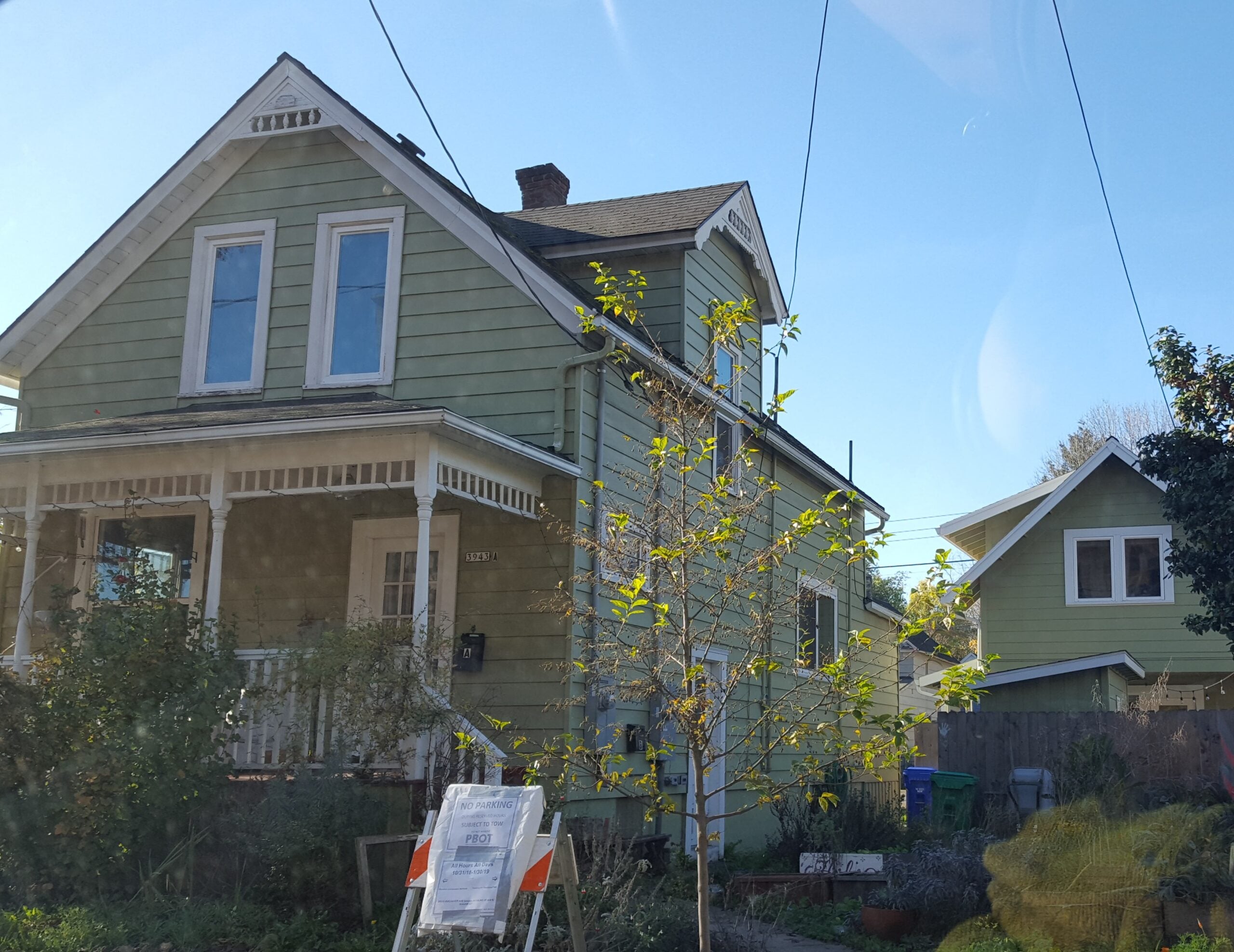
Photo: Anna Fahey. Used with permission.

SwatchJunkies

Mother-in-Laws do matter! But we’re not talking about our spouses’ moms. (Hi, Linda!) We’re talking about apartments over garages, daylight basement suites, and backyard cottages. This kind of home can be a great living solution for renters and owners alike—with benefits for the whole community too.

READ MORE: ADU Parking Quotas Are Climate Killers

A key tool to keep rents and home prices under control in cities big and small is to change rules that prevent all but the largest, most expensive homes. Giving owners more freedom to create accessory dwelling units—granny flats, laneway houses, mother-in-law apartments—in centrally-located neighborhoods gives flexibility for all kinds of households and all stages of life. An ADU might make it possible to stay in your home and age in community. You might be able to help out a family member. Or maybe you could use some income from a small rental. On the flip side, you might be a renter who cuts costs and commute time by finding a modest, affordable ADU home near work, school, or good transit. 

An ADU opportunity in Washington state

Read about the new ADU bill that was introduced by state representatives Mia Gregerson (D-SeaTac) and Andrew Barkis (R-Olympia)in Olympia this week. 

Tips for talking up the many community benefits of ADUs

Small apartments in existing neighborhoods—often in existing homes or structures—offer multiple benefits. Here’s our guide for communicating about this low-impact, common-sense affordability solution. You can find the whole guide here. Here’s our cheat sheet:
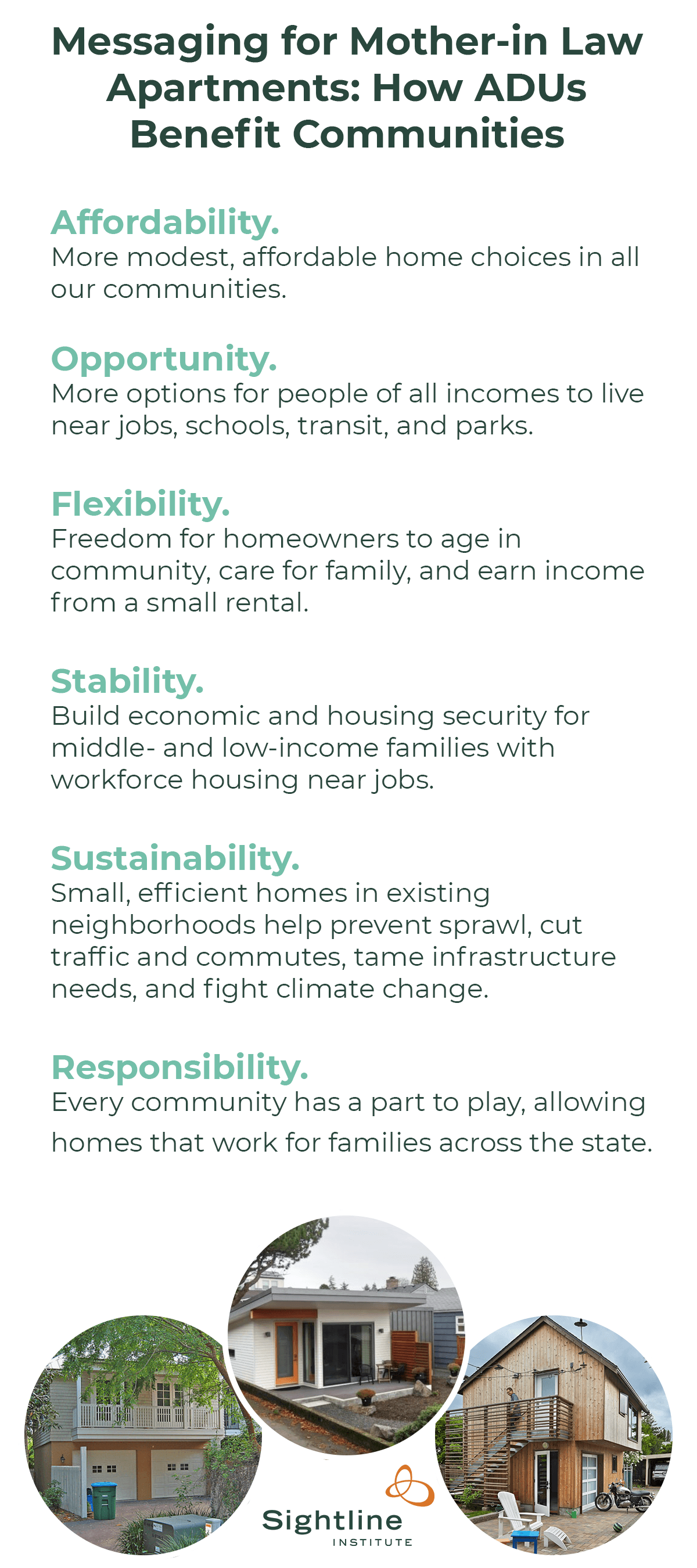
Original Sightline Institute graphic by Kelsey Hamlin, available under our free use policy. Graphic uses a photo from Benjamin Benschneider with permission.

Talk to the Author

SwatchJunkies

Talk to the Author

Anna Fahey

Anna Fahey, Principal Director of Strategy, leads Sightline Institute's framing and messaging strategies and coordinates the organization’s cross-cutting legislative campaigns. She serves on Sightline’s executive team.

Talk to the Author

Margaret Morales

Margaret Morales was a senior researcher for Sightline Institute. She earned her master’s from the University of British Columbia’s Institute for Resources, Environment, and Sustainability, where she was a Bridge Fellow focusing on issues of public health and the environment. There her research examined wastewater and biosolids management in British Columbia and Latin America. She received her Bachelor’s degree from Duke University in Environmental Science and Policy, and English. She also holds a certificate in Documentary Video from Duke and worked as a documentary filmmaker for non-profits in the United States, Canada, and Latin America. Her work has screened in multiple film festivals.

In her free time Margaret enjoys cooking, reading novels, and working on her photography.

About Sightline

Sightline Institute is an independent, nonpartisan, nonprofit think tank providing leading original analysis of democracy, energy, and housing policy in the Pacific Northwest, Alaska, British Columbia, and beyond.

For press inquiries and interview requests, please contact Martina Pansze.

Sightline Institute is a 501(c)3 non-profit organization and does not support, endorse, or oppose any candidate or political party.

See an error? Have a question?

Find the author's contact information on our staff page to reach out to them, or send a message to editor@sightline.org.

Thanks to Richard Hay for supporting a sustainable Cascadia.

Our work is made possible by the generosity of people like you.

×
Privacy Overview
Sightline Institute

More information about our privacy notice

Strictly Necessary Cookies

Strictly Necessary Cookie should be enabled at all times so that we can save your preferences for cookie settings.

3rd Party Cookies

This website uses Google Analytics to collect anonymous information such as the number of visitors to the site, and the most popular pages.

Keeping this cookie enabled helps us to improve our website.

Additional Cookies

This website uses social media to collect anonymous information such as which platform are our users coming from.

Keeping this cookie enabled helps us better reach our audiences.