

Takeaways
- In March 2025, Washington state’s siting agency released a 1,083-page draft assessment of the potential environmental, economic, and other impacts of new large electric transmission lines in the state.
- The good news is that the draft study found power line projects can have largely negligible, low, or possible-to-mitigate effects on the environment.
- But the document misses the forest for the trees, omitting consideration of the environmental uber-issue, climate change. Plus, the agency failed to consult with most tribes before it released the draft.
- Washington state needs a smarter approach that reflects tribal perspectives and paints a fuller, truer picture of how a robust electric grid would in fact help the environment, by making it possible to stop burning fossil fuels and protect communities and ecosystems from a warming world.
Find audio versions of Sightline articles on any of your favorite podcast platforms, including Spotify, YouTube, and Apple.
In 2023, Washington state legislators attempted to make it easier to build long-distance power lines. Recognizing that more wires are essential to reaching 100 percent clean electricity—and that “transmission projects take a decade or more to develop and permit”—lawmakers directed a state agency to preemptively analyze the environmental impact of these projects.
More specifically, legislators tasked the Energy Facility Site Evaluation Council (EFSEC) with preparing a so-called “programmatic environmental impact statement” (PEIS) for hypothetical large transmission lines.1 The PEIS’s purpose is to evaluate possible environmental harms of transmission lines and identify ways to mitigate them before specific project proposals to facilitate more responsible and quicker project completion. Sightline supported the idea.
Two years, 1,083 pages, 432 assessments…and zero climate evaluations later
In March 2025, EFSEC dropped its draft assessment with a virtual thud. Spanning 1,083 pages, the PEIS catalogs dozens of possible impacts of transmission line projects, largely drawn from Washington’s State Environmental Policy Act (SEPA) rules. It is mind-bendingly comprehensive, assessing impacts ranging from the environmental (soil erosion and habitat loss) to the economic (changes in home value) to the faintly absurd (“Physical Hazard to Aerial Recreation Enthusiasts”).
EFSEC analyzed 72 impacts across three project phases (construction, operations and maintenance, and upgrades and maintenance) for both overhead and underground lines. To save you the math, that’s 432 distinct assessments.
But nowhere in its 1,083 pages does the PEIS analyze how transmission lines would affect the biggest environmental issue of our day: climate change.
EFSEC isn’t entirely to blame. The legislature directed the agency to focus on “significant adverse environmental impacts” of electric transmission facilities. Climate change does not obviously fit into this definition. (Though arguably, neither does aerial recreation.) And to be fair, the document does explain, in a two-page Purpose & Needs section, that “existing constraints on transmission capacity within the state already present challenges in ensuring adequate and affordable supplies of clean electricity.”
But by failing to assess how expanding the grid would reduce climate pollution, these 1,083 pages leave decisionmakers without the full picture they need to weigh the trade-offs of critical clean energy infrastructure.
The good news: Power lines’ impacts can be mostly small and often avoidable
Even though the draft PEIS only tells half the story, it does offer one clear takeaway: stringing up wires can be, by and large, not hugely environmentally harmful, and most harms can be mitigated through careful planning, site selection, and design.
EFSEC rates each possible impact on a scale ranging from “nil” to “high.” It then offers mitigation techniques that the agency says would bring the impact determination to a “less than significant level.”
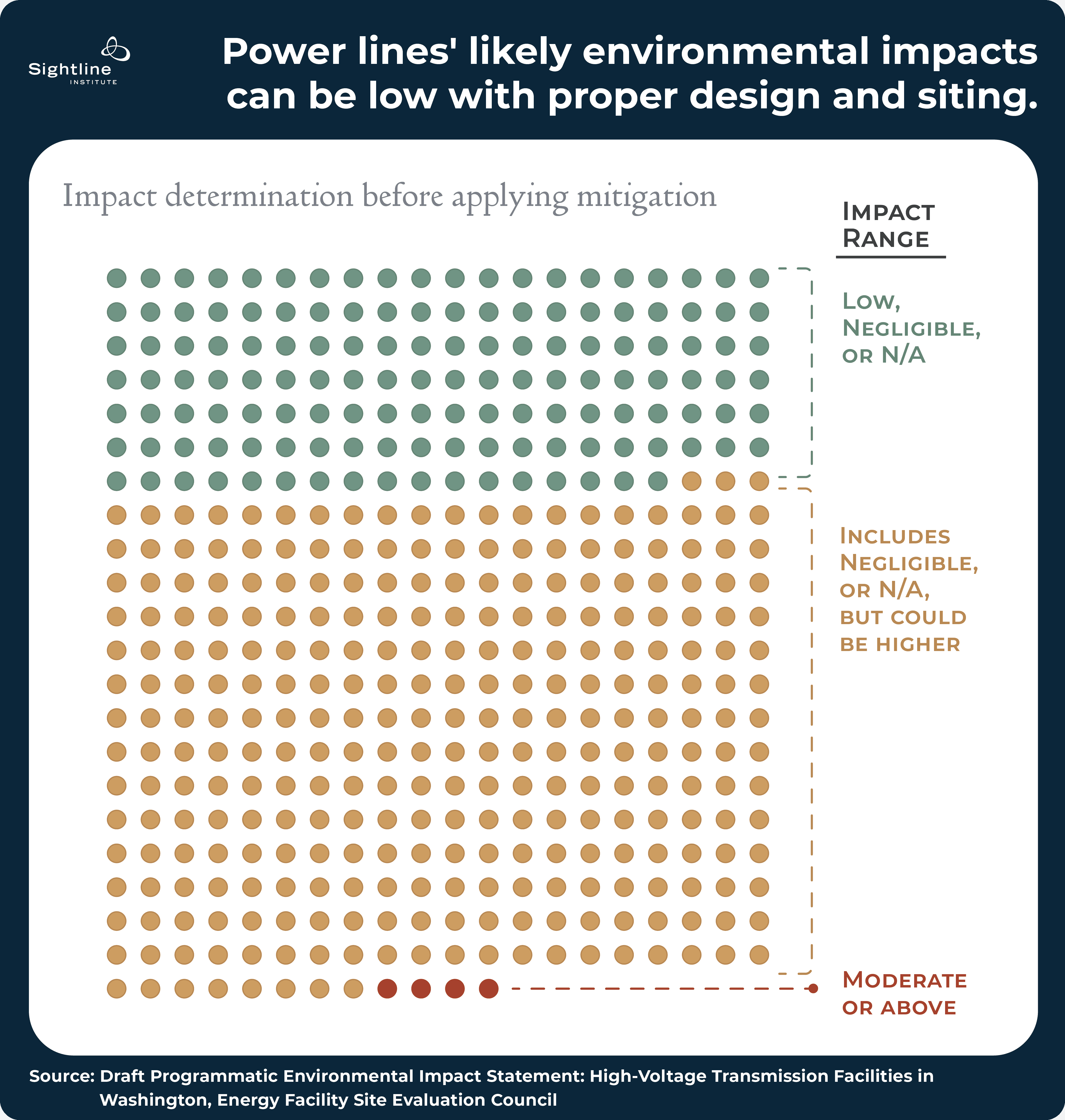
Before even applying mitigation measures, roughly a third of the total 432 assessments received a rating of “low,” “nil,” “negligible,” or “not applicable.” Public health and safety, recreation, energy and natural resources, and earth (e.g., soil erosion or compaction) are most likely to fall into this category, indicated by the green dots on the chart below. (Aerial recreation enthusiasts will be happy to know that they, too, land in this group.)
EFSEC also finds that, with smart design and siting choices, most remaining possible impacts could be negligible or low. Two-thirds of the assessments received a rating with an impact range that includes low, nil, or negligible (for example: “low to high,” or “negligible to moderate”), as indicated by the yellow dots below.
The bad news: EFSEC did not consult tribes
Of the 432 assessments, just four received a rating of at least “moderate” before mitigation. All four concerned tribal cultural resources.2
That tribal resources are the most likely to be affected by power lines makes another omission by EFSEC even more glaring than the climate one: the agency failed to consult with most tribes before it released the draft PEIS.
The legislature explicitly instructed EFSEC to “offer early and meaningful consultation with any affected federally recognized Indian tribe on the nonproject review…. The consultation is independent of, and in addition to, any public participation process required by state law, or by a state agency.”3
But according to the Yakama Nation, the Confederated Tribes of Warm Springs, the Confederated Tribes of the Umatilla Indian Reservation, and the Columbia River Inter-Tribal Fisheries Commission, EFSEC did not speak with them prior to publishing the draft PEIS.
“The trend is minimal consultation,” Donald Williams, an enrolled member of the Umatilla Tribe and CEO of From the Light Consulting, a tribal member-owned energy consulting firm, told Sightline. He wants tribes consulted at the beginning, not the end of projects, so they can help shape decisions and, even better, benefit from the green energy transition.
Tribes continue to bear the devastating consequences of the Pacific Northwest’s last big energy infrastructure build-out, with hydropower dams flooding burial grounds, displacing communities, and decimating fish populations, among other lasting harms. If the PEIS excludes tribal perspectives, it will prove useless in helping Washington develop transmission projects both swiftly and responsibly.
Washington can’t afford to miss the forest for the trees
In the near term, EFSEC could improve the PEIS, most obviously by immediately reaching out to consult tribes. The agency could also revise the document to fully weigh the immense upsides of transmission lines against their modest downsides. And EFSEC could winnow the impacts it evaluates to just the “probable significant adverse environmental impacts” (as the legislature originally directed) to make it easier for tribes and others to offer feedback.
But ultimately, this process may reveal that the PEIS is no longer the right tool for making decisions about clean energy projects. Washington is racing toward its legal greenhouse gas emissions deadlines and is not on track to meet them. An approach that worked well for opposing fossil fuel development may now be inadvertently prolonging the lifespan of these same dirty projects, by delaying the clean energy infrastructure needed to supplant them.
The Northwest needs a better approach, one that acknowledges the real trade-offs facing decisionmakers.
Yes, wires could “create visual contrast with rural or community character,” but they could also help us to curb the oppressive wildfire smoke that has come to define Cascadia’s summers.
Yes, power lines could disturb endangered species’ habitat, but they could also help avert the far greater threat that climate change poses to these species, including the Cascade red fox, the larch mountain salamander, and the Makah copper butterfly.
Yes, construction could briefly disrupt local businesses’ day-to-day operations, but transmission lines could also address today’s energy affordability crisis by increasing access to cheap, renewable power.
And so on. In other words, missing the climate change “forest” for the environmental impacts “trees.”
As it stands, EFSEC’s Programmatic Environmental Impact Statement is a bit like evaluating whether to install a smoke detector based only the noise it makes and the drill holes required—ignoring that it very well could save your life.

