
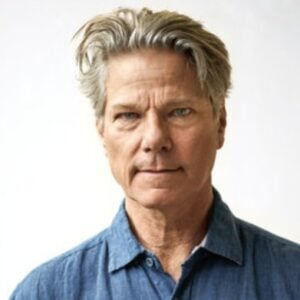
Editor’s introduction: John Vaillant is a Cascadian icon. An award-winning and bestselling author residing in Vancouver, British Columbia, he has written gripping tales, both fiction and nonfiction, on the nuanced interfaces between people and nature.
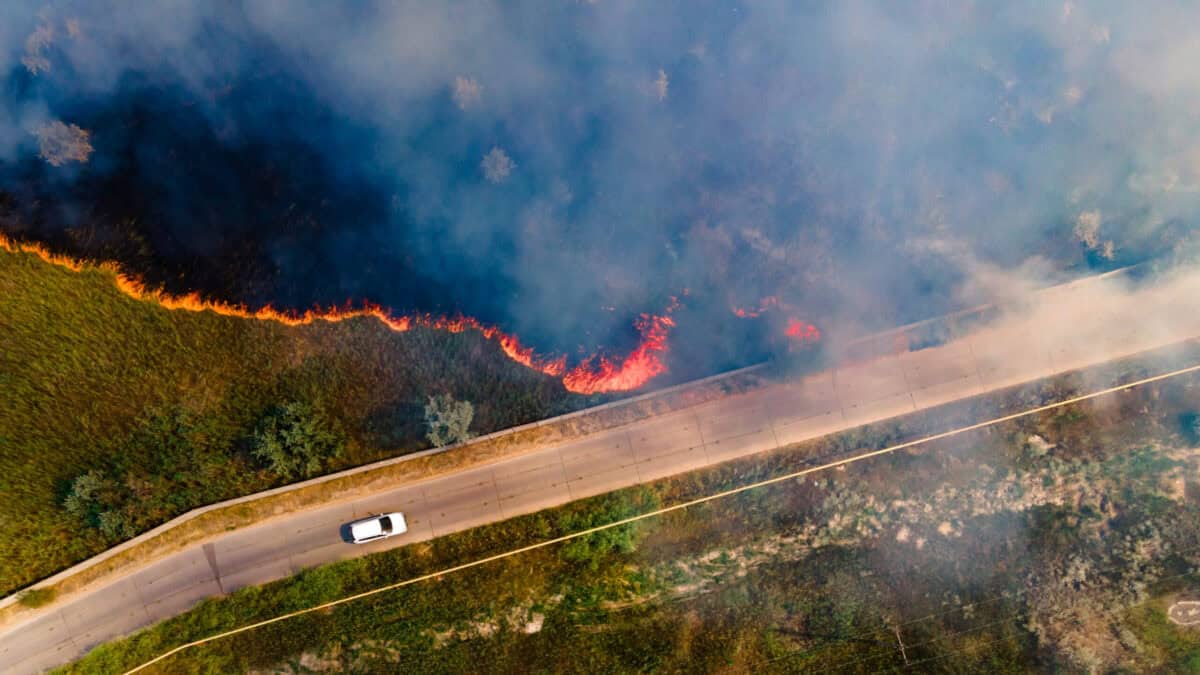
Vaillant’s 2023 Pulitzer finalist book Fire Weather: On the Front Lines of a Burning World recounted the harrowing 2016 megafire in the Alberta oil town of Fort McMurray, weaving in the histories of the oil industry, climate science, and the very technology of fire in human history. His account not only won international praise; it also drove urgent conversations about our new age of ultra-destructive, climate-fueled wildfires—a topic Sightline has also researched.
Below, John Vaillant shares his reflections on developments since publishing Fire Weather, answering questions from Sightline researchers.
Find audio versions of Sightline articles on any of your favorite podcast platforms, including Spotify, YouTube, and Apple.
It’s been a little over two years since you published Fire Weather—in other words, countless wildfires later and already well into a third “fire season” in Cascadia. Which wildfire stories have you followed most closely since? Or which have followed you?
The Los Angeles fires this past January were a signal event that forced twenty-first century wildland-urban interface fire and urban conflagration into the international consciousness with a new urgency. The size and speed of it, combined with the scale of the evacuation (about 200,000 people), the structure loss (16,000+), the cost (likely over a hundred billion dollars when all is said and done), and the death toll (30) shocked the nation.
I happened to be in Orange Country when those fires broke out, and I did more media interviews than I’ve ever done in my life. Those fires, as intense and destructive as they were, were “out of season,” implying that there is no longer a fixed “fire season,” but rather “fire weather,” which can now occur almost any time (see the hundreds of fires that burned across the Northeast last November).
That said, it’s summertime now, and huge, stubborn fires are wreaking havoc in the heart of Canada, and across the American West. Particularly intense fires, burning in record-breaking temperatures, have been destroying property and also causing fatalities across the eastern Mediterranean.
The Sightline audience needs no convincing of the fact that climate change is driving increasingly deadly and destructive wildfires. But what are the key ways it’s doing so? What does this mean for how communities experience and adapt to these wildfires compared to wildfires of the past?
Years—and in some places, decades—of prolonged drought have made many northern and western forests much more fire-prone. Milder winters, elevated summer heat, and year-round drought conditions have also enabled a variety of insects to kill or weaken vast swathes of forest, increasing flammability and transforming historic carbon sinks, like Canada’s boreal forest, into net carbon emitters. Meanwhile, as highly flammable, petrochemical-heavy modern homes push deeper into the wildland-urban interface (WUI) in search of the “neighborhood in Nature” sweet spot, more and more structures are exposed to wildfire energy and embers.
As I’ve been learning on my now-global Fire Weather tour, communities are at very different stages of awareness and/or preparatory action, ranging from high (Hornby Island, BC; Steamboat Springs, CO) to low (Lucca, Italy; Cambridge, UK; Jaipur, India). Individuals have taken some of the messages from Fire Weather (and their own hard-won experience) to heart, abandoning synthetic (petroleum-based) clothes, gas-powered vehicles, and/or urging their town councils to build alternative routes out of their dead-end valley communities.
Along with many analysts, we’ve been following the insurance industry as an “indicator species” of climate risks, watching as these corporations raise rates or pull out of markets altogether with disasters growing more frequent. It wasn’t a focus of your book, but are there threads to that story you’ve seen that might surprise readers?
The biggest surprise is how fast it’s happening, and how broadly. The petroleum industry, which is still insured, is destroying what was a very lucrative twentieth-century business: if you’re an insurance company pulling coverage from vast swaths of the country, you may be reducing your exposure, but you’re not making any money from policies either. You have to wonder if the industry is connecting these dots in a meaningful way . . .
It wouldn’t be a Sightline conversation without a foray into solutions. What are some ways, large or small, that you’ve seen people respond in this new age of wildfires? Anything that can scale to the policy level?
Fire Wise (FireSmart in Canada) is a really good local program that operates through local fire departments. I think every local solution, from yard planting choices, to external sprinklers, to alternate escape routes, to fire preparedness guides can be scaled to policy level. What makes this hard and slow is that it requires a shift in consciousness and these, like attitudes toward littering, smoking, conservation, are generational projects.
You began your writing career as a journalist. Sightline developed a short guide to help media make the wildfire–climate connection for audiences, but is there further guidance you would offer to those reporting on wildfires today?
I think the new generation of climate/weather/fire journos are very well educated and generally up to speed. There is so much good work, good science, and good folk out there.
But it can be crushing, and that’s where it’s really important keep an eye on the solar, battery, and EV industries outside the US. They are proceeding at a gallop and changing the world of energy (and emissions) in the process. It appears that China is on the brink of a CO2 decline—a historic milestone for our civilization.
In terms of self-care, make a point of spending a portion of your day in love and beauty. If those are lacking, seek them out, or create them. We live in a multi-strand, multi-dimensional reality. Heat, fire, and smoke, as intrusive as they can be, are only one part of a far bigger, more nuanced, and dynamic whole. Nature, and its impulse to flourish, will not be denied. If one path is blocked, it will find another—with or without us.

