

Takeaways
- Two new laws in Oregon legalize lot splits for starter homes, among many other changes, and allow the state to directly override local zoning to approve pre-permitted home designs.
- With statewide model codes, state housing targets, and a string of other laws, Oregon has done more than any US state to standardize zoning rules across cities.
- Japan, Australia, and New Zealand have all found success with similar measures.
Find audio versions of Sightline articles on any of your favorite podcast platforms, including Spotify, YouTube, and Apple.
Over the last eight years, a bipartisan coalition of Oregon lawmakers has led North America on a new trend: state-level zoning.
As zoning restrictions spread across the continent almost exactly 100 years ago, state and provincial governments mostly delegated to cities all decisions about where and what sorts of housing should be allowed locally. During the century that followed, that led to problems. A big one: cities and towns deployed zoning to gradually ban the rooming houses, duplexes, triplexes, and small-scale apartment buildings that had always been, until then, the places you could live when you had a small household or a tight budget.
At first, this wasn’t an obvious problem. A city banning apartments might reason that inexpensive homes would still be legal in the next town over. Or they might observe that the next town over had offloaded its housing needs on them by banning apartments, so it was only fair that they do the same.
It was all very rational, and contagious. And after a century of local rules upon local rules, here’s what the patchwork of zoning looked like in (for example) the state’s largest city:
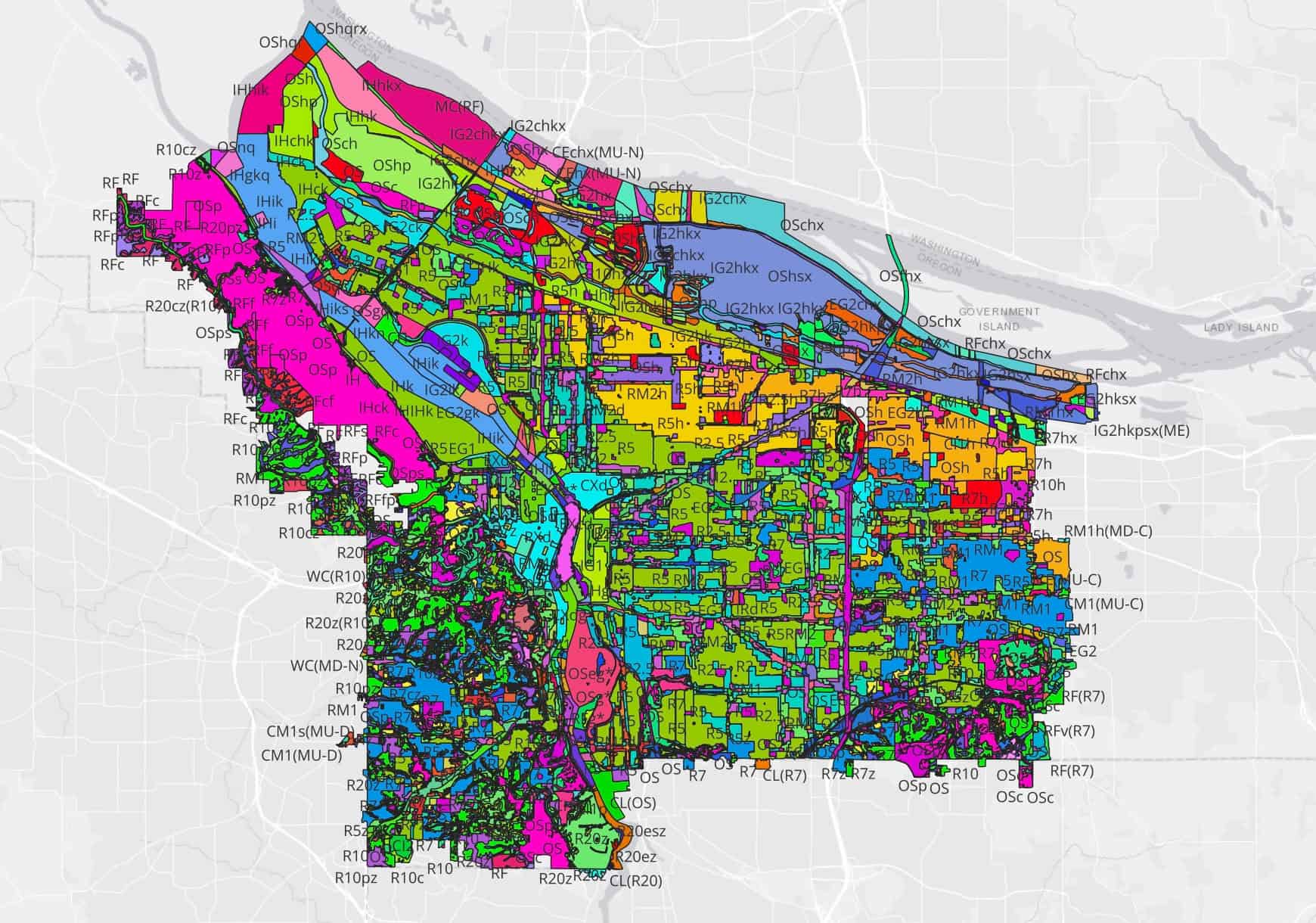
The complexity of Portland’s 779 distinct zoning categories, each one restrictive in its own ways and multiplied further across hundreds of other jurisdictions, has helped create a huge shortage of homes. That’s especially true for the smaller and less expensive sorts of homes, since those are the ones most frequently banned by zoning. That housing shortage and the rising prices it drives have spiraled across city lines and ultimately left many thousands of people sleeping on couches, in parking lots, and in the woods.
Starting in 2017 and with rising confidence in each year since, Oregon has been responding to this endless civic buck-passing by rethinking its 100-year-old decision to leave the details of zoning mostly up to local jurisdictions.
Instead, much of the work on this statewide issue is now returning to the place it maybe should have always remained: the state.
Pre-approved state zoning allows a race to the top
To see how far Oregon’s consensus has moved, read a bill Governor Tina Kotek signed today.
House Bill 2258 gives the state the power to override local zoning and allow any type of housing on standard urban lots.
Go ahead—read that last sentence again.
The bill passed the state House 50-2, and the Senate 28-2. Kotek, its chief advocate, held a signing ceremony Monday for it and others.
Aurora Dziadul, a legislative and policy analyst for the Oregon Department of Land Conservation and Development, said by email that her state agency plans to voluntarily apply “extra parameters” that narrow the scope of the program. But she said that yes, the bill does give the state the power to preemptively give zoning and building permit approval to any variety of housing project, from a backyard cottage to a skyscraper, on any lot that:
- allows housing of at least one type
- falls within an urban growth boundary (a border that, in Oregon, defines the frontier between suburban and rural areas)
- is between 1,500 and 20,000 square feet
- has no more than a 15 percent slope
- is outside areas officially designated as environmentally sensitive, naturally hazardous, containing significant natural resources, scenic, or open
- and is vacant, including from a recent demolition as long as it results in more homes.
A key phrase in the bill is in Section 4(2)a, which says that on such lots, the state may pre-approve only “attached or detached housing”—in other words, all housing. (That’s one item in a list of qualifying factors that Dziadul said includes an implicit “or.”)
It’s unlikely that the state will decide to use this power to legalize 4-story apartment buildings on every urban lot, for example. If it did, cities would have a strong incentive to look for ways to nullify the law—for example, with tight new regulations on demolition. Until any previous building on the site has been demolished, it wouldn’t qualify for the de facto state zoning code created by HB 2258.
Another issue: the staff of the state’s Building Code Division, which is part of a separate state department, isn’t actually directed to pre-approve any particular building permits. It might choose to pre-approve building permits only for the lowest-density structures—nothing bigger than a duplex or townhouse. That’d greatly limit the scope of the law. Though the text of HB 2258 doesn’t actually limit the state’s zoning powers to cases that use one of BCD’s pre-approved building plans, the governor’s staff advertised the two as going hand in hand. (By the same token, the governor’s staff also advertised the bill as allowing more than just townhomes.)
Localities will also retain control over engineering decisions like how the site manages stormwater and connects to existing water, sewer, and transportation networks.
But depending on how it gets implemented, HB 2258 gives the state the power to make a deep structural change to zoning in Oregon. It essentially creates two zoning codes for a property owner to choose between: a local option and a state option. And because property owners will tend to choose whichever code allows the project they most want to build, both local and state planners would have an incentive to make their code relatively flexible. If one planner writes a tightly restrictive code, the property owner will be more likely to choose the other planner’s code, leaving the first code with no control at all.
Some people have called for zoning to be abolished; HB 2258 doesn’t do that. Instead, it offers to set multiple zoning codes on a “race to the top” that would, over the long run, tend to let more people live where they want.
Oregon required cities to approve lot splits and accessible sixplexes
A few days after it passed HB 2258, Oregon’s legislature also approved a more direct law. That one, also signed by Gov. Kotek this morning, gave cities and counties 18 months to make their zoning codes more flexible, if they weren’t already, in a bunch of specific ways:
- They can no longer require new homes on low-density lots to be either attached to or detached from one another. It’ll be up to Oregonians themselves whether or not they want to share a wall with their neighbors.
- The owner of any low-density residential urban lot in larger cities and counties must have the option to build a duplex, triplex, fourplex, townhome, or a cluster of small cottages. (This was previously required only for the large majority of lots.)
- They must allow each home on such lots to be subdivided onto its own smaller lot and sold independently, regardless of when each home is or was actually built. These land divisions are also protected from appeal. Together with the previous two items, this essentially allows any urban lot to be subdivided for a few freestanding homes, echoing Houston’s extremely productive legalization of residential lot splits within city limits.
- They must count each sleeping unit in a co-living building with shared kitchens (also known as a single-room occupancy) as one-third of a home for the purposes of limits on homes per acre or required parking spaces per home. This will essentially re-legalize SROs statewide, building on a 2023 law that legalized them in all residential and mixed-use zones in the state but allowed cities to regulate them as if each bedroom is a full apartment.
- They must keep within rules, to be defined next year by the state land use agency, that will ban specific types of “unreasonable cost or delay” to the building of accessory dwellings and SROs.
- They must give a 50% density bonus, including both unit count and building size, to projects on low-density lots that meet a locally defined accessibility or affordability standard. By default, the bill makes six homes legal on any lot in large cities if at least one home is either affordable to a buyer earning 120 percent of the local median income or meets “type A” accessibility standards such as lower kitchen counters and large bathroom.
State-mandated zoning reforms like these have become common in legislation across the United States and Canada in the last few years. In Oregon’s case, many of these items follow up on past bills—notably HB 2001 from 2019, SB 8 and SB 458 from 2021, and HB 3395 from 2023. Each of those laws set statewide standards for local zoning; this one adds more detail to those standards, informed by projects that were getting built in the first few years of these other laws.
Separately, starting in 2027, the new bill will invalidate private bans on infill housing. Some property has deed restrictions or other built-in contracts that forbid future landowners from building anything other than a single home on site. In other cases, homeowners’ associations impose similar rules on their members. HB 2001 had voided such restrictions from new contracts and HOAs; now, HB 2138 will invalidate such restrictions from past contracts and HOAs. Specifically, deed restrictions won’t be able to ban duplexes, triplexes, fourplexes, townhomes, cottage clusters, or accessory dwellings; and HOAs will no longer be able to ban housing of any type as long as it’s consistent with public zoning. It’s plausible that this provision might be vulnerable to a constitutional challenge, though California passed a similar law, under its own state constitution, in 2019.
Another notable thing in HB 2138: it orders the state land use agency to define, but not to mandate, a “model” schedule of development fees. These so-called “system development charges” are an important part of infrastructure funding but can be a particular barrier to smaller and less expensive homes. A state-defined fee schedule would be able to set lower fees for smaller homes, and since such fee schedules typically require costly studies to justify, cities might find it appealing to voluntarily adopt the state’s version.
This is part of a sequence of laws and rules shifting zoning powers to the state
Let’s step back and look at Oregon’s recent trajectory:
- In 2017, Oregon legalized ADUs on almost all urban lots and required cities to use only “clear and objective” standards when reviewing almost all new homes (SB 1051)
- In 2019, Oregon became the first state to legalize fourplexes and cottage clusters on almost all urban lots. (HB 2001)
- In 2021, Oregon created statewide density bonuses for affordable housing projects (SB 8) and allowed newly built duplexes, fourplexes, and cottages to be sold to individual homeowners using fee-simple lot splits. (SB 458)
- In 2022, Oregon all but required cities within larger metro areas to end mandatory car parking, and required such cities outside the Portland metro to designate “climate-friendly areas” that allow up to four stories of housing. (Climate-Friendly and Equitable Communities rules)
- In 2023, Oregon’s legislature rejected a proposal to repeal the new climate rules (HB 2659), required all residential and mixed-use zones to allow SROs in some form (HB 3395), and gave the state authority to override zoning and other housing policies in cities underperforming their housing production targets (HB 2001).
- In 2024, Oregon ordered up a set of statewide model codes for various housing types, from detached homes to mid-rise apartment buildings (SB 1564), and created a new office to enforce state housing laws. (SB 1537)
This summer, in addition to the two new bills described earlier in this article, Oregon has released draft proposals for how cities can comply with 2023’s HB 2001 (see pages 30-32 of this memo) and a draft set of model codes for 2024’s HB 1564 that would, for any multifamily zones they apply to, fully legalize three-story apartment and condo buildings. (See pages 45-48 of this draft.) Under the model code, projects meeting affordability and/or accessibility standards could go to four stories or more.
If the state follows through by explicitly requiring cities to meet the standards set by the model codes, it will all add up to a revolution in Oregon’s urban land use. The benefits wouldn’t arrive immediately; it takes time for private companies to figure out how to use new zoning, time for buildings to be built, and then a few more years for those buildings to affect market prices.
But over time, if localities implement the laws well and complement them with their own efforts, the benefits to Oregon would be profound.
That’s exactly what Kotek called for in 2022, when the then-candidate for governor told a housing conference that Oregonians’ urgent desire to reduce homelessness was a chance to make long-term, structural changes that not only make homelessness less visible but also lower home prices:
People are going to be like “I just want to have the tent off my sidewalk.” Well, that is a bigger conversation than about just a shelter. That is a conversation about supply; that is a conversation about housing options; that is a conversation about income and wealth inequality. I’m an optimistic sort. Right now, the timing is right to say “I have a solution that’s not just a short-term one but a long-term one.”
Oregon is following good examples from other places

Oregon hasn’t gone quite as far as its Cascadian neighbors Washington and British Columbia to directly change local zoning with legislation, and its laws have been less sophisticated than the fine-grained sandstorm of pro-housing bills that has been systematically sweeping away California’s countless restrictions on building homes.
But thanks largely to its 50-year history of state oversight over land use, Oregon has probably done more than any other US state to systematically shift zoning powers from the local to the state level.
As it does so, Oregon is following the successful habits of more distant governments. Most notable, maybe, is Japan, where even fast-growing Tokyo has been able to keep home prices stable thanks to some of the fastest homebuilding among the world’s rich countries. Among Japan’s various oddities: its local governments sort their land use into just 12 nationally-defined zones, much like Oregon’s new model codes could.
Then there’s Australia’s booming state of New South Wales, whose program of “state significant projects” essentially creates an alternative state-level path for land use approval, similar to Oregon’s new HB 2258. Gabriel Metcalf, former CEO of the think tank Committee for Sydney, said this path has accounted for about 75 percent of new homes in Greater Sydney in this century.
Or take Auckland, New Zealand, where rents have plummeted amid a building boom that began with a broad local and, subsequently, national legalization of multifamily housing that resembles both of Oregon’s House Bills 2001 (2019 and 2023).
Oregon’s actions are still new or recent, and there’s no guarantee that even with time they’ll lead to outcomes like Tokyo’s or Auckland’s. Some factors are beyond any state’s control, like inflation-driven interest rates and tariff-inflated materials costs.
But as of mid-2025, one thing is clear: Oregon has picked a strategy to fix its housing shortage and is relentlessly pursuing it.

