


Takeaways
- Drought, heat, and sprawl are all escalating the risk that a Northwest utility’s infrastructure will spark a devastating, deadly fire.
- To avoid being on the hook for billions of dollars in damages and potential bankruptcy, investor-owned utilities (IOUs) in the region are spending millions of their customers’ dollars to prevent wildfires.
- At the same time, utilities are championing laws that would shield them from liability if they implement their own wildfire mitigation plans, arguing that doing so would benefit ratepayers by helping the company secure affordable financing.
- However, it would be premature for Oregon and Washington to follow Idaho and Montana’s precedent in protecting companies from liability, including because credit rating agencies continue to assess all Northwest IOUs’ outlook as “stable.”
- A smarter path would be to increase state capacity to scrutinize the cost-effectiveness of utilities’ wildfire spending, including relative to non-utility actions that prevent fires.
- In doing so, Northwest leaders can help prevent fires that devastate communities and that hamper companies from investing in the clean energy transition. They would also help rein in runaway electricity rates that could discourage Cascadians from ditching fossil fuel-powered cars and appliances in favor of clean, electric alternatives.
In 2018, a 100-year-old metal hook corroded and broke, dropping a live Pacific Gas & Electric transmission wire and igniting the Camp Fire. Eighty-five people in Paradise, California, died.1
In 2020, PacifiCorp kept its power lines turned on in woody areas despite forecasts for hurricane-strength winds, a decision that survivors claim sparked at least three of the seventeen Labor Day Fires. Eleven people in Oregon died.2
In 2023, Hawaiian Electric Company power lines broke and fell to the ground, setting ablaze plants nearby. One hundred and two people in Lahaina, Maui, died.
Utility power lines rarely start fires; they sparked just one percent of wildfires in the four Northwest states between 2021 and 2025.3 But as climate change worsens droughts, shrinks snowpack, and extends fire seasons, and as people sprawl into fire-prone areas, the risk of electric infrastructure igniting a devastating fire is mounting. Utilities in the Northwest are now spending millions of their customers’ dollars every year to cut trees near power lines, wrap wood poles in mesh, bury wires, inspect lines, and otherwise dampen fire danger. The region’s investor-owned utilities (IOUs) forecast more than doubling what they spend to prevent fires between 2023 and 2027. In 2026 alone, Northwest IOUs plan to shell out $735 million to prevent fires—more than the four US Northwest states combined spent annually in 2024 and 2025 to extinguish wildfires.4
In parallel, IOUs are championing bills that would shield their investors from wildfire liability, hoping to avoid the junk credit ratings, billions of dollars in damage claims, and bankruptcy that trailed recent utility-sparked wildfires. (Publicly owned utilities in Idaho, Montana, and Oregon already enjoy liability damages caps and, in Idaho and Oregon, some degree of sovereign immunity. This article focuses on IOUs.) IOUs argue that these liability protections benefit ratepayers, including by ensuring their companies can access affordable financing; financing costs flow through to rates. Plus, if they struggle to find willing investors, companies may lack the cash flow to pay for the wires, solar farms, wind turbines, and batteries that the region needs to fight climate change.
However, it would be premature for Oregon and Washington to follow Idaho and Montana’s precedent and protect companies based on these warnings. For starters, credit rating agencies continue to find all Northwest IOUs’ outlook “stable,” with the exception of PacifiCorp, and to grant all companies investment grade credit ratings.5 Additionally, states lack the capacity to sufficiently scrutinize the utilities’ wildfire mitigation plans that liability shield laws hang their hat on. As a result, these policies may encourage utilities to overspend on ineffective actions, raising electricity rates and dissuading customers from upgrading to cleaner, all-electric homes.
Instead, Oregon and Washington would be smart to ramp up their ability to assess how well and cost-effectively the companies’ plans reduce wildfire risk—including relative to other, non-utility actions, such as hardening homes or treating forests—while eliminating practices that encourage utilities to overspend. In doing so, the Northwest can rein in runaway electricity rates while preventing catastrophic fires from burning up the clean energy transition.
Related: Fire Hazard: The Mounting Costs of Northwest Sprawl | Honest information about homes’ fire risk can forge the way for more transformative changes to build out of harm’s way.
Cascadians are paying millions to prevent utility-caused fires
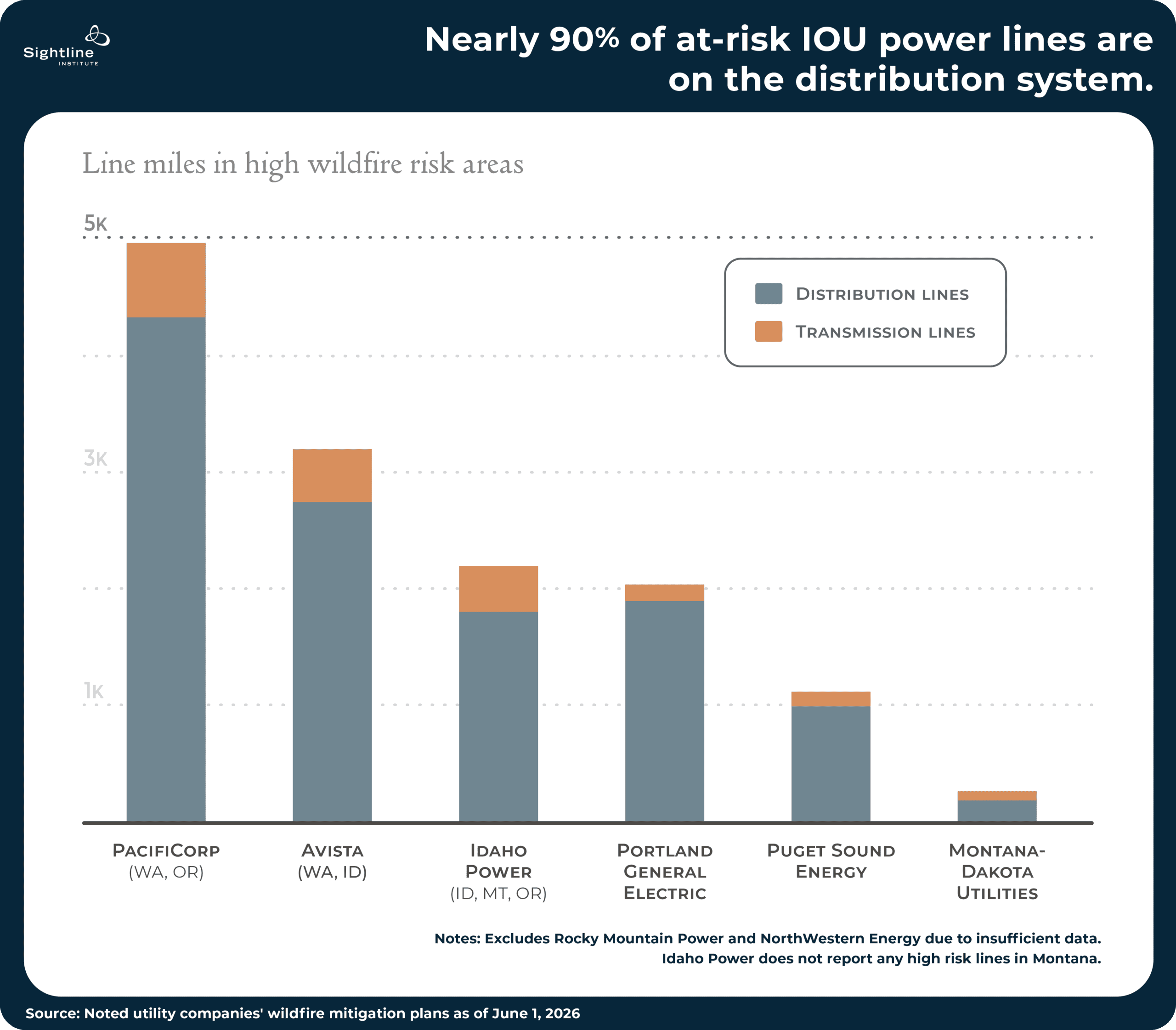
As Cascadia warms, dries, and sprawls, all electric utilities now face the reality that their equipment may ignite a fire that kills people, burns down homes, and devastates communities. Roughly 12 percent of IOUs’ power lines are strung in fire-risky places, according to Sightline’s review of utilities’ most recent wildfire mitigation plans.6 Wildfire threatens Avista more than other IOUs in the region; the Spokane-based utility counts more than a third of its distribution lines and roughly 20 percent of its transmission lines in high-risk areas.
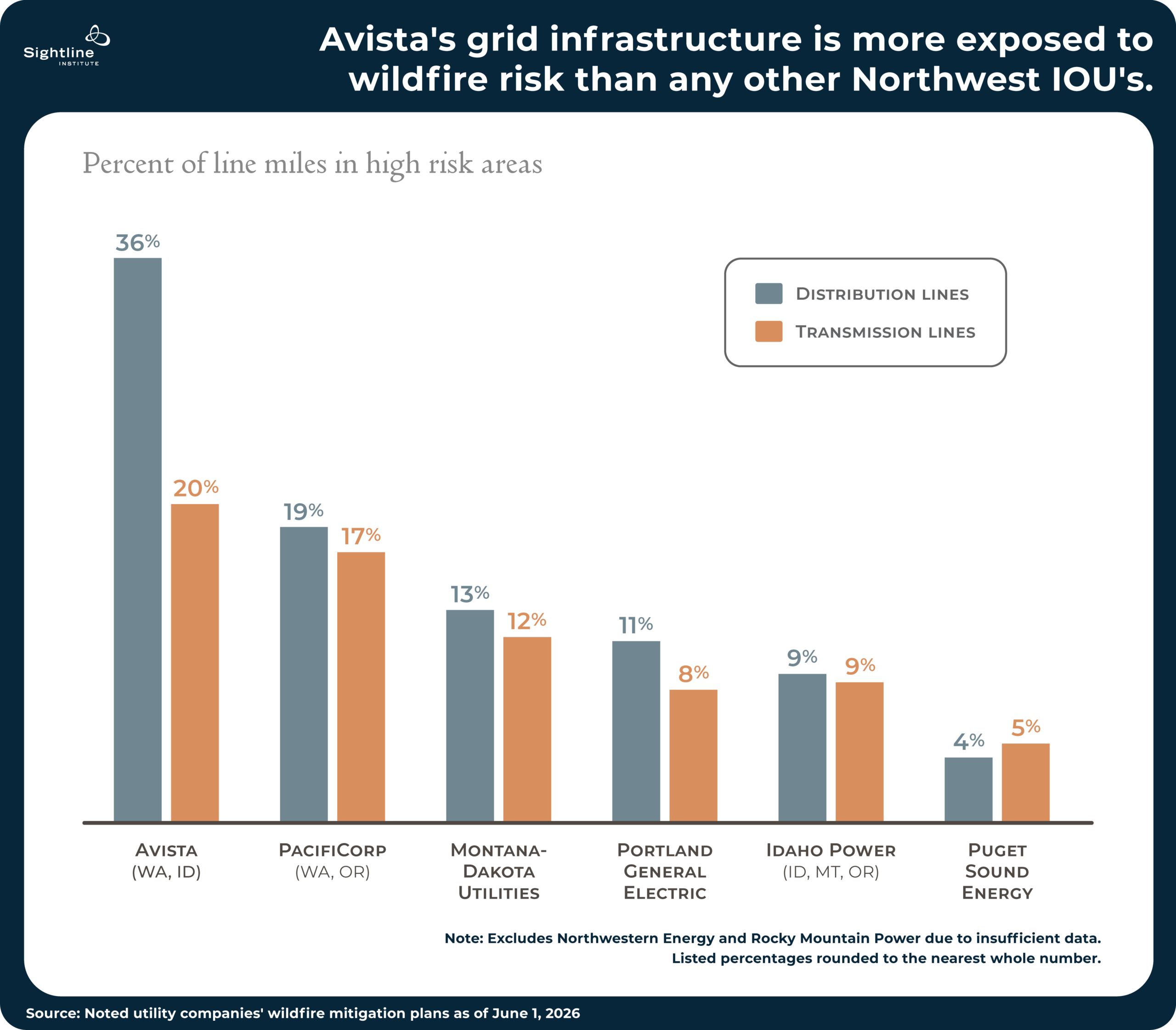
When measured by line miles, though, PacifiCorp tops the chart. Almost 5,000 miles of its power lines hang in areas most at risk for fire, representing more than a third of all of IOU exposed lines.
To respond to rising fire risk, all four Northwest states now require utilities to develop wildfire mitigation plans and submit them to regulators. Utilities’ plans vary in detail and sophistication, but they all outline the companies’ intentions to, among other things, trim vegetation, inspect poles and wires for defects, monitor weather, shut off power, and “harden” their infrastructure (e.g., by wrapping wood poles with mesh wire, or, less commonly, burying power lines).
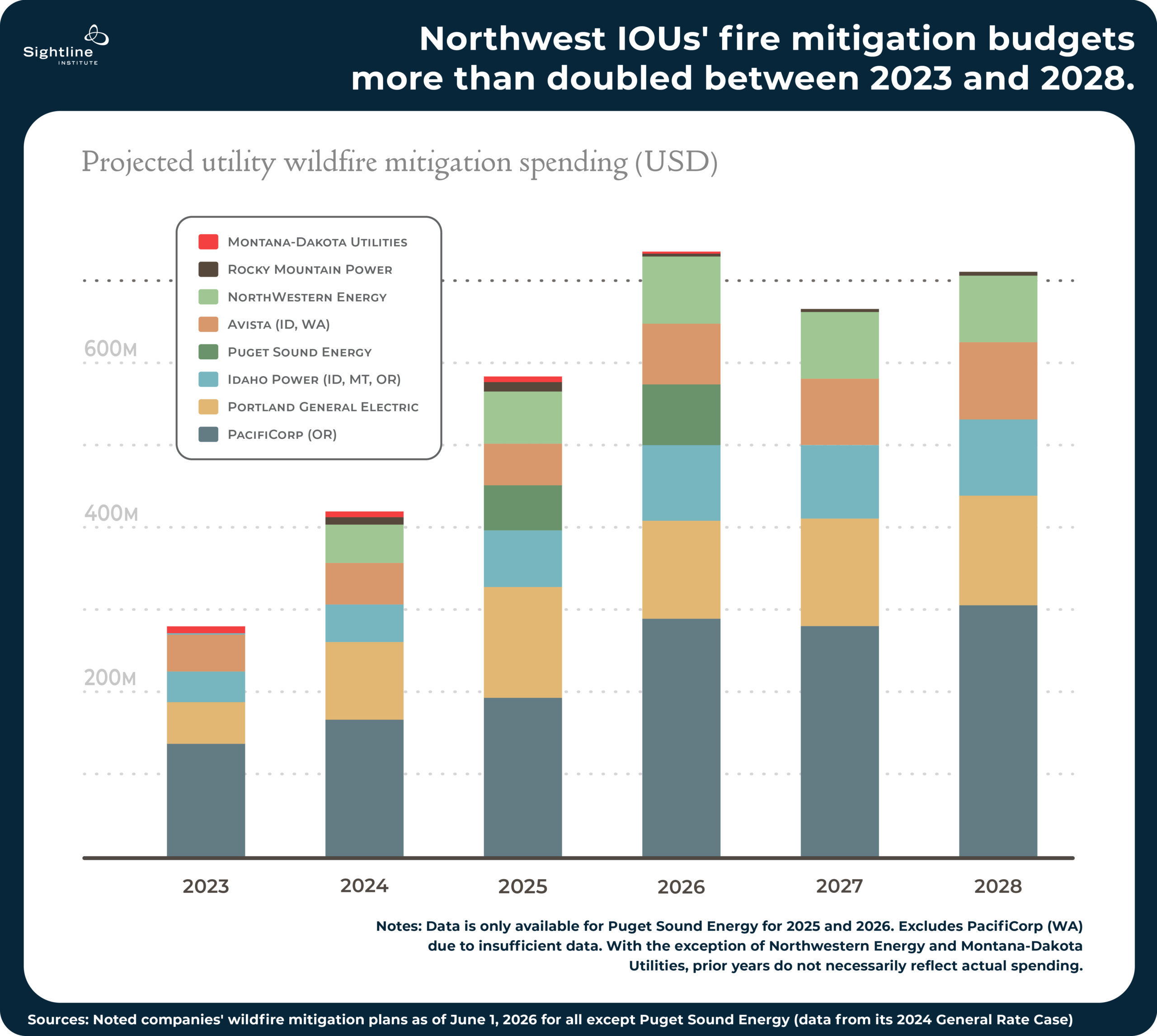
Virtually without exception, every utility in the region plans to ratchet up wildfire mitigation spending. Between 2023 and 2028, Northwest IOUs forecast more than doubling their annual wildfire mitigation budgets, from $279 million to $711 million.7 Utilities also tend to revise their cost estimates upwards each time they submit a new plan. In 2024, for example, Idaho Power projected laying out $63 million on wildfire mitigation in 2026; in the plan it submitted two years later, the company upped that number by 45 percent, to $93 million.
At this rate, IOU customers are on track to become the largest source of wildfire-related spending in the region. The four Northwest states spent $620 million to put out wildfires in 2024 (Oregon’s worst wildfire year on record), about $90 million less than utilities plan to prevent wildfires in 2026.8 And in 2025, Montana, Oregon, and Washington budgeted $87 million to mitigate fire risk, just 15 percent of what Northwest IOUs planned to spend toward the same goal that year.9 California ratepayers already fund most wildfire mitigation in the Golden State; California IOUs intended to spend $9.2 billion to prevent fires in 2025, more than twice what the California Department of Forestry and Fire Protection (CAL FIRE) budgeted for wildfire mitigation plus other wildfire efforts that year.
While all four Northwest states require utilities to “balance” costs with reducing risk, none has established cost-effectiveness criteria for approving wildfire spending plans.
Customers will also likely end up paying even more than these forecasts outline, since IOUs profit on capital expenditures, unlike their publicly- or member-owned counterparts. In 2026, nearly all IOUs project spending more on wildfire mitigation capital expenditures (e.g., replacing distribution poles or installing sensors) than on operating expenses (e.g., trimming branches or inspecting wires).10 PacifiCorp and Puget Sound Energy both intend to spend roughly 10 times more on capital costs than on operating expenses, the most lopsided spending ratio of any IOUs in the region, according to Sightline’s review of utility wildfire mitigation plans. Mounting evidence shows that regulators allow utilities to earn excessive returns on equity relative to what is necessary to attract investment.
“Utilities are deeply incentivized to put in steel poles, reclosers, and monitoring technology because they get all that money plus their rate of return,” Tad Robinson O’Neill, Assistant Attorney General in Washington’s Attorney General’s Office, told Sightline.
Making matters worse for ratepayers, Northwest regulators also permit some utilities to track and recoup wildfire costs through mechanisms outside of general rate cases (GRC), the standard proceedings in which utilities request permission to revise rates.11 These one-off mechanisms allow utilities to adjust rates more quickly and easily than if they waited for a GRC; Oregon lawmakers required the Public Utility Commission to establish this type of tracker to “allow timely recovery” of wildfire costs. However, adjusting rates outside of GRCs can inflate utility bills, since regulators and consumer advocates are unable to holistically scrutinize utility spending. Staff at the Washington Utilities and Transportation Commission (UTC) expressed concern in a recent filing that PSE’s wildfire tracker is ”removing spending control incentives”12
So far, Northwest IOU customer bills have not ballooned enormously from wildfire costs. The average Portland General Electric customer, for example, is paying about $5 more a month for wildfire costs than they were 4 years ago.13
However, if spending continues at its current pace, ratepayers could start to feel the squeeze. California customers of PG&E now pay on average $41 per month on wildfire costs, about 19 percent of their total bills. Sky-high electricity prices like those in California could discourage families and businesses from switching to all-electric homes and cars—upgrades that Cascadia’s climate goals hinge upon.
Utilities want states to limit their liability for fire, saying doing so will benefit customers
Utilities are spending so much on mitigation because they are worried about a far bigger cost: billions of dollars in damages if their equipment starts (or allegedly starts) a fire.
“The more they can show they’re shoveling money into mitigation, the more that helps them in court,” Bob Jenks, Executive Director of the Oregon Citizens Utility Board (CUB) told Sightline.
Unlike publicly owned utilities in most of the Northwest, IOUs and member-owned cooperatives in Oregon and Washington face unlimited potential damages if a court finds they were negligent in starting a fire.14 (As a federal agency, the Bonneville Power Administration, which operates 75 percent of the Northwest’s transmission system, also enjoys some immunity from wildfire liability, a protection it successfully leaned on to avoid paying damages for its role in the Labor Day fires.)
PacifiCorp has already settled more than $2 billion in damages with Labor Day wildfire victims and could be liable for up to $55 billion more, depending on the outcome of an ongoing lawsuit accusing the company of gross negligence for failing to turn off its power lines. For now, regulators have not allowed PacifiCorp to pass damages on to its customers, but they have permitted the company to keep track of these costs to potentially recoup later. (By contrast, customers would pay for damages if a court held a publicly owned utility liable for starting a wildfire.)
Utility companies argue that, to avoid PacifiCorp’s fate, states should shield them from wildfire liability, and they have now successfully backed bills across the United States that would do just that. Liability shields provide more certainty and stability for investors, utilities argue, making it easier for the company to attract affordable financing and insurance and to invest in the clean energy transition, therefore helping ratepayers.
Indeed, in November 2025, S&P Global Ratings downgraded PacifiCorp’s credit rating to BBB-, one notch above a junk rating, due to the ongoing Labor Day Fires lawsuit, though it revised the company’s rating upward in April 2026 after the company successfully appealed a jury’s finding of gross negligence. (Wildfire survivors appealed that decision in May 2026.)
Utilities are right that lower credit ratings directly raise borrowing costs, which inflates customer rates. And, with bankruptcy risk from billions in damages, IOUs could have trouble attracting investment capital to invest in energy infrastructure. “PacifiCorp is not investing,” Jenks told Sightline. “They’re extending the life of coal plants instead of building clean energy.”
However, credit rating agencies continue to assess all other Northwest IOUs’ outlook as “stable.” And PacifiCorp’s owner, Berkshire Hathaway Energy, raked in more than $4 billion in profit in 2026. The company boasted to investors in 2026 about its “access to capital from Berkshire Hathaway,” which arguably it could use to bail out PacifiCorp.
High liability risk also means many Northwest utilities are paying more every year for liability insurance, a cost regulators traditionally allow utilities to charge their customers. Avista, for example, estimates its insurance premiums will nearly quadruple from roughly $3 million in 2021 to nearly $12 million in 2026.15
Utilities also point out that other actors bear the blame for rising wildfire risk. For example, local and state governments allow builders to sprawl into wildfire-prone areas; state “obligation to serve” laws require utilities to string distribution wires to any new customers in their service territories, no matter the fire risk. Indeed, low-voltage distribution lines (as opposed to high-voltage transmission wires) that connect homes and businesses to the grid make up nearly 90 percent of IOUs’ wildfire-exposed power lines.
Still, it’s hard to imagine utilities would support eliminating the obligation to serve, which allows them to continue investing in new infrastructure and earning a rate of return.
And to be sure, IOUs don’t bear all the responsibility for climate change, the fuel supercharging the region’s fire risk. But they certainly don’t get off scot-free. In 2025, PacifiCorp generated more electricity from coal than any other power plant operator in the United States.16
Liability shields hinge on utilities’ wildfire plans, which lack strong oversight
The laws that utilities are pushing limit liability based on the extent to which a company follows its own, regulator-approved wildfire mitigation plan. However, utilities wildly out-match their regulators in wildfire expertise and resources. Without sufficient regulatory capacity to scrutinize and interrogate utility plans, states could grant utilities legal protection based on flawed mitigation strategies—and encourage excessive spending.
“Utilities have huge information asymmetry over the regulators,” Michael Wara, Senior Research Scholar at the Stanford Woods Institute for the Environment and Director of the Climate and Energy Policy Program, told Sightline.
Every utility wildfire expert Sightline interviewed agreed.
“Even in California, we had 80 people working on these, and we felt fairly outgunned [by the utility]. The government does not have the level of expertise to do the scrutiny that’s needed,” said Melissa Semcer, former Deputy Director of California’s Office of Energy Infrastructure Safety, the body responsible for monitoring utility wildfire mitigation plans.
In 2025, Idaho and Montana both enacted laws that, in the same breath, required electric utilities to develop and submit wildfire mitigation plans for regulatory approval and granted utilities a defense against claims of negligence if they follow their plans.17 Montana’s law is especially generous, barring a court from considering a utility’s “actual incremental cost” in weighing whether it followed its approved plans. In other words, if a court finds a Montana utility didn’t spend a new dime implementing its plan, it couldn’t use this fact to prove the utility didn’t, in fact, implement its plan.
In Oregon, PacifiCorp unsuccessfully promoted two bills that would have protected utilities from paying liability damages, again based on compliance with wildfire mitigation plans.18 The first, House Bill 3666, would have required the Oregon Public Utilities Commission (OPUC) to issue a “wildfire safety certification” if the commission found that the company is “prudently and reasonably” implementing its wildfire plan. This safety certification would then have equipped the utility with a defense against negligence claims. The second, House Bill 3917, would have established a catastrophic wildfire fund, which both ratepayers and shareholders would pay into, and which victims of utility-caused fires could tap up to a cap—if they agreed not to sue the company. The law also directed the OPUC to find that a utility acted prudently if it complied with its own wildfire plan, which would then preclude the company’s shareholders from having to replenish the fund.
To be fair, Oregon regulators are in a better position than many of their counterparts to assess wildfire mitigation plans; the OPUC now has several years of experience reviewing the documents, including with the help of independent evaluators (though it has declined to always follow the evaluators’ recommendations, according to Oregon CUB).
Washington lawmakers have not yet proposed directly limiting utilities’ liability, but they, similar to Oregon lawmakers, considered establishing a wildfire fund in 2026 that a utility could tap to pay damages above a certain threshold for a fire caused by the company’s negligence. The law would have allowed IOUs to charge their customers to capitalize the fund, meaning ratepayers would be on the hook for both excessive damages claims and mitigation costs. Again, lawmakers conditioned utilities’ access to this sweet deal on the companies’ compliance with regulator-approved wildfire mitigation plans. To date, regulators at the Washington UTC have no experience approving or rejecting these plans.19
A better path forward: More public scrutiny of wildfire risk and mitigation
There may come a time when wildfire risk has blanketed so much of Cascadia and IOUs have exhausted cost-effective measures to tamp it down (and have stopped making the problem worse by burning fossil fuels) that it makes sense for states to shield utilities from liability. If everything is flammable, negligence becomes hard to prove. When and if that day comes, Oregon and Washington could first consider policies like eliminating punitive damages and imposing caps on liability damages to mirror how Oregon law treats publicly owned utilities.
But for now, these states’ goals—preventing catastrophic fire, keeping electricity rates low, and addressing climate change—would be better served by investing in more public scrutiny of utilities’ wildfire mitigation plans. Idaho and Montana would be smart to ramp up oversight, too.
States can start by doing away with one-off ratemaking mechanisms, moving wildfire mitigation costs back into general rate cases so that regulators can review them holistically. They can also lessen IOUs’ capital spending bias, by reducing or even eliminating the return on equity for wildfire capital expenditures. California now prevents IOUs from earning a return on equity on the first $11 billion of their collective wildfire mitigation spending.20
Even more important is for Northwest states to invest in staff with the know-how and time to comb through utilities’ wildfire mitigation plans, evaluate them, propose alternatives, and assure that companies do what they say they will. A cadre of skilled and experienced regulators will also be better able to rigorously evaluate the cost-effectiveness of the items in utilities’ plans—and lawmakers can help make that happen. California also now requires IOUs to provide an estimate of “cost-per-avoided ignition” for wildfire mitigation measures and to show the cost efficiency of alternative mitigation measures.
Finally, the Northwest would be smart to assess the value—and equity—of relying on ratepayer funding to mitigate wildfire risk relative to other non-utility actions that can prevent fires, such as managing forests, helping people replace flammable building materials, or encouraging growth into low-risk areas. They could create a statewide framework to compare utility and non-utility risk mitigation actions (another idea the Golden State considered) to understand where to best spend scarce dollars. Without this type of overarching vision, Cascadian ratepayers could end up paying to bring down risk on utility systems to near zero—no matter the cost.
With stronger public leadership, the Northwest can both help utilities prevent devastating wildfires, bolstering companies’ ability to invest in the clean energy transition, and slow runaway electricity rates. In doing so, leaders will ensure that the specter of wildfires tomorrow does not scare away efforts to address climate change today.

