



Takeaways
- Ground-source heat pumps are the most efficient heating and cooling technology available—even more so when they’re linked together in a neighborhood-scale thermal energy network (TEN).
- If Northwest utilities took $2.2 billion that they recommend spending on new gas plants by 2045 to serve new heating loads and invest it in TENs, they could slash the region’s projected 2045 energy shortfall by as much as 10 gigawatts.
- But high upfront costs keep ground-source heat pumps out of reach for most Cascadians.
- Lawmakers can expand access to these systems by encouraging gas utilities to deploy TENs and directing electric utilities to reward both stand-alone and networked system owners for the grid benefits that come from these highly efficient systems.
Claiming that electricity shortfalls are coming, Northwest utilities are increasingly clamoring to roll back clean energy laws and build expensive, new gas-fired power plants, even though cheaper solutions are possible.
One such solution could be hiding right under the region’s nose . . . er, feet: ground-source heat pumps. By harnessing the steady temperature of the earth year-round, these highly efficient systems can slash how much power a home needs to heat and cool, freeing up space on the grid.1 And when ground-source heat pumps link together in a neighborhood-scale thermal energy network (TEN), the technology offers even more potential. TENs boost efficiency by allowing homes and buildings to share excess heat, offer a climate-friendly business model for gas utilities and their workers, and create a path to transition whole communities to cleaner energy.
In 2024, Washington lawmakers legalized utilities’ deployment of TENs, and the state has awarded grants to three of Washington’s gas companies to pilot the systems. But Oregon lawmakers have declined to adopt a similar policy, and the state risks falling behind now that 13 states have enacted laws encouraging utilities to build TENs. Oregon and Washington can do more to encourage both stand-alone and networked ground-source heat pump systems, including requiring electric utilities to pay for these systems’ benefits to the grid. In doing so, leaders can accelerate deployment of efficient heating and cooling systems, which benefits all Cascadians, regardless of whether warnings about electricity shortages bear out.
Ground-source heat pumps win on efficiency . . .
In 2025, consulting firm Energy + Environmental Economics (E3) released a high-profile study commissioned by Pacific Northwest utilities. The study forecasted that the greater Northwest region faces a 9 gigawatt (GW) resource adequacy shortfall by 2030 and a 26–46 GW shortfall by 2045.2 Sightline has written about the study’s flaws, including its reliance on a single high-growth demand scenario; failure to evaluate data center flexibility and other lower-cost alternatives to building new gas plants; and overstatement of the region’s projected resource gap.
Let’s add another flaw to the list: The study assumes that all buildings converting from fossil fuel to electric heating will install air-source heat pumps with inefficient electric resistance backup heaters that kick on during the coldest winter days. These toasters account for as much as 30 percent of the power gap (8–12 GW) that the study’s authors estimate the region faces by 2045, depending on the pace of building electrification.
Heat pumps move heat around—into buildings to heat and out of buildings to cool–using less energy than electric resistance heating, which generates heat directly by passing electricity through a heating element (similar to a toaster or baseboard heater).
Of course, this assumption oversimplifies the reality that many cold-climate air-source heat pumps don’t even come with backup resistance heaters and operate efficiently when the mercury drops below freezing. But not everyone is installing cold climate air-source heat pumps and regional power planners have found that many homes with regular air-source heat pumps employ backup resistance heaters in cold weather, in part because installers often configure systems to switch to backup heat at relatively mild temperatures and poorly insulated or drafty homes require supplemental heating to maintain indoor comfort.
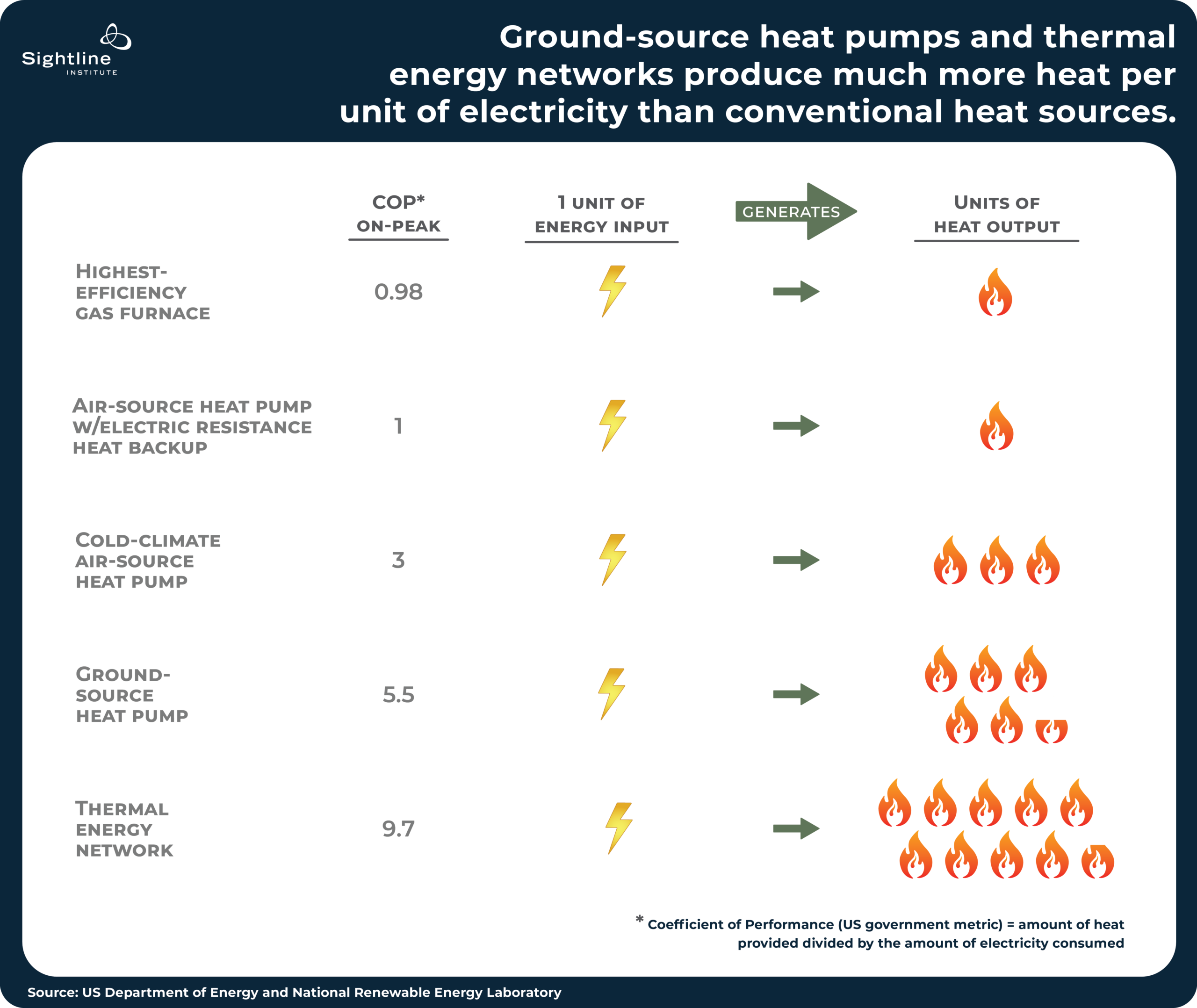
But air-source heat pumps are not Cascadia’s only option. Ground-source heat pumps are far more efficient, particularly in extreme temperatures, as shown in the table below. Ground-source heat pumps even outperform cold-climate air-source heat pumps (a high efficiency model) when the temperature dips below freezing. Frigid or sweltering weather doesn’t make ground-source heat pumps work harder. Instead, these systems harness the stable temperature of the earth, which, at just ten feet below ground, remains at around 50°F year-round.
. . . and could protect customers from overpaying to build new gas plants
One of the barriers to ground-source heat pumps going mainstream is their high upfront cost. Stand-alone systems sell for as much as $40,000 for an average-size home—roughly double the price of an equally sized cold-climate air-source heat pump. Yet ground-source heat pumps typically last about 40 percent longer than air-source heat pumps, narrowing the gap in costs over the systems’ service life. And compared to air-source heat pumps, they are also less expensive to operate and maintain because they run more efficiently and because the heat pump is typically placed indoors, protected from the elements.
But the largest economic advantage of ground-source heat pumps and thermal energy networks may be what they can avoid: strain on the grid.
Because utilities build the grid and energy-generating resources to meet peak demand during extreme weather (when people are blasting air conditioners or turning up their thermostats), relying on the most efficient heat pumps mitigates how much new electric transmission and generation Northwest utilities need to build.
Table 1: Heating an average-size home with a ground-source heat pump places much less strain on the grid than using other electric heating technologies.
| Electricity demand on coldest days of the year Peak demand (kW) | |
| Electric resistance heating | 10.55 |
| Air-source heat pump (with backup electric resistance heating) | 10.55 |
| Air-source heat pump (cold-climate) | 6.03 |
| Ground-source heat pump | 1.92 |
| Thermal energy network | 1.09 |
A single home heated and cooled by a ground-source heat pump that is part of a thermal energy network, instead of an air-source heat pump with an electric resistance heating backup, could save the region as much as $40,000 in grid expansion costs per home over 25 years.
Table 2: Over 25 years, heating an average-size home with a ground-source heat pump instead of an air-source heat pump can avoid $17,000–$40,000 per home in grid expansion costs.
| Relative to air-source heat pump with electric resistance heating backup | Relative to cold-climate air-source heat pump | |||||
| Avoided capacity (kW) | Annual avoided capacity value ($/year) | Present value of avoided capacity (25 years) | Avoided capacity (kW) | Annual avoided capacity value ($/year) | Present value of avoided capacity (25 years) | |
| GSHP (COP 5.5) | 8.6 | $ 3,030 | $ 36,077 | 4.1 | $ 1,443 | $ 17,179 |
| TEN (COP 9.7) | 9.5 | $ 3,321 | $ 39,548 | 5.4 | $ 1,898 | $ 22,599 |
Northwest utilities could spend as much as $2.5 billion over the next 25 years in building new gas plants just to meet the peak winter electricity demand created by air-source heat pumps using backup electric resistance heating in cold weather, according to E3’s analysis.
If utilities instead invested in thermal energy networks and redeployed the approximately $2.2 billion they saved to reward customers for the grid benefits of these systems, they could erase as much as 90 percent of the heating-driven load growth they intend those peak-demand gas plants to serve.3 Doing so would slash the region’s 2045 shortfall by as much as 10.8 GW. Avoiding fuel costs and operating and maintenance expenses for the gas plants would yield even more savings for Cascadians.
To be clear, air-source heat pumps are crucial to decarbonizing buildings and growing Cascadians’ access to efficient heating and cooling. And the region does not need to boost fossil fuel infrastructure to accommodate them. Expanding the electric transmission system to harness more wind and solar power can allow the Northwest to meet its energy demand. In tandem, the region can take better advantage of the benefits of highly efficient ground-source heat pumps to temper strain on the grid.
States can boost efficient heating and cooling systems by directing utilities to pay for their grid benefits
Until 2025, stand-alone ground-source heat pumps intermittently enjoyed a 30 percent federal tax credit through the residential clean energy credit, narrowing the upfront costs gap relative to air-source heat pumps when adjusted for service life. In 2025, Congress slashed the Biden-era tax credits for homeowners installing ground-source heat pumps; however, the 30 percent federal investment tax credit remains available through 2032 for commercial and third-party-owned ground-source heat pump systems, including thermal energy networks. As a result, utilities and other third-party owners can still capture a sizable federal subsidy for TENs projects (another reason for Oregon to reconsider a TENs policy for gas utilities).
Related: The Northwest Hasn’t Learned the Lessons of WPPSS (“Whoops”) | How overreliance on one grid study could drive a fossil fuel comeback in the Northwest.
Recognizing the value of avoiding unnecessary grid infrastructure, some states have enacted other reforms to boost ground-source heat pump adoption, for both stand-alone and networked systems. In 2021, Maryland added ground-source heat pumps to its list of renewable energy technologies that qualify for renewable energy credits (RECs). Utilities and energy suppliers purchase these credits to comply with the state’s renewable portfolio standard. This allows owners (homeowners, business owners, and third-party leasing companies) to earn money from the clean energy their ground-source heat pumps (or TENs) create. Third-party firms can aggregate credits from many systems, sell them in the REC market, and pay homeowners monthly or lump sum amounts.
Maryland’s policy and complementary incentive structure has also made it possible for third-party firms to install stand-alone residential ground-source heat pump systems and lease them to homeowners for as little as $10–$40 per month. Illinois and Virginia recently passed policies similar to Maryland’s: Virginia’s law restricts its market to stand-alone ground-source heat pump systems, while Illinois’s law includes TENs.
However, Maryland’s approach doesn’t perfectly fit the Pacific Northwest, which lacks a REC compliance market. Instead, the Northwest could adapt its existing utility planning processes, including avoided-cost calculations and energy efficiency programs, to reward thermal energy.
Washington has already begun pursuing such an approach. In 2025, the state enacted a law that authorizes electric utilities to discount electricity rates for operators of TENs systems that run more efficiently than conventional systems or that shift loads off-peak.
To build on this, lawmakers in both states could require electric utilities to compensate ground-source heat pump or TENs owners directly for the system benefits they provide, including avoided capacity investments. This approach would apply the same principle utilities and regulators already use in demand-response programs, which rewards customers for reducing their electricity use when the grid is stressed. Right now, homeowners and building owners who install technologies that reduce future grid costs rarely receive compensation that reflects the value they create. Unlocking these benefits would help reduce the costs of ground-source heat pumps, lowering one of the highest barriers to adoption.
Thermal energy can help solve Cascadia’s grid woes and expand access to efficient heating and cooling
Ground-source heat pumps and thermal energy networks reduce peak electricity demand, helping to defer costly electric grid upgrades and obviating the need for more natural gas generation. But the upfront costs of the systems have put the technology out of reach for most.
If utilities started rewarding owners for these heat pumps’ value to the grid, more people may adopt them and expand access to climate-friendly heating and cooling. Oregon and Washington can direct utilities to issue these rewards, which would allow the region to take advantage of the efficient heating and cooling technology waiting right under our feet.

Related: Washingtonians Will Soon Enjoy Cleaner Heating and Cooling Options | HB 2131, to allow thermal energy networks, unanimously passed in the 2024 legislative session. It’s a win for consumers, the climate, pipeline workers, and electric grids.
Data and Methodology
This analysis combines published research with original calculations estimating the electric-grid value of ground-source heat pumps and thermal energy networks (TENs) in the Pacific Northwest.
Data sources and efficiency assumptions
The analysis primarily draws from Energy + Environmental Economics’ (E3) report, Resource Adequacy and the Energy Transition in the Pacific Northwest, published in April 2026. Heat pump performance is represented using the Coefficient of Performance (COP) at 5°F: electric resistance heat (1.0), cold-climate air-source heat pumps (3.0), ground-source heat pumps (5.5), and thermal energy networks (9.7), based on US Department of Energy’s Energy Star data and National Renewable Energy Laboratory’s evaluations of community-scale systems.
Peak demand and load modeling
Household peak heating demand is assumed to be 36,000 BTU/hour (10.55 kW of thermal load), which is consistent with midsize homes. Electric peak demand is calculated by dividing this load by each technology’s COP.
Regional load growth assumptions are based on E3’s projections of 8–12 GW of additional peak demand from electrification of heating by 2045. This cumulative growth is annualized over 2026–45 and extended through 2050 to estimate yearly incremental peak demand under different heating technology scenarios.
Avoided capacity valuation
Avoided capacity is defined as the difference in peak demand between baseline technologies (e.g., air-source heat pumps or resistance heating) and higher-efficiency systems (e.g., ground-source heat pumps or thermal energy networks). This avoided load is multiplied by projected capacity costs for new gas peaking resources from E3 ($351/kW-year in 2030, declining to $242/kW-year in 2045, in 2024 dollars). Values between years are linearly interpolated, with endpoints held constant outside the modeled range.
Present value and limitations
Annual avoided capacity values are discounted to present value using a 4.3 percent discount rate and 2.1 percent inflation assumption, consistent with Oregon Energy Trust’s avoided-cost methodologies. Results represent the present value of avoided peak capacity investments through 2050.
This analysis focuses solely on electric system capacity impacts and does not represent a full life cycle cost comparison of heating technologies. Results should be interpreted as illustrative estimates of potential grid value under the stated assumptions, and will vary with building characteristics, climate conditions, equipment performance, and future system planning assumptions.

