

Takeaways
- Portland’s voter-supported new system of government—with a larger council elected by proportional ranked choice voting and a professional city administrator now handling day-to-day city business so council can focus on policy—has been in place for nearly two years now.
- While Portlanders were glad to see the old system go, the new one has taken some adjustment: councilors have had to learn it, sometimes clumsily; they’ve been divided on numerous issues; and those divisions have been on full, awkward public display thanks to a new state law.
- Still, council is slowly delivering neighborhood and citywide wins for Portlanders, while members find their feet and rhythm together.
- Fall elections will have half of council on the ballot and serve as a first test of political accountability. Meanwhile, Portland—its leaders, commentators, and voters alike—will continue settling into the new system, which in turn will hopefully continue delivering more for Portlanders.
As half of Portland’s city council gears up for re-election this fall, constituents and voters take stock: How has the council performed so far under its voter-supported new size, composition, and structure?
To be sure, voters were eager to see a change from the dysfunction of the old commission-style government. In 2022, they approved proportional ranked choice elections to select 12 councilors across 4 districts, ranked choice voting for mayor, and a new structure under which a professional city administrator (sitting under the mayor) manages day-to-day city operations, where the council focuses on legislation as guidance for the city’s direction. The city ran its first elections under the new system in late 2024, and winners took office the following January.
Since then? Well, the first year-and-a-half of the new government hasn’t been smooth sailing. Everyone had to learn the new system, and the council has been divided on numerous issues—extra visibly so thanks to a new state public meetings law. Still, signs of progress have emerged, from local infrastructure wins to citywide cutting of red tape for new housing that the city needs.
Sightline has monitored Portland’s council since 2024 with little public commentary. Mostly, that’s because it’s still too early to assess anything definitively, and what we do know has been well covered elsewhere.1 This year’s elections in Districts 3 and 4 will offer more evidence about how voters view half the councilors, but it’ll still be years before we understand the long-term effects.
Any assessment of Portland city government today also faces the quandary of the right standard of comparison. Holding it up against an ideal of how a city government should function might not paint a terrific picture. Contrasted instead with the old Portland government, it shines. Even measured against other city governments (see Los Angeles with recent corruption charges or Phoenix with secretive hiring agreements, for example), Portland looks, well, rosy.
With those caveats, here are five early conclusions of how Portland’s council measures up.
Conclusion 1: This model beats the old one
Let’s get this out of the way first. Portland’s prior, commission model wasn’t working. It was the last remaining US instance of that particular model—in which elected commissioners each administered separate city bureaus—and the cracks showed. From bureau infighting to a lack of accountability, the city had a hard time with basic functions like funding transportation and creating parks. Overall, it was not serving residents.
Portland still has challenges, but they’re now more in line with those of similarly sized cities. Take the budget deficit in Louisville, Kentucky, for example, or cuts to the auditor’s office in Denver, or fights against federal immigration sweeps in Nashville—all issues Portland has had to contend with, too. Portland has a lot to deal with, but at least it’s no longer facing the total dysfunction of the old model.
Conclusion 2: Councilors have had a lot to learn
Portland’s new councilors haven’t had an easy time. While some had plenty of government experience coming into office, others had none, and they’ve all jumped into designing and partaking in a new process all at once. As then-council president Elana Pirtle-Guiney told Axios in December 2025, “We weren’t just building the plane while we flew it. We were deciding what the flight path should be as we flew this plane that was half-built.”
Any government change—which, to reiterate, Portlanders desperately needed—would have created some transition issues. In this case, the council has kept hitting snafus but lacked any norm to revert to. It needed to set guidelines for public comment (in committees? in full council meetings? both?); figure out how to work with the (also new) executive branch; confirm a long-term city administrator; structure and then re-structure committees; establish district offices; sort through how to manage board and other appointments; even set the norms for the language councilors use when introducing motions.
All of that while also thinking through the emerging role of artificial intelligence, responding to ICE raids and the imposition of the National Guard, trying to create pathways for new housing, balancing budget needs, and the plethora of other everyday tasks of city policymakers.
It’s no wonder that council has struggled to gain its footing. Still, one area of controversy is worth calling out: councilors don’t seem to be getting along.
Conclusion 3: Councilors are visibly divided
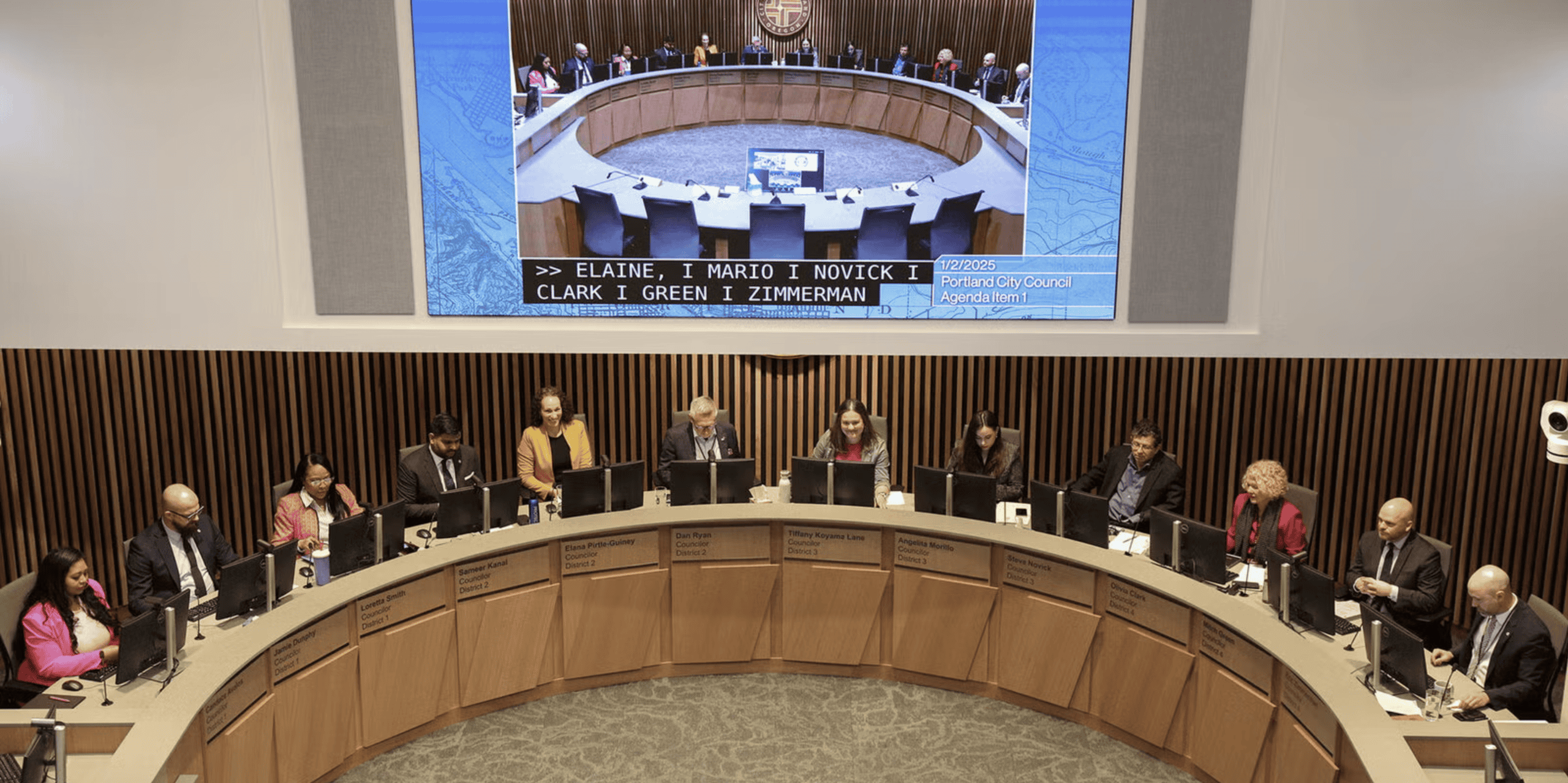
A major rift in Portland’s council became apparent from its very first vote: the selection of council president in January 2025. It took nine rounds to finally elect Elana Pirtle-Guiney, with most votes resulting in a six–six stalemate between the progressive caucus (P-Cauc, or “Peacock,” as it became known) and the more moderate councilors.2 This year, a very similar split cleaved the council—over the course of three separate council meetings—this time resulting in Jamie Dunphy’s reluctant acceptance of the position for 2026.
Current councilors are disagreeing (and tying) on other decisions, too, more than councilors on prior commissions. According to Rose City Reform, the council’s non-unanimous votes rose sixfold in 2025 compared to 2024, and close to seven times the average of 2020–2024 votes. The budget process brought up the bulk of those disagreements, with most others related to governance and procedure.
Structure plays some role here. Because of the government reorganization, the mayor and city administrator now make most operational decisions. Council no longer has to accept reports from city bureaus or adopt related resolutions for actions, so it’s passing less legislation than in previous years and focusing more on specific policies and overall direction, which tend to be more divisive. Plus, an even number of councilors makes ties between competing groups common.
Portland’s current council is also larger and more diverse than prior governing bodies, being more representative of different parts and viewpoints of the city than probably any council in Portland history. While a great win for fair representation, councilors do take longer to understand each other, and there are simply more people to disagree with and more opinions to be heard.
Conflict isn’t necessarily a bad thing, though. Working through disagreement, after all, is the point of politics. And while 42 percent of all 2025 votes were non-unanimous, over 80 percent of final votes passed unanimously. Councilors started with lots of disputes, worked through the process, and ended up finding common ground.
Still, one might have expected greater variety in the coalitions that form, disband, and reconvene issue by issue, particularly from a council as diverse as this one. Instead, the progressive bloc maintains remarkable cohesion, agreeing on an average of 87 percent of votes during the 2025 budget process (the other six members agreed 64 percent on average).
While 42 percent of all 2025 votes were non-unanimous, over 80 percent of final votes passed unanimously.
National US political polarization might contribute to this cleavage. The only model of politics Portland councilors see is two antagonistic parties bitterly fighting for power, and political resentment in the US has become more personal in recent years. Local politics tend to exhibit less rancor but aren’t immune. Portland councilors may not yet have realized that their electoral incentives differ from those of most national politicians, given that they’ve been elected proportionally within their districts. They have more room for nuance and shifting perspectives—as long as those ideas satisfy enough constituents.
Oregon’s public meetings law is also likely amplifying the divisions.
Sidebar: Oregon’s public meetings law distorts discussion
In many local governments, councilors get a chance to work through various arguments and options on an issue before a public vote. Portland councilors didn’t do that for their leadership selection or for any of their other votes. Instead, the discussion, the thinking, the persuasion, and round after round of unresolved stalemates happened in real time, in public.
The main reason for this ungainly display isn’t Portland’s updated government model; it’s an Oregon state law enacted on a similar timeline. HB 2805, which went into effect in 2023, specifies that any quorum of the members of a public governing body (including committees) is not allowed to meet to discuss any matter within the body’s jurisdiction outside of official public meetings, or even to communicate through intermediaries about the same issues. In practice, this restriction means that councilors must refrain from talking with each other about any topic that might someday come before council. All discussions must unfold only before the public, during official council or committee meetings.
Transparency is generally viewed as serving public accountability, giving viewers more insight into the inner workings and discussions of a governing body. And as the Oregonian’s Shane Dixon Kavanaugh said on Rose City Reform’s Stump Talk podcast, “I think there is a real argument that this is extremely transparent. We are all going to see how governance is actually done in real time—in a public setting.”
Extreme indeed. There simply isn’t time for every person to weigh every eventuality in a public setting. Prohibited communications may even include sharing information related to a decision to be made, meaning that councilors cannot send each other educational materials about an issue coming before the dais or have their staff talk through issues together.
Plus, full visibility leaves public posturing as the only interaction councilors have with one another, with few opportunities to build personal trust or rapport. Grand gestures might win social support but likely won’t commend a councilor to their colleagues, and there’s certainly at least some evidence of personal animosity between members, particularly between those in opposing groups.3
Portland isn’t the only Oregon locality to run aground due to the public meetings law. The city of Salem, the Springfield school board, and other governments have also found the guidelines on the law unclear and the rules a barrier to discussion. Oregon legislators tried to pass an update to the law in 2026 with HB 4177, but Governor Tina Kotek vetoed the legislation under pressure from journalists and ethics officials. So, Portland remains under the strict law, at least for now.
Council can take steps to adapt, such as now-president Jamie Dunphy’s addition of a “Committee of the Whole” to give the full council more time together. And we as viewers might need to adjust, too, recognizing a new standard in open government looks messier than we’re used to—“sausage-making in public,” as Dunphy put it after the 2025 council president vote. While we can and should expect our public officials to have done their homework and worked out some of their thinking ahead of time, that isn’t always possible under the limitations of Oregon’s current law.
Conclusion 4: Wins large and small are underway
Council has not been all strife and angst, though. Despite its challenges, Portland’s new government has achieved tangible improvements for residents. District representation helped an advocate finally get an East Portland light post fixed. Councilors have advanced a plan to add sidewalks to neighborhoods long without and are paying attention to other city-wide infrastructure needs. Building permitting is more streamlined than the bureaucratic quagmire of the past. Businesses are feeling more optimistic and perhaps have some reason to ascribe that to Portland’s council. Wait time on 911 calls has dropped. The increased information shared beyond the silos of the prior bureaus helped reveal $106 million in unspent housing funds, $56 million of which the council quickly reallocated to new housing initiatives.
Portland’s council may still be struggling with drawn-out meetings, but it’s moving the city forward, step by step.
Conclusion 5: Elections matter
Finally, any assessment of governance (however preliminary), would be remiss not to mention the mechanism of self-government. International NGOs and other experts have developed a large assortment of frameworks for assessing governance, covering principles such as accountability, transparency, efficiency, participation, and equity.4 Each framework differs from others depending on context; every one that Sightline reviewed points to the importance of fair and representative elections for establishing stable and effective democratic governance. The fact that Portland has the most representative government in its history is not merely an afterthought in a discussion of how the government responds to the people; it is core to what issues that government can even consider.
This year’s elections will offer a first test of accountability, although even then we might not get clear information about what motivates voters behind the scenes. How incumbents fare could be related to views of the current council overall or perceptions of specific councilors. Some voters may have strong opinions and try to strategize to vote someone out, where others following less closely may rely more on name recognition.
Either way, 2027 has the potential to usher in new dynamics on the dais. Councilors will continue learning, as they have been, but at least some will now have a few years under their belt. Perhaps they’ll figure out new ways to build personal relationships and work together, or Oregon’s public meetings law will get the update it needs to help move along discussion between electeds. Most importantly, they’ll hopefully achieve more wins on the issues that matter most to Portland residents.

