


Takeaways
- Washington’s top-two primaries have broadly lived up to reformers’ expectations, reducing political polarization and engaging a more ideologically diverse voter base.
- But the top-two primary also has a serious defect. On rare occasions, voters in a heavily Democratic area must choose between two Republicans (and vice versa).
- Other unanticipated issues with the top-two model include voters who ignore same-party contests and lower engagement for third parties and independents.
- Alaska’s top-four primaries and ranked-choice general elections expand on top-two’s laudable successes and address its glitches, giving voters more choices.
Find audio versions of Sightline articles on any of your favorite podcast platforms, including Spotify, YouTube, and Apple.
On September 4, 2024, Democrats across Washington State let out a collective sigh of relief. A recount of the primary election finally confirmed that one of their own, then-King County Councilor Dave Upthegrove, would appear on the November ballot. Even though Democrats had won 270,000 more votes than Republicans in the primary for Commissioner of Public Lands, Upthegrove squeaked into second place by just 49 votes.
This math story problem gone awry is a hiccup of Washington’s top-two primaries, in which the two candidates with the most votes, regardless of party, square off in the general election. Democratic voters split their majority five ways, allowing two Republicans to float toward the top of the pool with a combined 43 percent of the vote. Only the narrowest of margins spared blue-leaning Washington an all-Republican ticket in the general election. (It wouldn’t have been the first time.)
So do Washington’s nonpartisan top-two primaries need to go? Certainly not. Two decades of research point to their overall positive impact on elections and governance. Compared with the 47 states that use partisan primaries, the top-two model has a depolarizing effect on lawmakers, gives candidates an incentive to appeal to wider audiences, and turns out a more representative electorate.
But while Washingtonians could claim for years to be leading the pack on primary reform, the top-two model has also stumbled, occasionally producing backward results and unfavorable conditions for third parties. Since 2020, Alaska’s top-four primaries and ranked choice general elections have avoided top-two’s tripping points while still retaining and building on its positive qualities.
Washington’s not down and out by any means; with a simple top-four (or top-five) tune-up, Evergreen state voters could get the same results.
Top-two primaries: A step in the right direction…
In 2004, Washington voters approved Initiative 872, which created top-two unified (or nonpartisan) primaries. In these races, all candidates appear on the ballot together and the top two vote-getters (of any party) advance to the general election.1 California adopted the model six years later.
Most states hold partisan primaries, which are exclusive to candidates of a given major party and tend to produce combative campaigns and extreme legislators. But reformers theorized that unifying the races—i.e., making them nonpartisan and allowing all voters to participate—would produce more moderate legislators who better represented the majority of voters.
They were right. Political polarization stabilized in the California and Washington legislatures post-reform while the problem worsened in most states with partisan primaries.
Why such a dramatic difference? For one thing, unified primaries tend to turn out more voters that better represent the overall electorate than partisan primaries, which skew older, whiter, wealthier, and, some researchers suggest, more ideologically extreme than those who show up for general elections. Because Washington’s unified primary voters look more like the general voting public than most other states, candidates and lawmakers have cause to court voters from all sides (not just a narrow base) to secure one of the top two spots.
Another key element is that the top two candidates regardless of party advance out of the primary. Two Democrats or two Republicans can face off in the general election if an area skews heavily toward either party. Voters of the dominant party get more options in the general election, while voters in the political minority can sometimes “play kingmaker,” putting a more moderate candidate over the top.
There’s no better illustration of the dynamics top-two has introduced than Washington’s Fourth Congressional District. About 60 percent of voters in the district backed Donald Trump in 2016, 2020, and 2024. But Rep. Dan Newhouse (👉), one of only two US House Republicans to vote to impeach Donald Trump and win reelection in 2022, has won out over a more conservative fellow Republican in three separate elections.
👉 US Rep. Dan Newhouse (WA-4), one of only two US House Republicans to vote to impeach Donald Trump and win reelection in 2022, has won out over a more conservative Republican opponent in three separate elections. The district may be more red than blue, but given a choice between two candidates of the same party, District 4 voters across the political spectrum vote Newhouse.

👉 US Rep. Dan Newhouse (WA-4), one of only two US House Republicans to vote to impeach Donald Trump and win reelection in 2022, has won out over a more conservative Republican opponent in three separate elections. The district may be more red than blue, but given a choice between two candidates of the same party, District 4 voters across the political spectrum vote Newhouse.
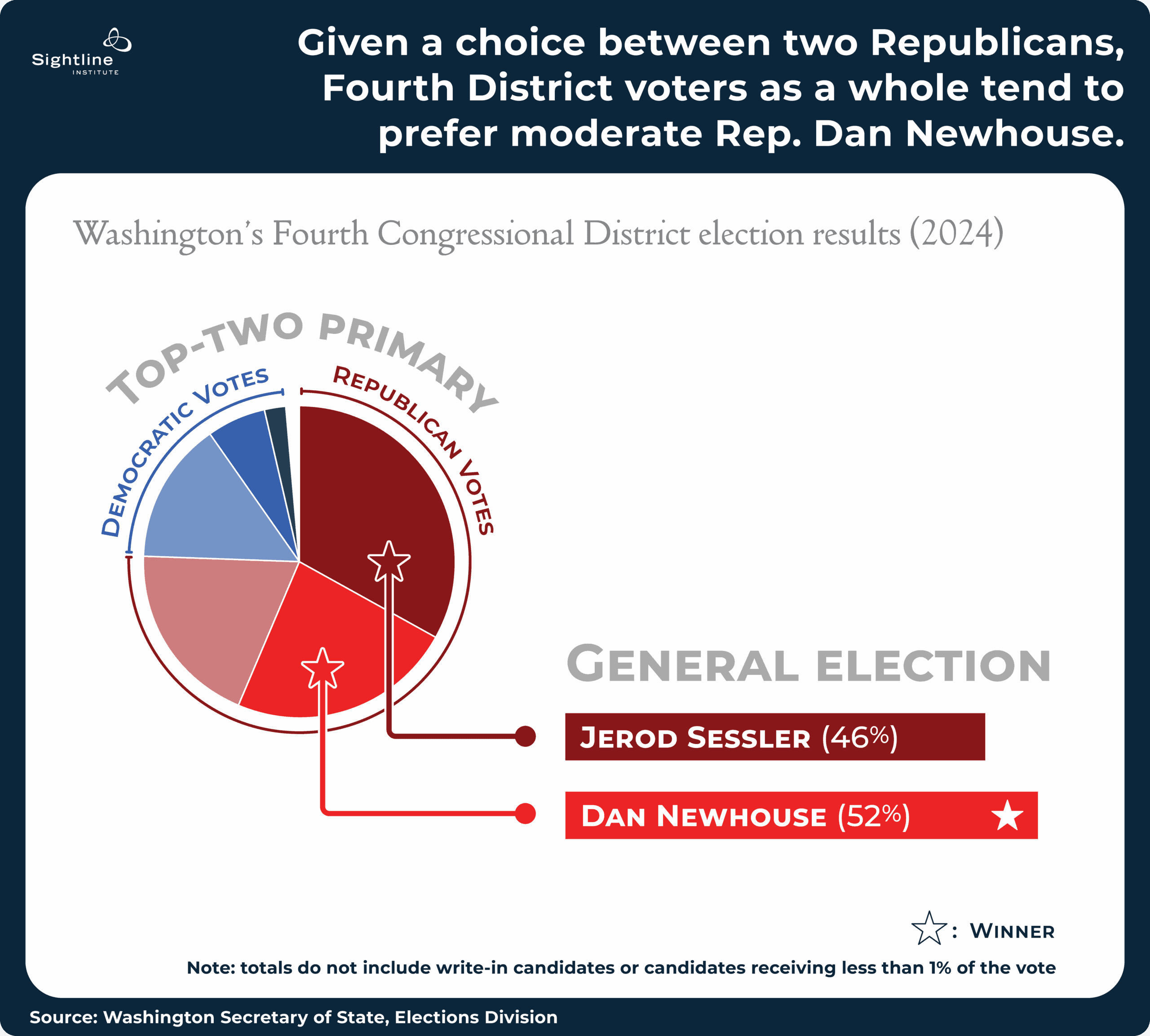
Under partisan primaries, Newhouse would likely lose to more extreme candidates, who would square off against the single Democratic nominee in the general election, winning easily (despite being the first choice of only a tiny fraction of voters). The district may be far more red than blue, but given a choice between two Republicans, District 4 voters consistently prefer Newhouse.
…But there have been bumps in the road
For all its exciting properties, the top-two model has exhibited a few unexpected defects. Voters sometimes get stuck choosing between candidates that don’t represent their state or district. Contests between two candidates of the same party can prompt a segment of voters to skip a race on their ballot entirely. And despite good intentions, the top-two model may be draining support for third parties.
When one party divides, the other conquers—not always in the way voters want
Though top-two skews toward electing partisans with broad appeal to residents of a state or district, sometimes the opposite happens. Once in a while, top-two produces a spoiler-like situation in which a heavily Democratic electorate gets stuck picking between two Republicans (or vice versa).
Dave Upthegrove may have squeaked through a splintered primary to the 2024 general election, but Washington Democrats haven’t always been so lucky. Take for example the Washington State Treasurer election of 2016 (👉). The Democratic majority—52 percent of primary voters—split their vote between three candidates in the primary, so two Republicans advanced to the general election, despite having fewer overall voters in their corner. For the next four years, Washington had a Republican Treasurer against the likely preference of most voters.
👉 Democratic voters splintered their majority in the 2016 primary for State Treasurer, leaving blue-leaning WA to pick between two Republicans in the general election. The winner, Duane Davidson, was the only Republican to hold the position since the 1950s.


👉 Democratic voters splintered their majority in the 2016 primary for State Treasurer, leaving blue-leaning WA to pick between two Republicans in the general election. The winner, Duane Davidson, was the only Republican to hold the position since the 1950s.
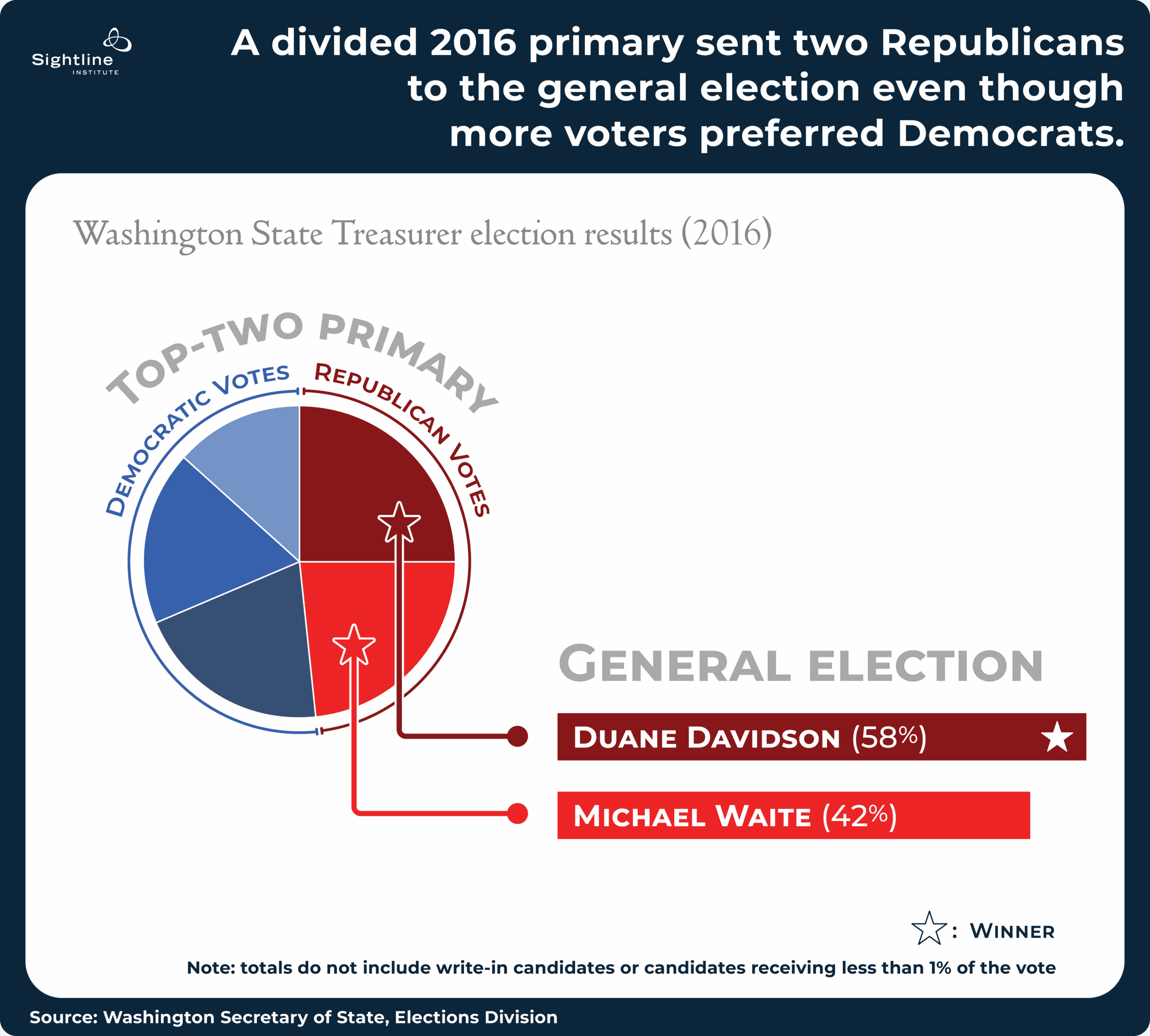
And it’s not just a Democratic problem: Republicans cried foul when Washington voters got no Republican options in the general election after the divided 2020 primary for Lieutenant Governor (even though there was a Republican candidate for governor).
Some voters who don’t like their choices simply give up and move on
Call it the dilemma of the peckish: pop open the refrigerator looking for a treat, and there’s nothing inside that catches your eye. Now, a dedicated snacker might pick between less-than-ideal options even if they’re not in the mood. But somebody who’s not that hungry is more likely to just close the door and walk off.
Turns out, about seven percent of voters feel the same way about their ballots. Even though they have their pick between two candidates, they’d rather “roll off” and abstain from voting entirely when they see two Democrats or two Republicans in a race (compared with two-or-more-party contests).
In same-candidate elections where the margin of victory is below seven percentage points, like the narrow two-Democrat race for State Senate District 35 in 2018, one can’t help but wonder if those abstaining voters might have changed the outcome.
Third parties are getting iced out
Third-party and independent candidates tend to perform worse under the top-two model than in partisan primary states, in which they can sometimes appear on the general election ballot. It’s not hard to see why: when only two candidates can advance out of primaries, they’re almost always Democrats or Republicans. Voters who might be inclined to support a third party in the primary generally recognize the slim odds of success and go for one of the two major parties instead.
Of course, the impact on election outcomes has been minimal, as third parties rarely win elections anyway. However, with reduced access to the ballot, non-mainstream candidates don’t just lose the slim chance they have of seeing success; they no longer get even the awareness-boosting exposure of participating in general elections.
In a country deeply divided between two parties, almost 60 percent of Americans yearn for a third option. Unfortunately, Washington’s current primary model may not get there: in the words of Unite America Democracy Fellow Richard Barton, “for those who believe that a healthy political system requires more than two parties, Top Two may actually be worsening American democracy.”
The Alaska model: New and improved
Alaska’s top-four primaries share the benefits of top-two’s unified primary concept. Allowing all voters and all candidates to participate means better turnout, a more representative slice of the electorate, and incentives for candidates to appeal beyond their base. But advancing four (or, as some reformers suggest, five) candidates, rather than two, plus using ranked choice voting in the general election, is how Alaska’s model fixes what top-two doesn’t get quite right.
For starters, when four candidates advance from the primary, there’s little to no chance that any area will produce a one-party ballot (so long as more than one party runs for office). Compared with advancing two candidates, there are simply greater odds that at least one will be a good match for any given voter in their state or district. So those voters who are inclined to skip single-party races? They’ll rarely have occasion to do so.
Meanwhile, those third-party and independent candidates who get locked out of general elections under top-two have greater odds of advancing in a top-four primary—and under ranked choice voting, voters have more reason to vote for them. In a pick-one contest, a voter might avoid “wasting” their vote on someone outside the two major parties lest they spoil the election. Ranked choice voting ensures that voters can express their true preference, and if their preferred candidate gets eliminated, their vote simply transfers to their next-favorite choice, unwasted.
Despite occasional hiccups, Washington’s top-two primary has improved who gets to meaningfully vote and how lawmakers govern. But the Evergreen State wouldn’t be tossing away decades of progress if it were to upgrade to the Alaska model. In adopting four- (or five-) winner primaries and ranked choice general elections, Washingtonians would be tuning up their well-loved, but not always reliable, primary. They’d be fashioning it into something more functional, efficient, and dependable—while reclaiming their spot in the front of the pack.

