



Takeaways
- Ranked choice ballots allow voters to express nuanced political opinions across party lines. Voters can back their favorite candidate without spoiling an election for their second-favorite.
- In Alaska’s first ranked choice elections in 2022, Democrat Mary Peltola won and held the state’s US House seat with cross-partisan support from Nick Begich voters. In a 2024 rematch, Begich (a Republican) won a majority with support across parties.
- Alaska’s top-four ranked choice system doesn’t favor one party over another—but it does encourage candidates to consider how their campaign might win broad support.
In 2022, former Alaska State Representative Mary Peltola made history: she became the first woman to represent Alaska in the US House, the first Democrat to hold the seat in half a century, and the first Alaska Native ever to serve in the chamber. Importantly, she was also the first person to win a statewide ranked choice election in Alaska.
Some Republicans, including Peltola’s challengers Nick Begich and former Governor Sarah Palin, cried foul. The late US Representative Don Young, a Republican, had held the seat for half a century. Ranked choice voting, they fumed, must have been a ploy to elect Democrats.
Results from across the country indicate otherwise. Ranked choice voting doesn’t help members of one party or another; it elevates candidates with broad popular support among voters.
Sightline’s analysis of ballot data from the Alaska Division of Elections spells out a similar narrative: one of a Democrat with cross-partisan appeal in 2022, and of a Republican who captured a majority of hearts and minds during a conservative surge in 2024.
The August 2022 Special Election: Mary Peltola’s landmark win
A somber development gave Alaskans an early taste of the top-four primaries and ranked choice voting they adopted in 2020. Don Young, Alaska’s long-time US representative, passed away in March of 2022. His absence teed up a heated contest: in the first test of Alaska’s top-four primary, 48 hopefuls appeared on the June special primary ballot to serve the rest of Rep. Young’s term.
Republicans Sarah Palin and Nick Begich, independent Al Gross, and Democrat Mary Peltola secured the top four spots; but when Gross dropped out of the running, Alaska’s first ranked-choice contest came down to two Republicans and one Democrat.1
Animated chart by Sightline Institute using official results from the Alaska Division of Elections.
Mary Peltola led the field with 40 percent of first-choice votes. Palin followed with 31 percent of the vote. Begich was a close third with 28 percent. No one candidate won a majority of votes, so election officials eliminated Begich, the lowest-performing—and allocated his votes to voters’ second-place rankings. Overall, Peltola had more support than Palin.
Immediately, some Republicans lashed out at ranked choice voting. Arkansas Senator Tom Cotton, for one, scoffed at the notion that an election in which 60 percent of voters picked Republican candidates first could produce a Democrat. Sarah Palin shared the same sentiment: “It’s effectively disenfranchised 60 percent of Alaska voters.”
Cotton and Palin ignored the core tenet of ranked choice voting: it gives voters a chance to express nuanced political opinions. And Alaskans did.
Begich voters were not necessarily hardcore Republicans
In short, Begich voters liked Begich; not all of them liked Palin.
Animated chart by Sightline Institute using official results from the Alaska Division of Elections.
Only half of Begich voters ranked Palin second on their ballots. Nearly a third of Begich voters—29 percent—cast bipartisan ballots with Peltola second, enough to put the Democrat over the threshold. Some 21 percent of voters had no second-choice preference, so their votes did not transfer.
Begich voters supporting Peltola wasn’t a fluke. The cast vote record, an anonymized data set showing how voters filled out their ballots, revealed that 27 percent of his supporters cast ballots for non-Republicans in the gubernatorial primary as well. Peltola, a low-profile and moderate Democrat, had a similar degree of cross-partisan appeal for some Alaskans who liked Begich.
But what about those 21 percent of Begich voters who had no second-place preference? If every one of those voters had picked Palin, she would have prevailed over Peltola, but if they had picked their second choices in the same proportions as the other Begich voters, Peltola still would have won.2
More to the point, not ranking anyone second is a legitimate choice for voters. After all, Alaskans for Better Elections found that 85 percent of August voters thought ranked choice voting was “simple.” Begich-only voters could have ranked if they chose to do so, but they decided against expressing a preference between Peltola or Palin.
Begich and Palin turned against each other, and some voters followed suit
Palin’s withered support among Begich voters may have had roots in a venomous campaign. Begich called Palin a “quitter” and “intellectually deleterious.” Palin told her supporters that Begich was “full of bull.” Trading insults throughout the campaign didn’t exactly endear their bases to one another. Voters aren’t inclined to dole those rankings out to candidates they’ve come to hate.
In fairness, the Republicans were simply following an outdated campaign playbook. Attacking and undermining other candidates had long been a winning strategy in Alaska’s often divided pick-one, plurality winner elections prior to reform. But ranked choice voting encourages candidates to build bridges rather than burn them. If candidates can’t be a voter’s first choice, they can still appeal to be their second.
While Begich and Palin were snapping at each other, Peltola was snapping selfies with them. Her “Fish, Family, Freedom” slogan was upbeat and nonpartisan. She maintained a respectful tone when discussing her opponents, and they reciprocated—Palin even called her a “sweetheart.”
Perhaps if the Republicans had followed Peltola’s friendly lead and encouraged their supporters to rank one another, they could have drummed up enough support to keep the seat in Republican hands. Instead, they salted the earth.
The November 2022 General Election: A ranked choice rematch
Primary voters teed up a familiar field to move on to the general election for a full term in the US House. After a long-shot Republican dropped out, the options came down to Peltola, Palin, Begich… and Libertarian Chris Bye.3
Bye failed to make much of a splash, but with a few months as an incumbent representative under her belt, Peltola saw a leap in popularity. A near majority, 49 percent of voters, ranked Peltola first, up from 40 percent in the special election.
Animated chart by Sightline Institute using official results from the Alaska Division of Elections.
As the rounds of counting went on, the Begich-Peltola contingent once again put the Democrat over the top. Bye, with the fewest votes, was first to go. His voters didn’t deliver anyone a majority, so Begich, who had taken third place, was next. Though a smaller percentage of Begich voters ranked Peltola this time, they still carried her across the finish line. An overall majority of voters preferred her to Palin.
“Rank the red” came too little, too late
Bad feelings from the special election still plagued the leading Republicans’ campaigns. Palin initially called for Begich to drop out of the race. When Begich refused, Palin and the state Republican Party reluctantly adopted a new tactic: “rank the red.”
In an Anchorage Daily News opinion piece, Palin fumed that Republicans had to play the hand they had been dealt, even though ranked choice was (in her words) a “cockamamie system.” Despite ostensibly encouraging unity, Palin still swiped at Begich. “The other Republican in that race is merely a distraction—and a potentially harmless one, as long as conservative Alaskans do the smart thing and ‘rank the red’ by voting for both Republican candidates, in whichever order they prefer,” she wrote.
Some Republicans appeared to pay attention. 67 percent of Begich voters ranked Palin above Peltola in November 2022. It was an improvement over the special election’s 50 percent, but far short of the 94 percent she would have needed to overtake the incumbent Democratic Representative’s lead. The momentum was on Peltola’s side—and ultimately, so were a majority of voters.
Peltola was pretty popular
Peltola was a sitting Congresswoman and had a nearly insurmountable lead (49 percent of the vote) to begin with. This time, only 12 percent of the pro-Begich crowd ranked Peltola, but there were still enough votes to re-elect her for a full term.
Animated chart by Sightline Institute using official results from the Alaska Division of Elections.
Framed another way: if Begich had dropped out of the race, enough of his would-be supporters would have likely preferred Peltola to deliver her a majority victory outright. Ranked choice voting allowed them to express that preference while still supporting their number one.
Two years later, preferences would shift in Begich’s favor.
The November 2024 General Election: Begich rides the red wave
In the lead-up to the 2024 election, “rank the red” dropped out of the Republican lexicon for a different slogan: “drop if not on top.” Republican operatives and local party committees encouraged second-, third-, and fourth-place Republicans to drop out before the general election if another Republican bested them in the primary.
The logic, it went, was that giving right-leaning voters only one choice would consolidate support behind a single Republican. The idea caught on in GOP circles. Early on, Begich committed to dropping out if he lagged in the primary. When he came out on top of his fellow Republicans after all, lower-placing members of his party (including Lieutenant Governor Nancy Dahlstrom) cleared the field.
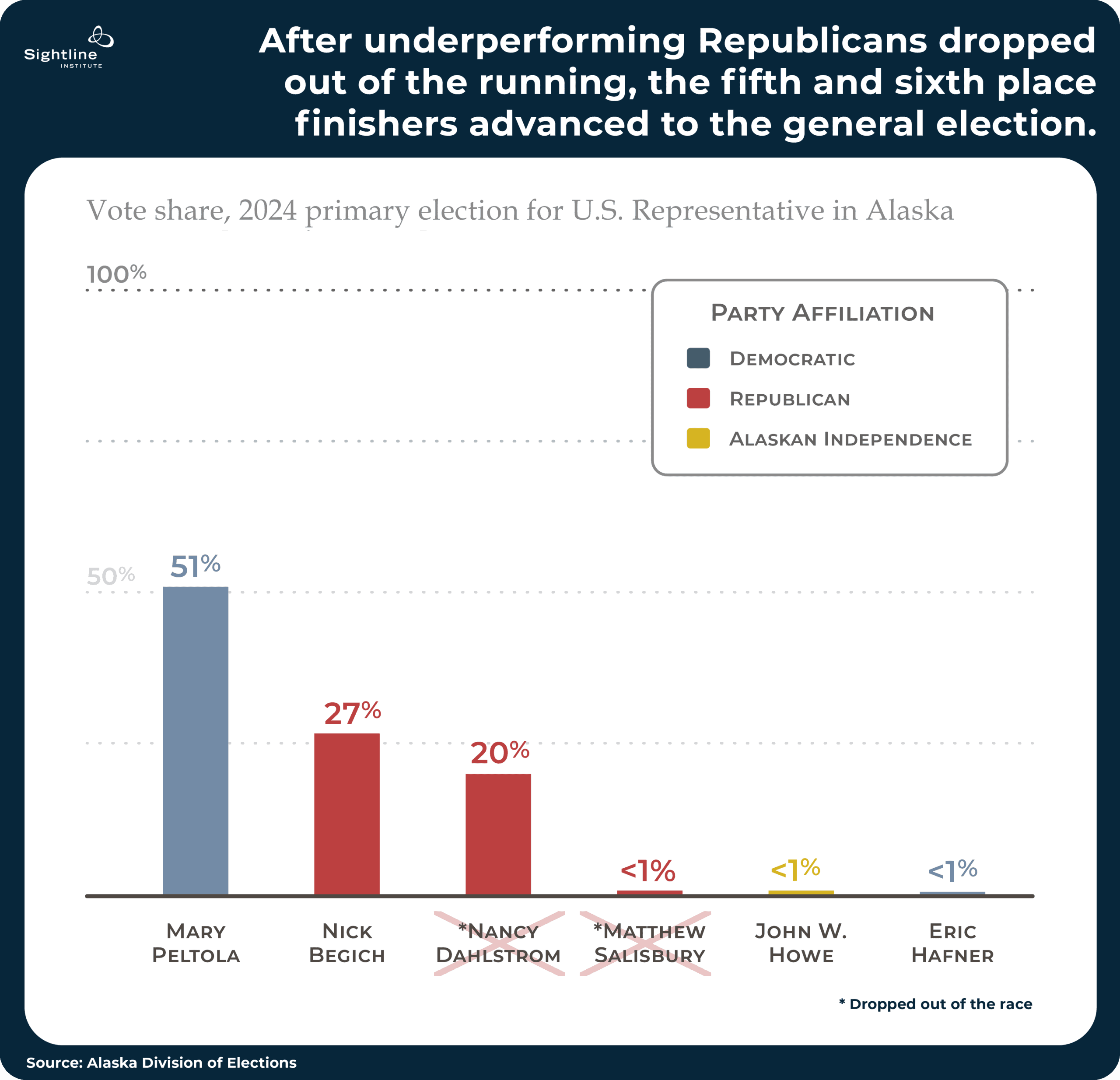
So it was that Begich and Peltola squared off against two unlikely finalists: John Howe of the (now defunct) Alaskan Independence Party, and Democrat Eric Hafner, a non-Alaskan who was serving a prison sentence in New York and likely would have been ineligible to serve in office.
Begich was the frontrunner in a pro-Trump year
With a couple statewide elections under his belt, Begich finally had the fame and name recognition he had lacked compared with Sarah Palin in 2022. No longer the underdog in the primary, he finished first among Republicans even though Lieutenant Governor Nancy Dahlstrom had the support of then-former President Trump.
Trump endorsed his second choice—Begich—after Dahlstrom exited the race. Meanwhile, in his own presidential campaign, Donald Trump won Alaska’s popular vote by his biggest margin to date in a very good year for Republicans. With Trump on top of the ballot, Begich saw his fortunes rise as well.
Animated chart by Sightline Institute using official results from the Alaska Division of Elections.
Begich led out of the gate, earning 48 percent of the first-place vote to Mary Peltola’s 46 percent. Though she outperformed Democratic presidential nominee Kamala Harris in the state, Peltola’s support among voters had slipped. As the rounds of counting went on, officials transferred votes from the last-place Hafner and third-place Howe according to voters’ preferences. This time, Begich had majority support.
Ranked choice voting gave Begich a majority win and a clear mandate
Ranked choice ballots allowed all voters to pick their favorite candidates first. Alaskan Independence Party voters might have been disappointed that their man in the running didn’t make it to Congress, but they preferred the lone Republican over Peltola, and their votes counted toward Begich’s win.
Animated chart by Sightline Institute using official results from the Alaska Division of Elections.
Alaskan Independence Party voters sent Begich to Congress with a majority and a mandate. He had the popular support of the most Alaskan voters in 2024. Just as it had delivered wins when voters leaned toward Peltola, ranked choice voting made it clear that the tides of public opinion had shifted in Begich’s favor.
Some Begich supporters maintained a soft spot for Peltola—more than 6,000 of his voters still ranked her second on their ballots. And more than 10,000 Peltola voters indicated Begich would be their second choice.
Despite a decisive win, Begich bashed Alaska’s electoral model
With less than half a year to reflect on his victory, Rep. Begich introduced an unsuccessful bill to ban ranked choice voting in federal elections largely based on the misconception that new rules—not the will of the people—delivered Mary Peltola’s initial victories in Alaska. The opposite is true.
The story of Alaska’s recent elections demonstrates that ranked choice voting elevates candidates with broad popular appeal, even as voter sentiment changes each election season. In the state legislature, moderate Republicans win in moderate districts, and conservative Republicans win in conservative districts. At the state level, Peltola had appeal across party lines in 2022, just as Begich did in 2024.
Alaska voters got the final say.
The November 2026 General Election: Ranked choice voting’s next chapter
Regardless of how officials from party leaders to the president feel about Alaska’s electoral methods, voters will have at least one more cycle to cast nuanced ballots across ideological lines. And if Alaskans turn down a November ballot measure to repeal electoral reforms as they did two years ago, top-four primaries and ranked choice voting could be the state’s status quo for a lot longer.
This year, Mary Peltola has her eye on incumbent Senator Dan Sullivan’s seat. She’s running on what worked before: sticking to the “fish, family, freedom” slogan and policies that transcend party lines. In her campaign announcement video, the unmissable centerpiece of her website, Peltola positions herself as a DC outsider and praises Alaska’s late congressmen Rep. Don Young and Sen. Ted Stevens—both Republicans.
And Nick Begich, now running for a second term in the US House, once again finds himself in a contest where every last vote could count. If he wants to hold on to his seat in what’s shaping up to be a “blue wave” election, Begich may need to quietly build on the cross-party appeal that propelled him to victory in 2024.
If he and other Alaska Republicans are looking for winning strategies in a competitive year, they might consider rifling through Mary Peltola’s playbook.

