

Takeaways
- Washington’s property tax system quietly rewards landowners who sit on vacant lots in our cities, while penalizing investment in the new homes, shops, and jobs that create real community value. The fix for this counterproductive dynamic is a land value tax that lowers the tax on buildings and raises it on land.
- A new report from the Center for Land Economics proposes a policy that would exempt building value from property tax to create a revenue-neutral tax shift from buildings to land, replicating a land value tax while adhering to Washington state’s tax rules.
- The report models this approach in the city of Spokane, finding that it would encourage the in-city homebuilding that cities need to curb prices, and discourage vacant lots and land speculation; it would flip the incentive structure without touching the city’s bottom line.
- Most homeowners wouldn’t see much change in their tax bill at all, while the shift would be progressive in lower-income and more racially diverse neighborhoods, where homeowners would see larger tax reductions.
- By granting this authority through the Vibrant Cities Act, the Washington legislature would empower cities to use their own tax code to cool land speculation, spur homebuilding, and return community-created land value back to the public.
In communities across the state, Washingtonians are reeling from high home prices and rents caused by the state’s severe shortage of homes. In cities and towns, big and small, from Bellingham to Walla Walla, people need more affordable home choices. At the same time, thousands of acres of vacant and underused lots pervade many of our urban neighborhoods, even in otherwise dynamic downtowns.
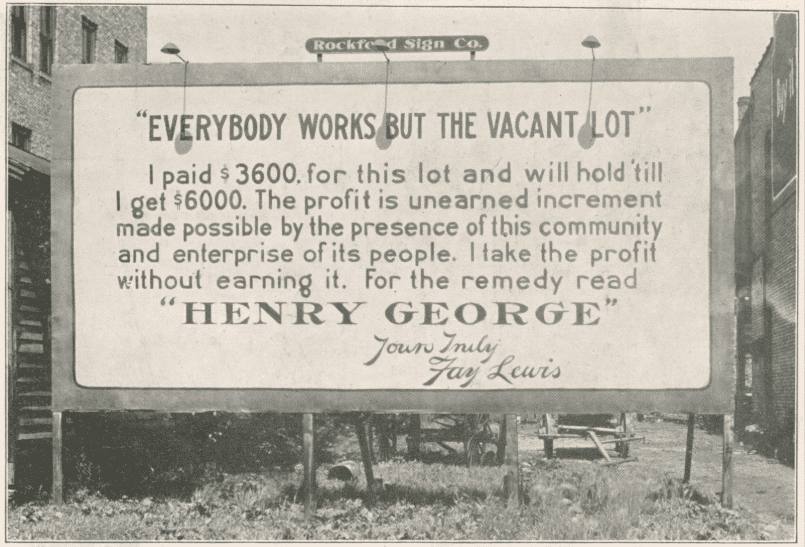
One big reason for this disconnect? The tax structure. Under North America’s standard property tax system, the owner of a vacant lot is taxed only a fraction of what’s paid by their neighbor who owns a productive building on a similar lot. The tax system rewards speculation on underutilized land, while discouraging investment in the new homes, shops, and offices that generate community vitality.
A fix for this dysfunctional state of affairs is known as a land value tax. Translation: tax the land more and the buildings less.
The problem is that, while a land value tax may be conceptually simple, it’s also fraught, both politically and legally. Politically, because, well, it’s taxes. And legally, Washington state has a particularly formidable barrier: the state constitution prohibits taxing buildings and land at different rates.
Undeterred, local electeds in Spokane who recognized the benefits a land value tax could bring to their city have for the past year been cooking up an alternative that has the same effect but wouldn’t run afoul of Washington’s constitution. Instead of reducing the tax rate on buildings, it would exempt assessed building value from taxation. And it would raise the overall tax rate to compensate so that the total tax collected wouldn’t change. The result: a revenue-neutral shift of property taxes off of buildings and onto land.
Related: Policy Brief: The Vibrant Cities Act | To spur homebuilding and economic investment in Washington cities, tax buildings less and vacant lots more.
Could it work in the real world? A new report from the Center for Land Economics focused on the City of Spokane says yes, absolutely. Check it out for all the weedy details. Here’s the short version.
A building exemption in Spokane would do the trick
The report does the math on Spokane’s tax database of every parcel in the city. To start, one thing it finds is that if the full value of all buildings were exempted, to keep things revenue-neutral, the property tax rate would have to be raised higher than Washington’s legal limits. The solution is a partial exemption, through either a flat amount, a percentage, or a combination of both. To maximize the tax shift while staying legal, the modeling exempts $100,000 plus 75 percent of the building’s remaining value for all of Spokane’s levies except one, which had to be dialed back to $40,000 plus 20 percent.
This formula yields the key outcome you’d expect from a land value tax: for parcels that are vacant or have dilapidated buildings on them, the property tax bill goes up a lot, perhaps doubling. Instead of passively gaining from rising value thanks to investments made by the community in the surrounding area, owners holding that land get a new signal: speculating now comes with a higher cost. And that makes them more inclined to invest in building something productive on their lot or sell it to someone else who will. Tah-dah! Empty lots become homes or businesses.
Other findings:
- For most owners of single-detached houses, it’s a wash: the tax increase on their land is offset, more or less, by the tax reduction on their house—the median house in Spokane even sees a 4 percent decrease.
- The scheme is progressive in two ways: it yields greater tax reductions to homeowners in census tracts that either have lower incomes, or higher racial diversity. The flat part of the exemption bolsters these benefits because it gives a proportionally larger exemption to lower-value homes.
- Commercial and industrial properties tend to pay slightly more tax, with median increases of 0.7 percent and 2.4 percent, respectively.
- Properties with higher-value structures, such as apartment buildings, get larger tax cuts: 14 percent for Spokane’s median multifamily building with five or more homes. Importantly, this effect also sparks new homebuilding. Property tax is an operating expense for buildings, and the lower that expense, the easier it becomes for proposed housing to pencil. That means more homes get built, helping to keep rents and prices under control for everyone.
State legislation could give every Washington city a new option for boosting homes and local economic development
Last year, Spokane’s local electeds teamed up with policy wonks at the Center for Land Economics and Sightline Institute, and began working with Representative Natasha Hill (D-Spokane) to develop legislation called the Vibrant Cities Act. It would grant Washington cities authority to implement the building exemption tax shift model. Unfortunately, the bill was not sufficiently developed to run in the 2026 session. Work will continue on fine-tuning the policy and building a coalition in anticipation of a 2027 bill.
A land value tax is good policy in any economic climate. But it’s especially opportune today, when high interest rates and bloated costs for materials and labor have stymied homebuilding almost everywhere. Shifting taxes from buildings to land is something Washington cities could do, at virtually zero cost, to counteract the slump. In fact, the catalyzed new construction, new local business opportunities, and ongoing economic activity it would create could generate a lasting net gain in total city tax revenue.
On top of all that, there’s one more benefit that may be the best reason of all to love land value taxes. The value of a piece of land is largely determined by what’s around it. In cities, that value lives in the nearby buildings and businesses and public facilities that the community as a whole creates. It’s the owner of your favorite new neighborhood pizza shop, the builder eager to meet the local need for starter homes, or a new city-funded pocket park. As these investments help cities prosper, the price of land goes up even for landowners who keep their lots vacant and contribute nothing to that prosperity.
In short, taxing land pays dividends on community-created value—and reinvests it right back into that very community to fund shared public benefits. That’s about as fair as any tax can be!