

“By preserving county-wide voting in general elections, the five-district option maintains better representation and council cooperation.”
Whatcom County, Washington, is exploring voting options that are instructive for voters throughout Cascadia. In my last article, I described the deficiencies of Whatcom’s district-only proposal. Now I describe how the competing five-district charter amendment measures up relative to five possible voter expectations about representative democracy. Next time, I will analyze proportional representation.
The county-council-sponsored five-district proposal would retain Whatcom’s system of district-only primary elections and countywide general elections, but would replace the current three districts with five smaller districts. Currently, all county voters select two councilors from each district and one at-large. If the five-district amendment passes, voters would select one councilor from each district and two at-large.
By preserving countywide voting in general elections, the five-district option maintains better representation and council cooperation. By drawing districts around more contiguous communities instead of slicing and dicing Bellingham, five districts would give urban and rural voters a better shot at electing like-minded councilors. (The map below roughly approximates where the new district boundaries might fall).
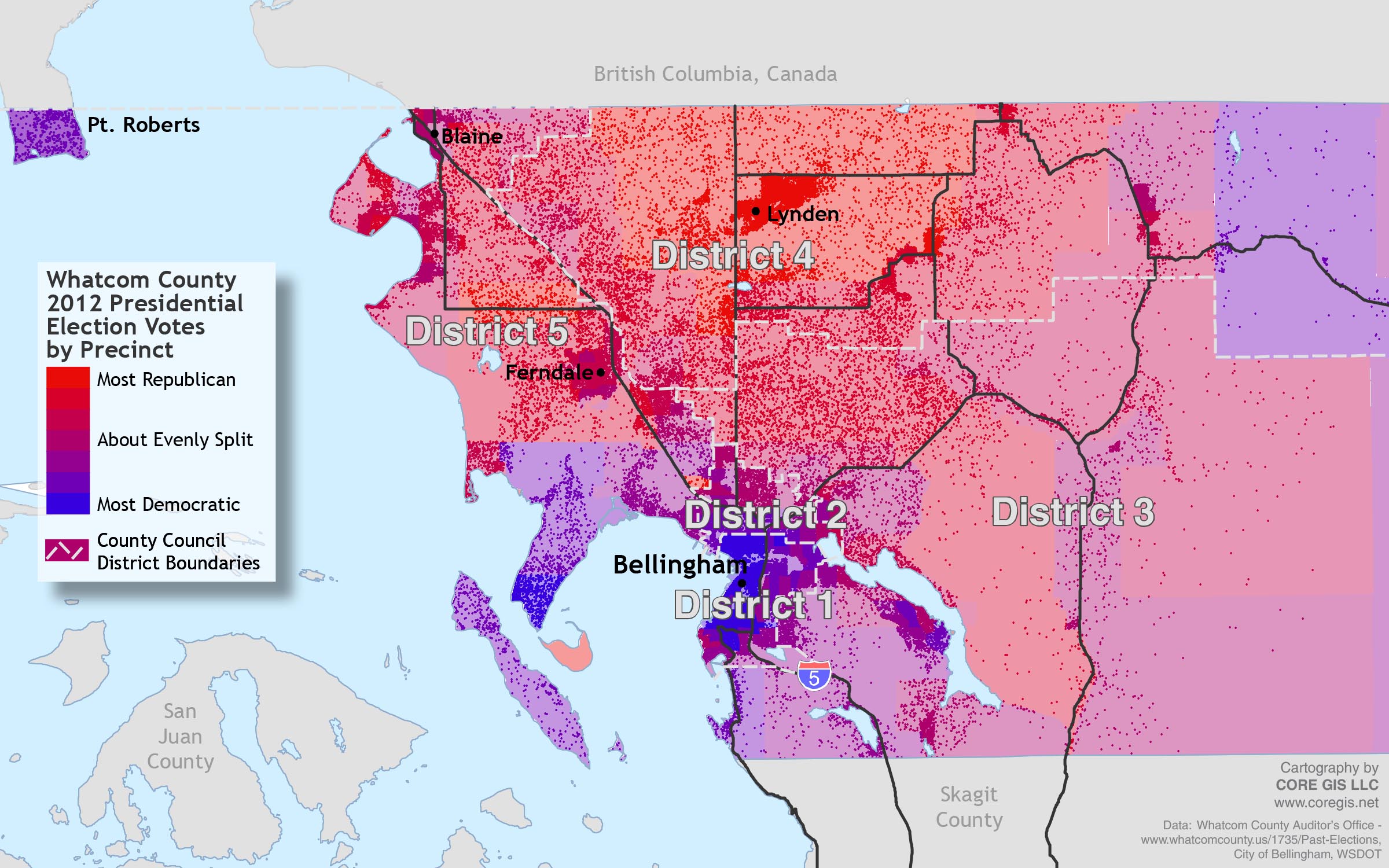
However, by retaining winner-take-all voting—where each councilor must win a majority of votes to win a seat—this voting scheme remains problematic. Voters with minority views will still not get representation on the council, and lesser-known candidates will still have little chance of getting elected.
1. Can I elect one or more councilors who represent my views?
You would get to vote for all seven council seats in general elections. Whether you lean Democrat or Republican, you would probably elect three or four councilors who represent your views. If your views fall along urban or rural lines, you would likely get to select two urban-minded councilors from Districts 1 and 2 and three more rural-oriented councilors from District 3, 4, and 5.
However, if you lean more Green Party, Tea Party or libertarian, you would likely continue to have limited or no options for electing a councilmember who reflects your preferences.
2. Will the council accurately reflect voters?
The council would probably continue to vacillate mostly between three to four Democrats and three to four Republicans, with some exceptions. Voters with third-party preferences would continue to have little or no voice on the council.
3. Will councilors be responsive to my concerns?
You would vote for every councilmember so all councilors would need your vote and need to respond to you.
4. Will councilors work together for the good of the county?
Yes, to the same extent they do now.
5. Will regular people be able to run for office?
Incumbents will continue to have a big advantage, and campaign costs will be much the same: higher in years with more important issue at stake and lower in other years.
Countywide voting is better than district-only
Countywide voting certainly beats out district-only. But just wait until the new guy enters the ring—next time, I’ll tell you about proportional representation and why voters in Whatcom and across Cascadia should be clamoring for a new match.


I suspected this was heading toward alternative vote-counting methods. This is a super tall order. Even ‘smart’ people have a hard time understanding it–it requires highschool math skills, which most people have forgotten by the time their twenty. Seriously though, this would probably require running a multi-yearlong grassroots campaign in a targeted entity. And, the principles probably have deep cultural flaws, like revenue-neutral ballot measures do, for example.
I think that voting is better for the people in that district and it gives some one from that district a chance to win.