Donate Newsletters

Hate Negative Campaigns?

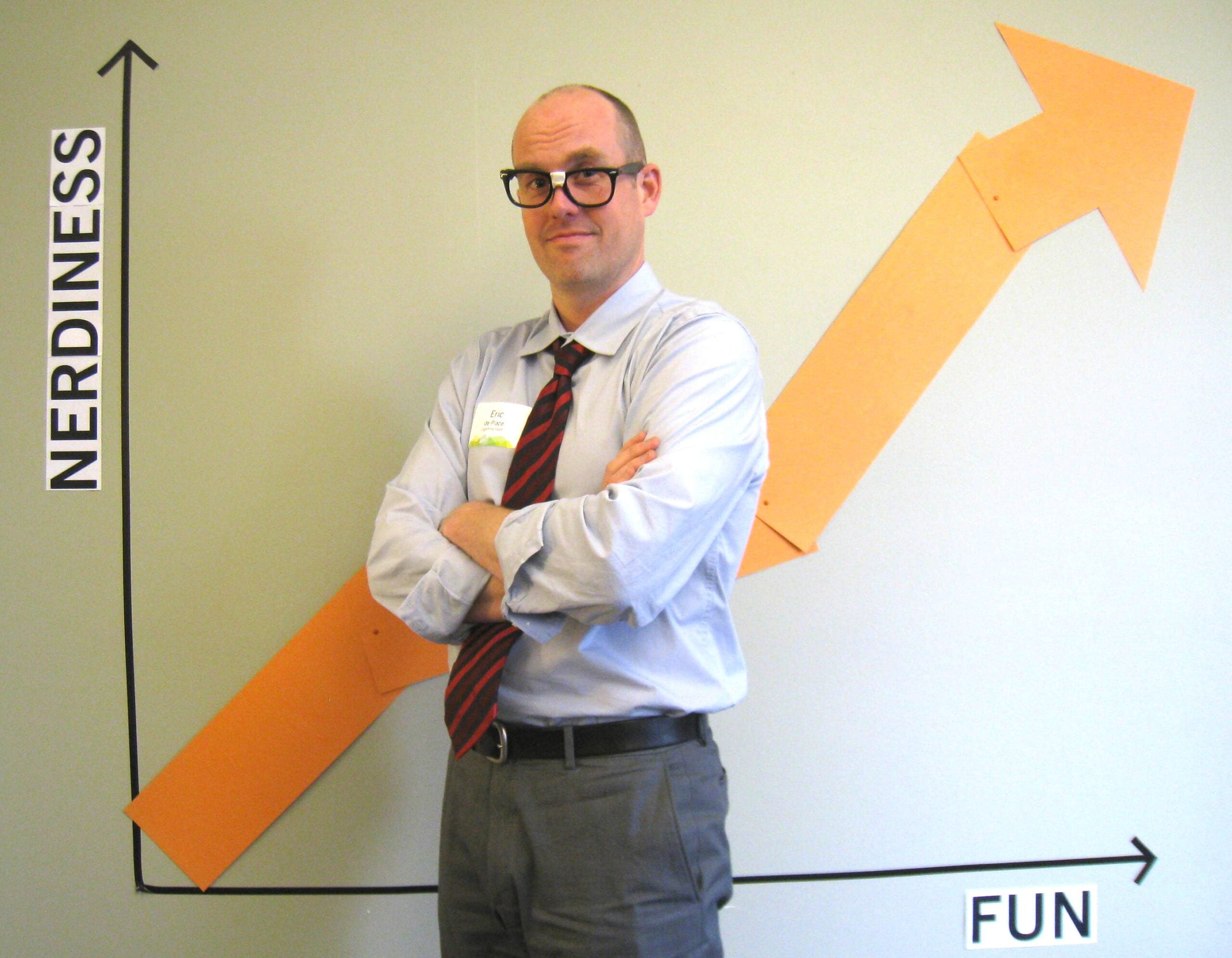
It’s tempting to think of politics in terms of personality problems: if only Obama were warmer, he might be able to break through Congressional gridlock. If only Dino Rossi weren’t such a hard-nose, he wouldn’t inspire such negative campaigns. But with wave after wave of negative campaigns, it seems the problem is not really politicians’ personalities. Maybe all politicians are not bad apples. Maybe our voting system is a bad barrel. The apples are fine when they go in; the barrel itself makes them rot.

In my last article, I explained the problems that winner-take-all voting creates: unrepresentative government that gives short shrift to women, racial minorities, and third parties, and the solution that multi-member districts and ranked-choice voting offers for generating proportional representation in which women, racial minorities, and political minorities have a voice in government proportional to their strength in the populace. In this article, I’ll show that winner-take-all voting spawns negative campaigns. But fair voting—multi-member districts with ranked-choice voting—creates more civil and engaging campaigns.

Problem: Campaigns are negative and divisive.

North Americans have a long history of outrageously negative campaigns, reaching back to 1800 when John Adams’ campaign called Thomas Jefferson a “mean-spirited low-lived fellow, the son of a half-breed Indian squaw, sired by a Virginia mulatto father” all the way to a more recent campaign in which Canada’s Conservative Party opened its home page with an animated puffin defecating on the opposition leader’s shoulder. It isn’t because North Americans are uniquely antagonistic; it is because winner-take-all elections inherently reward negativity.
Read more

Ridley’s Coal Exports: A Terminal Illness?

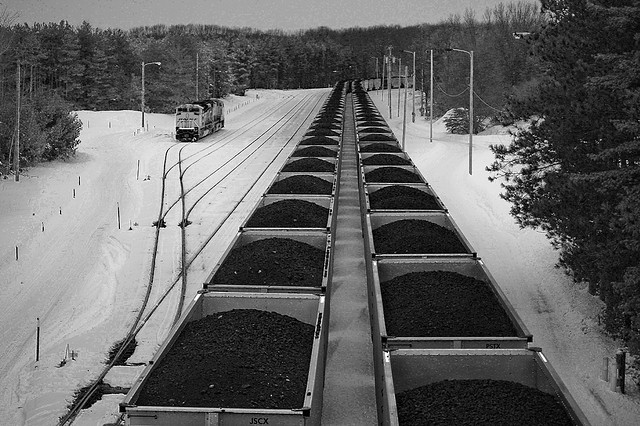
The Ridley coal export terminal in Northern BC, which has been suffering through a dismal year of collapsing exports in the face of weak international prices, recently published its 2014 annual report on its website.

And it’s a doozy.

Annual reports usually are written with a hint of sunny can-do optimism. They trumpet every shred of good news, present even the direst challenges as golden opportunities, and paint a vision of a bright and profitable corporate future.

But Ridley’s 2014 annual report is written differently. There’s no sunny optimism, just a litany of woes. You can’t read it without thinking that the authors are as depressed as the coal markets that are dragging down their business.

The sense of doom starts from the top.

Read more

No Taxation Without (Proportional) Representation!

If you put your money in a vending machine and punched in the number for trail mix, but it instead gave you a pack of gum, would you use that vending machine again? Unfortunately, voting in North America is often not so different from this vending machine. In the United States, most voters vote Democrat, yet the Republicans control Congress. Voters ask for trail mix but keep getting gum. In Canada, about 35,000 Conservative voters can elect a Conservative Member of Parliament (MP) to represent them, but it takes more than ten times as many—over half a million—Green voters to elect a single Green MP.

This is not how it’s supposed to work. Second US President John Adams believed the legislature “should be in miniature, an exact portrait of the people at large. It should think, feel, reason, and act like them. … [E]qual interest among the people should have equal interest in it.” In other words, the legislature should proportionally represent the people.

“Winner-take-all elections give the biggest block of voters 100 percent of the representation, and all the other voters get none.”

Here’s what an “exact portrait,” proportional representation, would look like: imagine people of different ideological stripes are different fruits and vegetables on a spectrum from orange to green. In Foodtown, 17 percent of voters are oranges, 20 percent peaches, 20 percent apples, 20 percent cucumbers, and 23 percent broccoli. If Foodtown elects a five-member legislature that is “an exact portrait of the people,” it would be one orange, one peach, one apple, one cucumber, and one broccoli.

Unfortunately, in Canada and the United States, winner-take-all elections give the biggest block of voters 100 percent of the representation, and all the other voters get none. In winner-take-all, also known as “first-past-the-post” or “plurality” voting, the candidate with the most votes wins, regardless of how many votes he or she gets. In an election with only two candidates, the winner will need a majority—half plus one—of the votes to win. With three candidates, the winner only needs a plurality of votes to win: one-third of the votes plus one; with four candidates, one-fourth of the votes plus one; etc.

If Foodtown was split into five single-member districts with winner-take-all voting, the biggest voting blocks would win all the seats, so Foodtown might elect five broccolis. Or, likely, Foodtown would get four peaches and one broccoli. In Oregon, 55 percent of voters are Democrats, yet Democrats hold 4 out of 5 Congressional House seats. In 2012, Americans voted for Democratic candidates by a 52-48 margin, yet gerrymandered single-member districts resulted in Republicans winning 57 percent of the House seats.

Read more

We Can’t Fix Anything Until We Fix Democracy

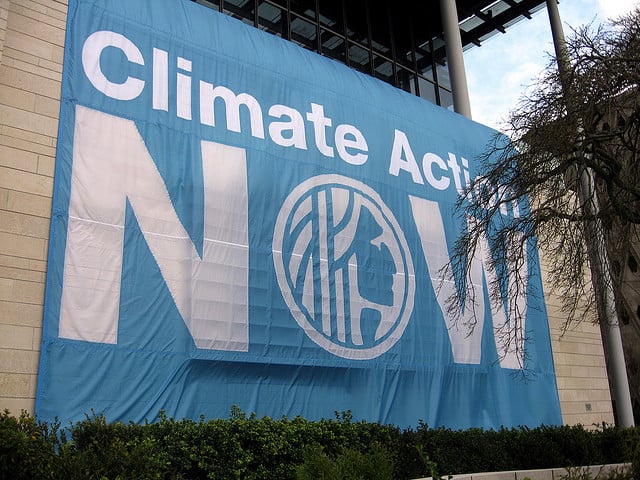
Grab the issue you care most about—climate change, sustainable cities, a fair economy, or something else—sit it down, look it in the eye, and tell it there will be no Christmas this year. Or next year, or the next—we cannot fix important problems until we fix democracy.

[prettyquote align=right]”Remove #corruption from elections, and #democracy will become responsive to citizens.”[/prettyquote]

Climate change should be imminently solvable. We know which policies work. We have clean technologies, and people want to fix it. But none of that matters if government doesn’t represent the people. If government is implementing policies and propping up industries because they are lucrative for a small group of plutocrats, then no amount of public demand or technology solutions will help us solve climate change. Or any other issue that we care about.

We need a government that represents the people.

Professor Larry Lessig eloquently explains that the root of the problem, the fundamental corruption of US democracy, is elected officials’ dependence on the tiny number of wealthy funders who control elections. Remove corruption from elections, and democracy will become responsive to citizens.

But there is more than one root.

Read more

Oil Train Explosions: A Timeline in Pictures

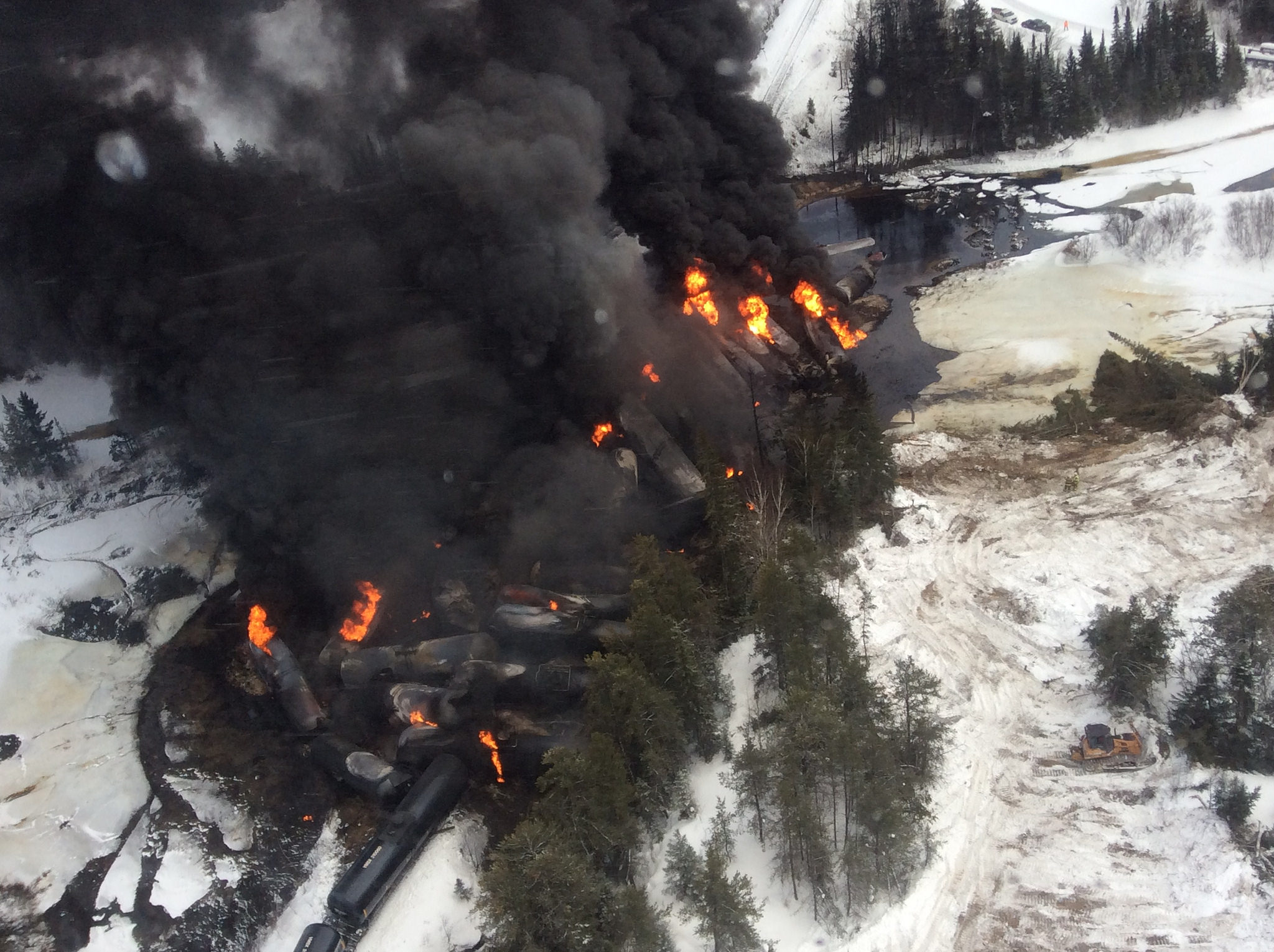
At 7:15 this morning, yet another crude oil train erupted into an inferno, this time near a small town in central North Dakota. As these wildly dangerous trains continue to explode—at least 10 in the last two years—it’s become challenging to keep track of them all. So, for the record, we’ve assembled here a pictorial timeline of North America’s bomb trains.

Last week, the Obama administration adopted new regulations that will phase out many of the most hazardous tank cars over the next five to six years. The regulations also substantially reduce public oversight of train movements and industry behavior.

We will update this post as new explosions occur.

The Thin Green Line Grows Stronger

Important update 5/8/15: The news just keeps getting better. In a stunning reversal, Portland Mayor Charlie Hales withdrew his support for a large propane-by-rail terminal in the city. The Willamette Weekly calls it a “death sentence” for the project. As the Oregonian reported, “At some point, those of us in power have to listen to those who put us there,” Hales said in an interview. It’s a huge—and hugely surprising—win for the opposition movement to Northwest fossil fuel exports.

Yesterday at the annual Climate Solutions breakfast, Seattle Mayor Ed Murray demonstrated what the Northwest means for big fossil fuel expansion plans. Expense. Delay. And ultimately, failure.

In February, the Port of Seattle surprised everyone by rushing through a secretive lease arrangement to host Shell Oil’s Arctic drilling fleet for maintenance in preparation for a summer of drilling the Chukchi Sea bed off Alaska’s North Slope. The move earned bracing admonitions from nearly every environmental group in the state. Local activists are turning out more than a thousand people at opposition rallies, submitting more than 8,000 critical comments, and generating national media attention as they take on the most profitable industry on the planet.

On stage yesterday, the mayor revealed that he had a surprise of his own in store. He announced that the city’s planning department had found that hosting the drilling fleet would violate the Port’s existing land use permits. If the Port wants to proceed with its unpopular and environmentally destructive plans, it must apply for a new permit. In a way, the mayor was actually handing the Seattle Port Commission a huge opportunity: a second chance to do the right thing.

Read more

Six Pictures that Illustrate the Staggering Growth in Oil by Rail

Trains have come to play an increasingly large role in North American oil transport over the last several years. Now, with a recent flurry of online publications from the US Energy Information Administration, we have data that illustrate just how profound the shift has been in the United States.

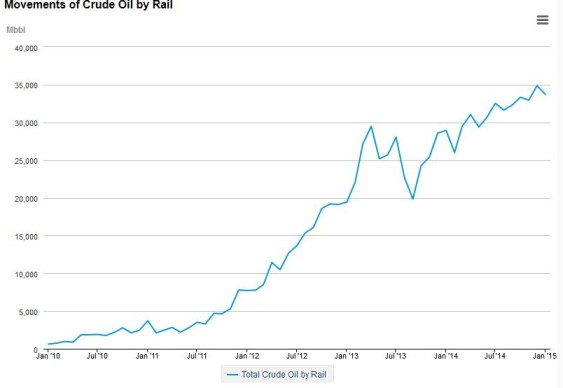
Crude oil by rail shipments have skyrocketed from just over 20 million barrels in 2010 to more than 373 million barrels transported in 2014.

Total crude by rail (thousands of barrels per month). Source - US EIA.
Total crude by rail (thousands of barrels per month), by US EIA

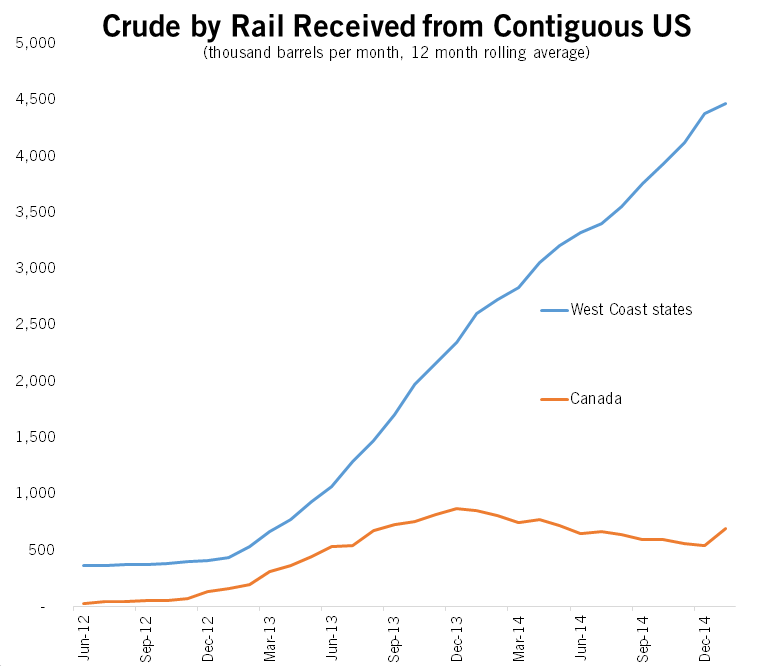
The growth in crude by rail has been, so far, mostly a US domestic phenomenon. The volume of crude transferred by rail from destinations and to origins within the contiguous United States has been on a steep ascent, while imports from and exports to Canada have grown more modestly.

Read more

VIVA Vancouver Reimagines Urban Streets

Robson Street, a major arterial in downtown Vancouver, BC, can be two very different places. On a Saturday in late summer, I found an entire block of Robson closed to cars and filled with people, some lounging on wooden benches under big yellow umbrellas. Amazing smells wafted from nearby food trucks, and a crowd gathered to watch an artist create a replica of the Mona Lisa on the pavement. The following Monday, the block had reverted to its typical configuration, with car traffic on the roadway and pedestrians crowding the sidewalks. I could make out only a hint of the artwork painted on the asphalt just two days earlier.

Read more

Be a Champion on May 5

The Northwest is full of champions, from our winning sports teams, to the masses of sustainably minded and socially aware folks who populate our evergreen cities and towns. These heroes work to make our communities dynamic and equitable. We are grateful for the chance to team up with so many smart, committed friends who champion our shared cause to make the Northwest a global model of sustainability. It’s people like YOU, our dedicated readers, supporters, and allies, who make Sightline’s work possible.

GiveBIG’s Day of Champions is the perfect time for you to join forces with thousands of donors across the region and support Sightline’s sustainability research, communications tools, and news service. Save the date and give to Sightline here on Tuesday, May 5 in order to have your gift amplified.

Curiosity piqued? In case you’re wondering…

Read more

Weekend Reading 5/1/15

Nick

A new map from Pembina Institute highlights over 14,000 jobs from clean energy in B.C.​ and allows users to explore 156 renewable energy projects currently in operation or under construction. This first phase of the map specifically examines jobs from clean energy supply; the next phases will examine the bigger clean energy picture, including jobs in energy efficiency, green buildings, and clean transportation.

Serena

“There was a wreck on the highway—and the wreck is our agricultural system.” Remember that truck full of bees that overturned on I-5 in Seattle a few weeks ago? From my ever thoughtful honey provider, Urban Bee Company, a beautifully written, sobering, big-picture call to action on the real bee emergency.

Baltimore is the latest city to rise in answer to state violence and police brutality. From Ta-nehisi Coates, reflections on nonviolence:

When nonviolence is preached as an attempt to evade the repercussions of political brutality, it betrays itself. When nonviolence begins halfway through the war with the aggressor calling time out, it exposes itself as a ruse. When nonviolence is preached by the representatives of the state, while the state doles out heaps of violence to its citizens, it reveals itself to be a con. And none of this can mean that rioting or violence is “correct” or “wise,” any more than a forest fire can be “correct” or “wise.” Wisdom isn’t the point tonight. Disrespect is. In this case, disrespect for the hollow law and failed order that so regularly disrespects the community.

Read more

×
Privacy Overview
Sightline Institute

More information about our privacy notice

Strictly Necessary Cookies

Strictly Necessary Cookie should be enabled at all times so that we can save your preferences for cookie settings.

3rd Party Cookies

This website uses Google Analytics to collect anonymous information such as the number of visitors to the site, and the most popular pages.

Keeping this cookie enabled helps us to improve our website.

Additional Cookies

This website uses social media to collect anonymous information such as which platform are our users coming from.

Keeping this cookie enabled helps us better reach our audiences.