

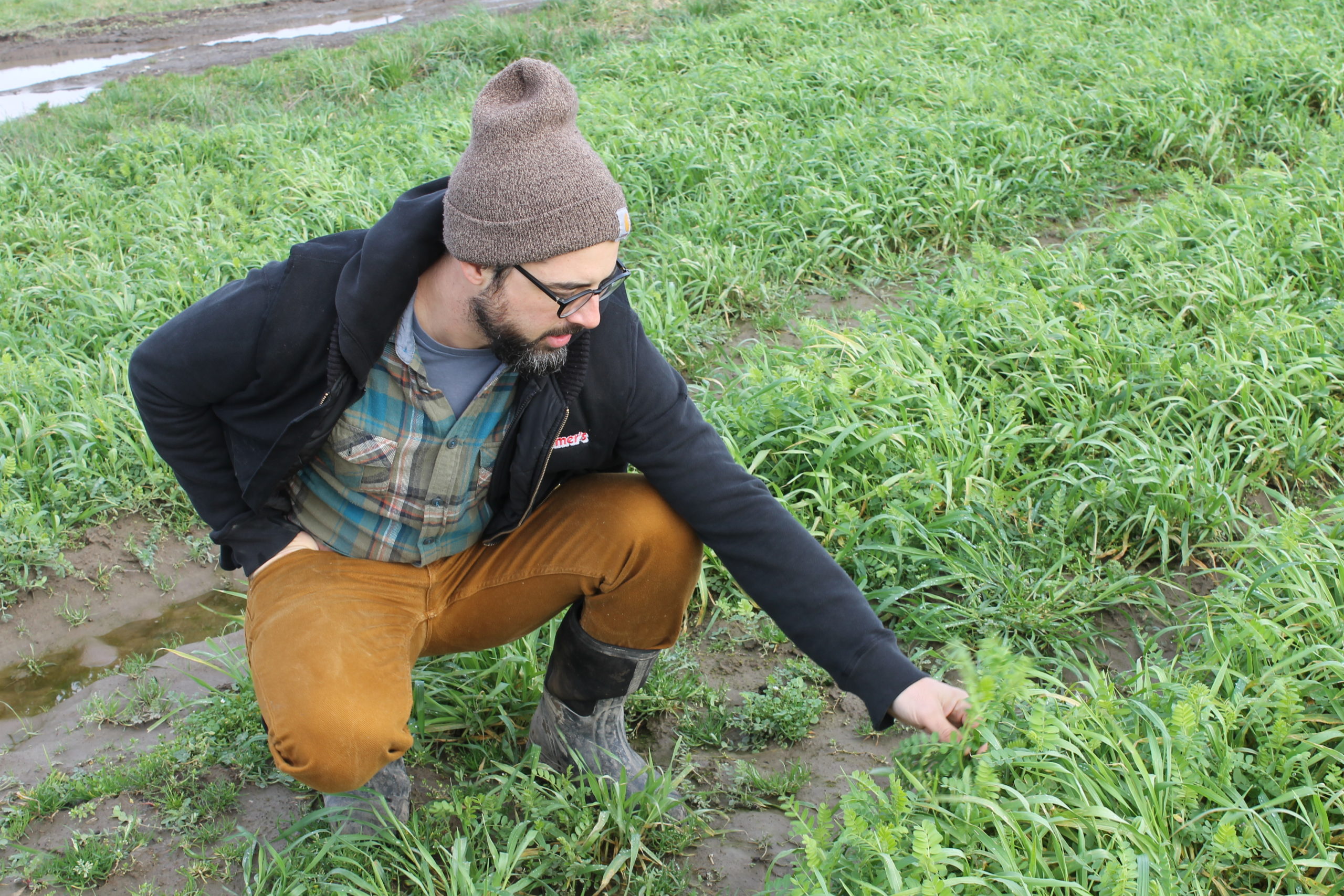
After harvesting 40,000 pounds of winter squash last October, Giana and Matthew Cioni did something unusual: they started planting again. Most fields across the region sat empty after harvest, vulnerable to heavy winter rains that wash away rich topsoil. But those at The Crows Farm, outside Mount Vernon, Washington, lay snug, protected by a web of fast-growing grasses and legumes. The couple believe the second planting will benefit their production over the long term, even though the extra labor and expense bit into their bottom line. But planting cover crops had a second benefit that paid off for the region this year: it kept nearby waterways cleaner.
Soil isn’t the only thing winter rains wash off fallow fields. Persistent rainfall also carries fertilizer residue into surface waters, or else drives it deep into the soil, where it can enter groundwater. Nearly half of Pacific Northwest watersheds carry high toxic loads from fertilizer runoff. Recent studies link drinking water heavy in nitrates, a byproduct of nitrogen fertilizer, to a host of chronic illnesses, including cancer, insulin-dependent diabetes, and fertility complications.
Across the United States, nearly six million people drink from water systems with elevated nitrate levels, a number which does not include households on private well water, for which there is no consistent testing standard. Latino residents living in rural areas disproportionately bear the exposure to this toxic discharge.
While fertilizers are by no means the only source of nutrient pollution in Cascadia’s waterways—leaky septic tanks and manure effluent add to the load—they are a ubiquitous one. And one with a cost-effective solution.
Winter covers crops soak up rains along with the fertilizer leftover after harvest.

Winter covers crops, like those at The Crows Farm, soak up rains along with the fertilizer leftover after harvest. In the process, the covers reduce nitrate leaching by up to 70 percent, offering tremendous benefits to the water-drinking public.
In addition to the public health benefit, Matthew and Giana plant cover crops for the on-farm benefits, as the practice can boost soil resilience to a range of risks. Perhaps most importantly, over years the practice can double soil water holding capacity, a key defense against drought. Unpredictable precipitation patterns pose one of the greatest risks to regional food production in the coming decades. Cover cropping can also minimize other liabilities, like weed pressure and soil erosion. But these on-farm benefits accrue only gradually over years.
For most producers, the hope of long-term benefits does not outweigh the up front costs and risks. Cover crop seed alone stretched the Cioni’s seed budget by a fifth last year, a big investment for their eight-acre operation, especially for something with an uncertain return. In the United States, farmers plant cover crops on about five percent of annually cropped fields. Pacific Northwest farmers do so at about half that rate.
Cover cropping remains rare because it presents a mismatch between costs and benefits: farmers bear the up front costs and risks of planting and managing cover crops, while the largest near-term benefits accrue to the public. Reducing the cost to farmers can help minimize the divide, yielding both public health benefits and growing a more resilient food system.
Several other states fund cover cropping initiatives that compensate producers for as much as 90 percent of the seed, labor, and equipment costs required to sow and manage cover crops. Many of these ambitious programs have tripled annual cover crop acreage within a handful of years. And the programs are a shockingly good deal, with a price tag of about $8 per pound of avoided nitrate pollution, a fraction of the cost of other methods of preventing nutrient runoff. It’s time to bring this model to the Pacific Northwest.
The stubborn cycle of fertilizer loss
Conventional, industrial agriculture has many inefficiencies, but here’s one of the most surprising realities: many crops use only about half of the nitrogen fertilizer farmers apply each year. Nearly all the rest ends up in local waterways.
In the Pacific Northwest, ground and surface water in the most intensive agricultural zones carry the highest nitrate loads, particularly in the Willamette Valley, and parts of the Columbia and Snake river basins.
Uncertainty about crop needs year to year drives the heavy application—in good weather years, crops can soak up more nutrients and produce bumper yields. But farmers frequently apply most fertilizer at the beginning of the season, when they have best access to the field. If the weather proves less favorable, the plants won’t use as much fertilizer and more will go down the drain. But the cost of losing out on a bumper harvest is far higher than the cost of preemptively over fertilizing.
Crop needs even vary within a single field as soil micro conditions shift. Most research on reducing fertilizer runoff has concentrated on developing precise application techniques combined with granular soil quality data, but collecting that data is expensive and time-consuming.
Rising costs of nitrogen fertilizer have led to some improvements in efficiency in recent decades. Though taxing fertilizers further could tip farmers towards more judicious application, it could also have negative consequences. Making the price too high could ultimately reduce food production and drive smaller farms, with slimmer financial margins, out of business. Instead, managing fertilizer loss could reduce the damage to public and environmental health. And that’s where cover crops come in.
Cover crops slash toxic runoff at a low cost
Cover crops interrupt the pollution pathway, transforming the typically slick sheets of bare winter fields into obstacle courses that slow the water’s flow.
Cover crops interrupt the pollution pathway, transforming the typically slick sheets of bare winter fields into obstacle courses that slow the water’s flow. Legumes and grass roots bore pores into the soil surface that act as chutes for rainwater. Once below the surface, the living roots of the cover slurp up the moisture, along with the excess nitrogen, trapping it, and reducing nitrate leaching by 40 to 70 percent.
The practice offers the most cost-effective means of on-farm nutrient capture. In 2019, Maryland’s state-funded cover crop incentive program diverted 2.5 million pounds of nitrogen from the Chesapeake Bay, at a cost of about $8 per pound. Other on-farm nutrient diversion projects, like planting filter strips and field borders, tend to cost several times this amount.
Dealing with the pollution after it leaves the farm is even more expensive. Washington’s Department of Health spends millions funding new well connections in communities across the state where existing groundwater sources exceeded safe nitrate levels.
Cover crops grow resilient soils
In addition to the public cost savings, the spongier fields pay their dividends forward for the farm. In the spring, Giana and Matthew tilled the winter’s cover crop back into the soil, treating it as a ‘green manure’ to feed their fields before planting the next crop.
The soil health benefits of the practice compound year after year as the accumulation of previous covers builds organic matter in the soil. In some cases, long-term cover cropping can double a field’s water holding capacity, a benefit producers highly value as weather patterns grow increasingly unpredictable.
Covers also dramatically reduce soil erosion—slashing it by as much as 80 percent. Left unabated for decades, soil erosion can turn a productive field into a wasteland.
The practice offers other on-farm benefits, too. The fast-growing dressings outcompete weeds which easily take hold on fallow fields. Over years, the natural weed competition can reduce herbicide needs. In addition, the green manure tilled into the soil before spring planting can carry forward some of the excess fertilizer to feed the next crop, though this benefit varies by location, crop, and year.


 Before we dive into our findings, a quick note about corporate emissions will help make our analysis intelligible. Carbon analysts generally break down corporate emissions into three categories: