
Donate Newsletters

Citizens Re-United?

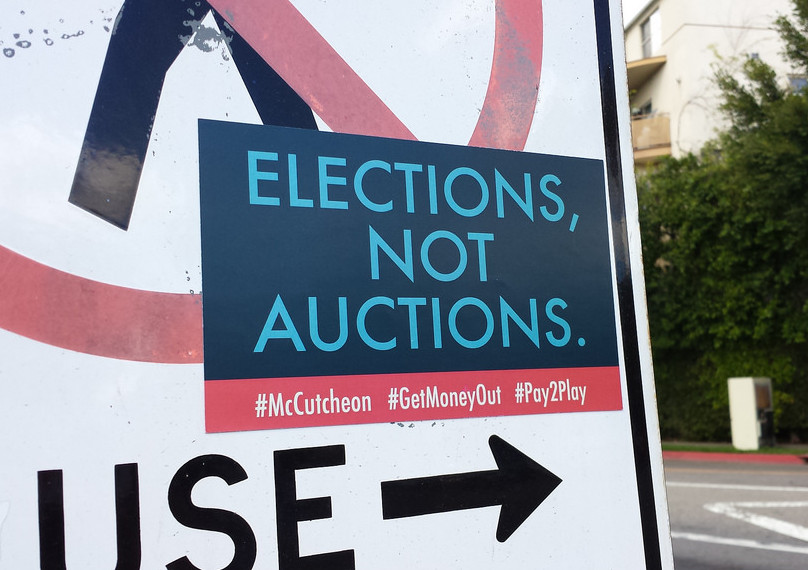
A demonstrator after the McCutcheon decision, Los Angeles, CA. By Public Citizen, cc.
A demonstrator after the McCutcheon decision, Los Angeles, CA. by Public Citizen used under CC BY-NC-SA 2.0

When the conservative majority of the US Supreme Court this week blew up the legal caps on the contributions the richest Americans can make to political parties and federal candidates, it was Citizens United redux: champions for those richest Americans gloated in newspeak about “free speech,” political reporters predicted even more private money flooding the air waves with attack ads, and reform leaders issued outraged statements. Most people, though, just shrugged, despondent but unsurprised, rolling their eyes in a giant, collective “what did you expect?” To most people, the whole system has long seemed rigged by the rich and powerful, and hope for reform is close to nil.

The vagaries of fate are such that the Northwest, especially Oregon and Washington and even more especially Seattle, are positioned to lead the national response to this latest travesty from the bench. They could do so both symbolically and practically, at the ballot box in both cases: by voting against the court’s ruling and then by creating a whole new way of paying for campaigns.

Wrecking Crew

The McCutcheon decision extended the money-is-speech-and-speech-is-sacred logic of Citizens United, and the Court majority gave no indication it is done using that logic to demolish campaign finance regulations. Eventually, the majority may smash others too: the ban on direct gifts from corporations to candidates, for example, and the limit on how much you can give to an individual pol.

Already, the Court’s wrecking crew has made these restraints largely irrelevant. Thanks to Citizens United, anyone, including a corporation, can spend unlimited sums, anonymously, on spuriously named “independent expenditure campaigns.” McCutcheon opens the door to a scam that eviscerates the direct-gift cap: candidates can solicit multi-million dollar gifts for their “joint campaign funds,” then parcel out the proceeds to members of their caucus. Those caucus members can reciprocate, tit for tat. Presto! Each candidate ends up with as much money as she or he raised from each billionaire. (In his vehemently dissenting opinion, Justice Breyer spelled out several other ways that candidates can waltz right past the individual gift limit, thanks to the majority’s see-no-evil ruling.)

Read more

Will Oregon Cook Up a Carbon Tax?

The BC recipe for carbon pricing looks something like this: Take a carbon tax and mix it with corporate and personal income tax reductions; keep it simple; slowly shift the tax burden from income to carbon pollution over time.

Is Oregon the next place this dish will show up on the menu? Governor Kitzhaber is running for re-election on a platform that prominently includes tax reform. “It’s got to be on the agenda,” he told state business and labor leaders, “and it’s my intention to put it squarely on the table.” Kitzhaber has not yet committed to proposing a carbon tax, but he’s considering it.

Last year, the legislature in Salem passed a study bill specifically focused on “the feasibility of imposing [a fee or tax on greenhouse gas emissions] as a new revenue option that would augment or replace portions of existing revenues.”

The study itself will not be completed until November, but the state has awarded the contract to Northwest Economic Research Center (NERC), headed by Portland State University economics department chair Tom Potiowsky, who previously spent a decade as the Oregon state economist. NERC has already conducted a preliminary report on carbon pricing in Oregon.

The key takeaway from that report was that environmental tax reform can benefit the economy and reduce emissions. “The report shows that putting a price on carbon in Oregon can result in reductions in harmful emissions and have positive impacts on the economy,” it says. Elsewhere, it notes, “[A] BC-style carbon tax and shift could generate a significant amount of revenue and reduce tax distortions while creating new jobs and reducing carbon emissions. The specifics of the tax shift program are key to ensure equitable distribution of costs and benefits, as well as preserve the strength of the price signal.”

Here are some targets to keep an eye on as the state moves forward:

Read more

A New Measure of Food Deserts

The concept of a “food desert“—a place where residents have little access to healthy, affordable food—can seem somewhat alien to the well-off. If you’ve got your own car, living close to a grocery store just doesn’t matter much: you can always drive a bit and stock up with a big load of groceries! But if you don’t have a car, fresh, healthy food is often simply out of reach. Taking a cab to the store is expensive; walking or transit can take too much time, or simply be too much of a hassle. So for many car-free folks living in food deserts, the only real options are processed foods from convenience stores, or else fast food meals—typically, the sort of inexpensive, energy-dense, nutrient-poor foods that contribute to North America’s obesity epidemic.

But even though there’s an emerging understanding that food deserts are a significant public health concern, there’s little academic consensus on how to define and identify them…which can make it hard for policymakers to even find food deserts, let alone decide what sorts of policies might help fight them.

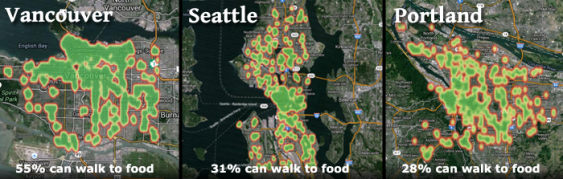
Enter Walk Score. They’ve constructed a new tool that offers basic maps of food deserts: places where residents can’t get to a full-service grocery store within a 5 minute walk. The tool could make a huge contribution to the healthy food movement, since it gives everyone—policymakers, activists, and ordinary citizens alike—a simple measure and a starting point for a discussion about food access.

Just as important, Walk Score’s tools introduce a bit of healthy competition into the food desert discussion.  Take a look, for example, at the three largest cities in the Pacific Northwest.

Cascadia big city food deserts


Read more

The Thin Green Line

The Pacific Northwest stands squarely between the most voracious energy markets in the world and huge fossil fuel deposits in the interior of North America—Powder River Basin coal, Bakken shale oil, Alberta tar sands, and remote natural gas fields. Big energy companies plan to unearth these vast reserves of carbon-intense fuels and put them up for sale in Asia.

If they are successful, these energy firms will unleash the carbon equivalent of roughly five Keystone XL Pipelines. But to get their products to market, energy companies first have to build new terminals and pipelines to move all that fuel. They need destinations for the scores of oil and coal trains that they plan to run across the Northwest, and they need right-of-ways to lay new pipelines.

In short, they need our permission.

So it is by geographic accident that the Northwest, perhaps the greenest corner of North America, will play an outsize role in determining the planet’s climate future. Will we double-down on coal and oil use, thereby jeopardizing our chance at a stable climate? Or will we act as a thin green line, insisting that we must do better—that our economy and our children demand a cleaner future?

To illustrate the threat—and the enormous opportunity—Sightline is proud to release a new video animation by Don Baker.

Read more

The G-Word

Here’s a Rorschach test. I’ll show you a word. You say the first thing that comes to mind.

The word is “government.”

Stop. Go down to comments and record your reaction.

Now, I’ll tell you what your answer means about you. If you’re like many of the friends I’ve asked, your answer is not typical. They said things like “protects,” “services,” “rule of law,” and “us.”

If you’re more normal, you said something less flattering. The most common answer among Americans is a derisive laugh. Yep. A laugh. The G-word qualifies as a one-word joke. Other common answers include snorts of disdain and words like “corrupt” and “waste.” One friend said “sociopaths”; another, amusingly, said “statues.”

Read more

3 Charts: Bus Cuts Drive Riders Away

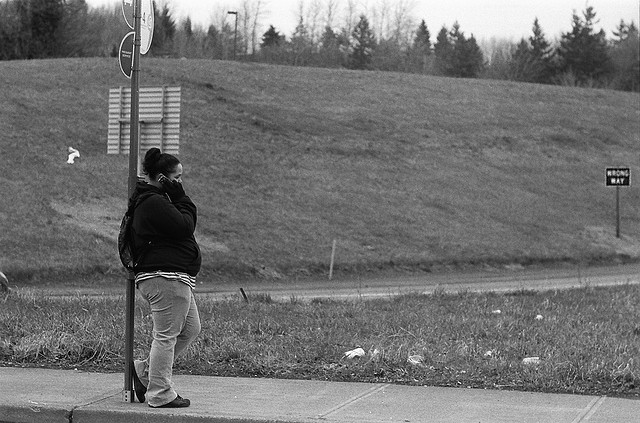
Bus wait

Seattle recently got accolades for being one of the US cities with significant growth in transit ridership. This mirrors a national trend in which more people rode buses, trains, streetcars and subways last year than at any time since 1956.

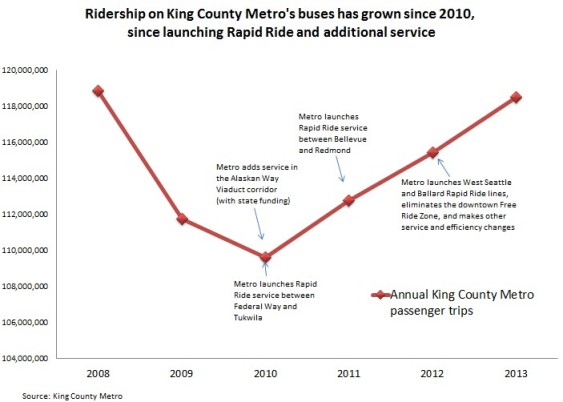
A good part of that bump came from Sound Transit. But King County Metro’s bus ridership also grew by 3 percent last year, and it has nearly reached the record levels the agency hit in 2008 before the latest recession drove ridership numbers down.

Yet several Cascadian neighbors, namely Portland and Tacoma, haven’t had that same experience. Portland’s bus ridership remains about 10 percent lower than its pre-recession peak, and Pierce Transit’s ridership has dropped by more than 30 percent.

What’s the difference? Bus cuts.

King County voters will decide on April 22 whether to approve Proposition 1, which would make needed investments to fix local roads and prevent an up to 17 percent cut in bus service. We can see from other places that significantly cutting transit service is one of the quickest ways to turn a region with healthy growth in transit ridership—which takes cars off our roads and allows the region to grow without adding to our pollution and traffic and health burdens—into a region where significant numbers of riders simply give up on transit and get back in their cars.

But first, let’s look at what King County’s experience has been over the last five years.

Original Sightline Institute graphic, available under our Free Use Policy

Read more

CRC Seismic Retrofit: Down the Memory Hole

You can’t make this stuff up. From yesterday’s Oregonian. Bruce Johnson, Oregon’s state bridge engineer…said no one has estimated the cost of seismically retrofitting the Columbia River bridges, but he believes a project would be extremely expensive. A new substructure would have to be built under the existing bridges for perhaps $500 million or $600 … Read more

Event: Sightline in Vancouver, WA, on Fossil Fuel Exports

Coal train in White Rock, BC, Canada. Credit AaverageJoe.

We don’t get down south as often as we’d like, but next Thursday, February 6, I’ll be on WSU Vancouver’s campus, joining the Center for Social & Environmental Justice as one of two speakers on fossil fuel exports out of the US Northwest and Canada.

I’ll talk from 12-1:15 p.m. on the climate impacts of Northwest fossil fuel exports, as well as the threats that shipping them poses to our communities. Then, stick around, because from 1:25-2:40, University of Alberta political science associate professor Dr. Ian Urquhart will go in-depth on the fate of Canada’s tar sands.

Have a friend who’s never heard of the coal and oil exports issues? Want some takeaway facts and stats to share in your community? Just want to see me in person? (Unlikely, I know.) Then this is the perfect lunchtime event for you.

Read more

Transit Score: Buses Matter

They’re out! The cool kids over at Walk Score just posted their all-new 2014 Transit Score rankings with data on transit service in more than 200 cities across the US. And in good news for the Northwest, Seattle’s Transit Score ranks 7th among all large cities, trailing only New York, San Francisco, Boston, DC, Philly, and Chicago. Portland, meanwhile, ranks 10th. (Note that Transit Scores only rank transit within city limits, and don’t cover suburbs or surrounding municipalities, and that I’m counting cities with at least half a million residents as “large.”)

There’s good news beyond the Northwest, too: on average, Transit Scores have inched up a bit since 2012—suggesting that more people are living closer to frequent transit service.

The bad news, though, is that both Seattle and Portland saw their Transit Scores fall over the last two years.

I was lucky enough to get an early peek at the raw data, which provided a fairly fine-grained look at the trends. As it turns out, Portland’s drop was so small that it probably doesn’t mean much. But Seattle’s Transit Score fell by more than a full point (technically, 1.3 points, but it winds up looking like 2 points because of rounding). That’s one of the largest drops among the 80 cities that had Transit Score rankings in both 2012 and 2014.

So what gives? Why did Seattle’s Transit Score dip?

Read more

Give Sightline Some New Year’s Resolutions!

Last year was a big one for Sightline. It was our 20th anniversary; we published the e-book Unlocking Home; and we continued to make waves on issues ranging from coal and oil exports to parking rules to ridesharing regulations, and more. All in all, it felt pretty great. But we want to know how it … Read more

×