Donate Newsletters

A New Anthology of Northwest Voices

I’m looking forward to my evenings this winter because I’ll be settling in with Cascadia: The Life and Breath of the World, a new anthology of Northwest writers and artists put out by the University of Hawaii Press. Many of the region’s better-known voices are included, but this isn’t a volume of greatest hits. It’s … Read more

Going Postal 2013

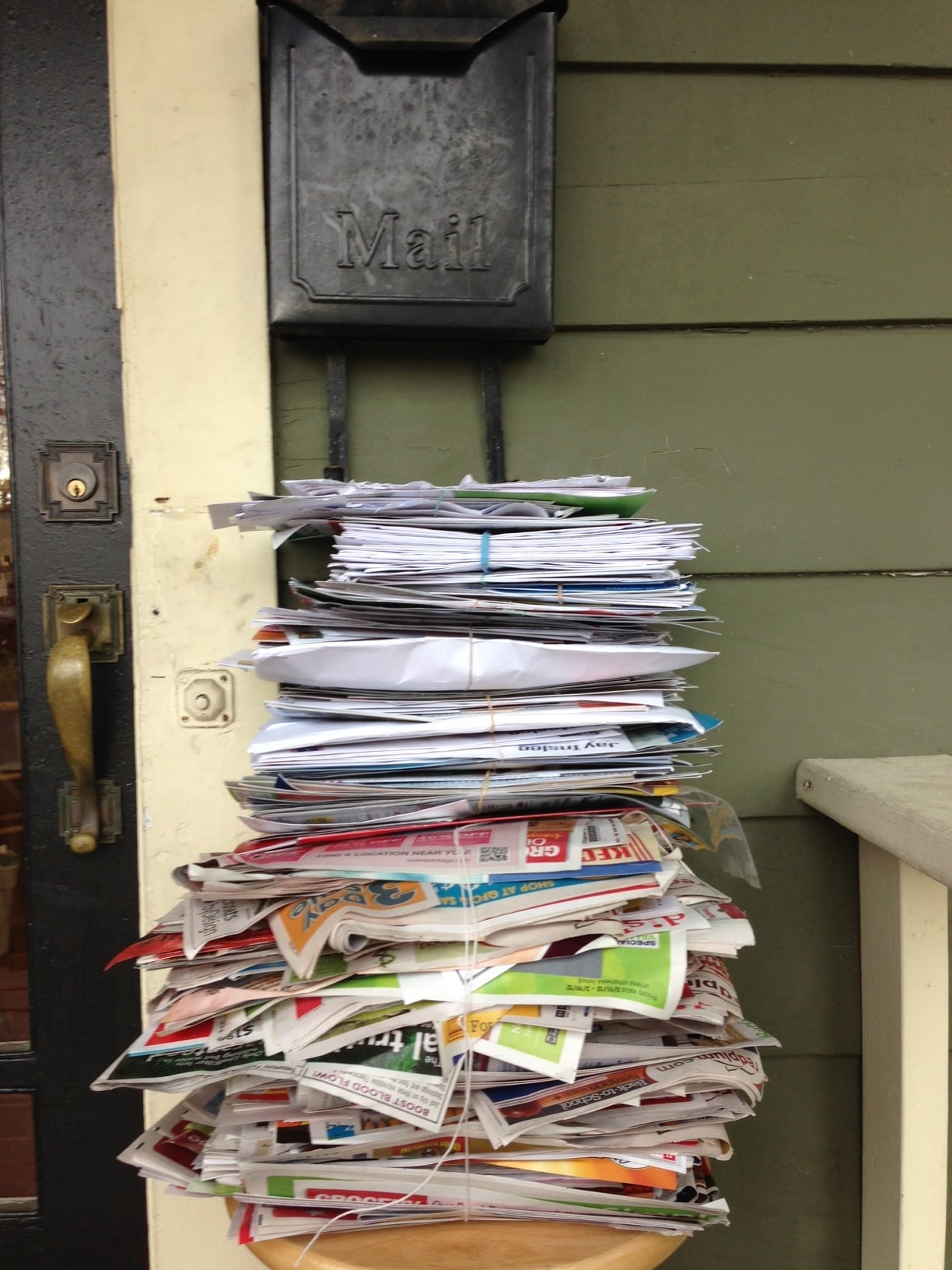
Thirty-three pounds of junk mail in 2012.

You see that picture? That’s one whole year of my junk mail. Almost 33 pounds of it. A 20 inch stack of expensive, forest-destroying, unwanted trash.
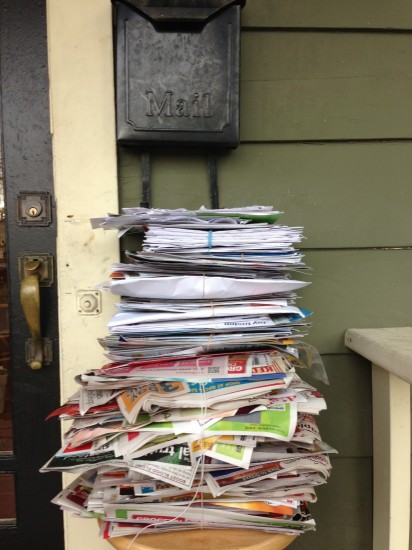
Thirty-three pounds of junk mail in 2012.

And that’s nothing! I’m five years into a crusade to defend my little mailbox from paper spam. A typical Seattle household gets three times as much: 100 pounds a year. In 2009, when I last did a 365-day count, my stack was four inches taller and weighed in at 50 pounds. That was after I’d already spent hours beating back the onslaught with the help of Catalog Choice, the de-junking website. I’ve done more of this tedious work since, opting-out online and calling customer service numbers, and I’ve pushed my tally down first to 33 pounds (for calendar year 2012) and, in the most recent six months, to the equivalent of 26 pounds per year.

Progress, yes, but it’s still an obscenity—to have to work so hard to keep other people from putting litter on my property. It’s also a drain on our communities: hauling away junk mail costs US cities and towns about a billion dollars a year.

Conclusion? Unchanged since 2009: we need a Do Not Mail Registry, just like the Do Not Call registry. Changed dramatically since 2009, however, is the overarching trend: US mail volume is in free fall. More on that below.
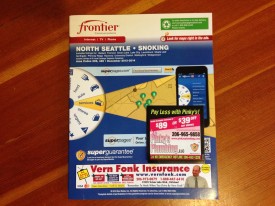
Frontier Yellow Pages, by Alan Durning
One phone book slipped through in 2013.

The big win in the stack pictured above, which shows my ad-mail from calendar year 2012, was the complete absence of phone books. From 15 pounds and six books, I went to zero. Seattle’s Yellow Pages Opt-Out program worked! Unfortunately, in my 2013 stack (which covers the six months after I spent May aggressively unsubscribing to junk mail), one small phone book appeared, from Frontier Communications. I checked Catalog Choice and saw that I’d already told Frontier to skip me. If Seattle’s Yellow Pages law were still law, Frontier could have been fined for ignoring my request. Unfortunately, the Yellow Pages industry won a court challenge, so the fines are no longer in effect. Aggravating! Naturally, I have torn up the Frontier book and folded its yellow paper into a voodoo doll. I’ve been spending evenings tossing it in the air and catching it on my ice pick.

Read more

Talking Politics on Turkey Day

Elaine Mejia, Senior Program Associate at Public Works—a communications think tank fostering a more positive national discourse and public will around government and taxes—reminds us that turkey, dressing, and cranberry sauce are, unfortunately, often served up with a “heaping side dish of heated, unpleasant conversation about government and politics.”

Whether it’s the wine or the tryptophan or just…family dynamics, these holiday discussions can go terribly wrong. But with a solid game plan, we can all do our part to keep Turkey Day festive and, just possibly, while we’re at it, make a little progress reinforcing government as our best tool for coming together and making everybody’s lives better.

Of course every good quarterback knows delivery is key—and that means finesse. It’s a reminder that we can foul out too soon if we let our tone get angry or accusatory or defensive.

Anyway, the rule for talking politics at Thanksgiving is that it’s not about winning—or even about touchdowns or tackles—it’s about a productive conversation that moves the whole team forward. (Mejia’s football analogy should get her an MVP.)

I recommend reading the entire pre-game pep talk over at Public Works. But here’s a run-down of day’s best plays:

Filibuster Win!

The US Senate took the unprecedented step this week of revising its filibuster rule by simple majority, to allow confirmation of most presidential nominations free of filibusters. “The change is the most fundamental shift in the way the Senate functions in more than a generation,” said the New York Times. The implications of this change … Read more

Spot-less?

Parking reform may finally be coming. Here are eight reasons to hope for change soon:

BP Statistical Review of World Energy - Motion Chart

By flickr photographer shutupyourface, cc.

1. Noah’s (P)ark. UCLA planning professor Donald Shoup, like a modern day Noah, has been carrying a new strategy for parking reform far and wide looking for dry land on which to release it. The three-step plan of action—charging market prices for curb spaces through performance pricing, rebating the proceeds to neighborhoods, and then eliminating off-street quotas—is now working in several cities: Old Pasadena and San Diego, for starters. Parts of it are working in many other places: Austin, Redwood City, Ventura, San Francisco, Washington, DC, and the Northwest’s big cities, too. Each success breeds more, as localities copy good solutions from each other.

2. Jurassic Park? Curb parking has long been an archaic, hunter-gatherer world with spotty enforcement and widespread cheating. But new technologies are dragging public parking out of prehistoric times and into the modern era. Smart parking meters, in-street sensors, parking-enforcement tools such as license-plate scanners, and apps for finding and paying for parking have opened up new possibilities for managing parking on the street. Cities can collect for and enforce parking charges even on quiet streets, and parkers can locate spots efficiently. All of this makes it much easier to charge for curb parking.

Residents selling space on their property for parking near the Puyallup Fair, Washington.
Puyallup Fair Parking, by Flickr photographer Dan O’Leary.

3. Spot Me. The same info-tech tools are making it possible for people to rent out their own parking spaces—a vast, distributed private market for parking spots. Dozens of new apps like Parkatmyhouse and Parkopedia are turning idle spaces into cash, allowing much fuller use of them and inverting their owners’ political motives. Owners of off-street spaces lose out from free on-street spaces and mandatory off-street spaces nearby. As parking space micro-entrepreneurs grow in numbers, and as they find their political voice, they will counteract parking territoriality.

Read more

Parking Break

This is the season climax, the culmination, the big reveal.

Previously on Parking? Lots!

Cities mandate off-street parking (guided only by junk science and groupthink). They do it in fear of territorial neighbors who want “their” curb spaces left alone. Our communities suffer horribly as a result. Information technology is shaking things up, though, and cities can now charge for curb spaces more easily. They can also share the proceeds with neighborhoods. Doing that breaks the vicious political circle that perpetuates parking quotas.

By flickr photographer Dunwich Type, cc.

The final step—here’s the reveal—is so simple it’s anti-climactic. (Sorry.) Once they’ve metered the curb and bought off neighborhoods, cities can just ditch parking quotas: scratch them out and turn the page.

There’s never been a good policy reason for minimum parking requirements. Their political rationale—preventing spillover parking—disappears when street parking is no longer free. Then, developers can figure out for themselves how much car storage to provide, just as they decide how many dishwashers, light fixtures, and bay windows to install. The market, a spot market, emerges.

What’s not anti-climactic—and what’s the focus of this episode—is the encouraging degree to which cities are already taking this step. A few are reducing or outright scrapping off-street parking quotas, and many are writing exceptions to them.

Read more

What’s Hiding in Ambre’s Financials?

It’s hard to imagine a company with a greater need for financial transparency than Ambre Energy.

In the midst of a global downturn in coal markets, the firm is trying to move forward with two controversial coal export projects in Oregon and Washington, for which it will have to raise about a billion dollars in start-up capital from increasingly skittish investors. The company is also hoping to win the public’s confidence and support for its export plans—an especially critical need, given that the company misled the public about the scale of their export ambitions in their initial permit filings. After that kind of start, the company just can’t afford to look like it’s hiding something now.

Yet for the past year, Ambre has been remarkably secretive about its financial situation. A few weeks ago, a reporter from The Australian uncovered evidence that Ambre had failed to disclose its 2012 year-end financial results. This may have put the company in violation of Australian securities law, which requires unlisted public companies, such as Ambre, to publish their financials within four months of the end of the fiscal year. For Ambre, that meant that they’ve been in violation of the disclosure rules since May 1.

But the website of the the Australian securities regulatory agency shows that Ambre has finally submitted its financial report for the 2012 fiscal year. Better late than never, right?

Well, sort of.

Read more

Curb Appeal

Imagine if you could put a meter in front of your house and charge every driver who parks in “your” space. It’d be like having a cash register at the curb. Free money! How much would you collect? Hundreds of dollars a year? Thousands? How might all that lucre shift your perspective on local parking rules?

The idea of a private meter (already available on eBay)—or a variant of it that is legal and practical—is the crux of this whole series. It’s the deal with the devil that forms the pivotal second step in UCLA planning professor Donald Shoup’s three-point plan to fix parking. Why that’s true is because of politics, and those politics take some explaining. The explanation will bring us back to the buccaneer parking meter, I promise. First, though, I need to show you some other terrain.

Read more

There’s a Place for Us

There are places in this world the savvy traveler would never drive with any hope of finding street parking: Fisherman’s Wharf in San Francisco, for example, or just about anywhere in downtown Los Angeles.

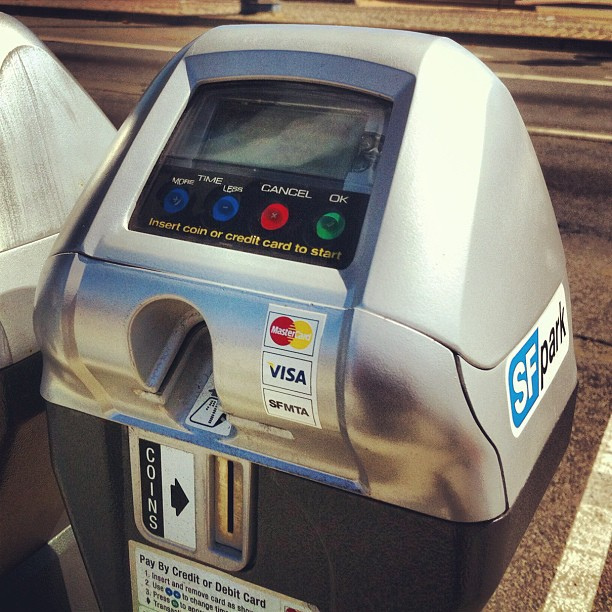
Parking meter in San Francisco.
Parking meter at Fisherman’s Wharf, San Francisco. Photo by Juli D’aniello.

That’s what you might think, anyway. If you actually drive to Fisherman’s Wharf today, though, you will have no problem finding a curb spot. A space will offer itself on each nearby block, if you’re willing to pay for it. The same goes for downtown LA.

These two cities plus Washington, DC, and a handful of others are experimenting with an approach to parking called “performance pricing.” Rather than dictating a flat meter rate citywide, their councils have set a performance goal: one or two empty spaces per block. They’ve instructed parking functionaries to charge what people are willing to pay, to use information technology to nudge meter rates up or down so that whatever block we citizens drive to, there will always be—with apologies to West Side Story lyricist Stephen Sondheim—a place for us.

Read more

×