Donate Newsletters

Taxi vs. Lyft: My Commute

Monday morning I got to work in a plain old Yellow Cab. Tuesday morning I tried Lyft, one of the new smartphone-based, on-demand “ridesharing” services that allows a regular person to turn his or her car into what operates much like a taxi with a pink mustache.

My experience with Lyft was radically better (more on that below), but not in the ways that its marketing strategy emphasizes. I wasn’t looking for my driver to be my best friend, or to feel like I was a part of a community, or to have scintillating conversations about politics before 9 a.m. I’m a mom with a poky kid, trying to get to work as quickly as possible, and I did that 34 minutes faster with Lyft.

That simple fact says a lot about the upstart—and, for now in Seattle, wholly unregulated—services that allow a customer to summon and pay for a ride from a fleet of drivers roaming the streets in their personal cars using a smartphone app. You can see on the map how far away your driver is, and that he or she is really coming. It’s much less stressful than calling a grumpy dispatcher and waiting on the side of the road, wondering if your cab will ever show up.

Read more

The Coal Export Bubble

There’s been so much news on the coal export front of late—the massive scope of the proposed Gateway-Pacific terminal’s Environmental Impact Statement; the Lummi Nation’s unequivocal opposition to a coal terminal at Cherry Point; and recent revelations about the ongoing financial woes of coal terminal developer Ambre Energy—that it’s hard not to sense that Northwest coal export projects are on the ropes.

But perhaps the most important coal export story has gotten surprisingly little attention—the collapse of Pacific Rim coal prices. With the latest price decline, I think we can definitively call the hype over Northwest coal export projects for what it always was: a bubble.

But to see why the inflated hopes for Northwest coal exports were the product of a bubble mentality, you have to look at the long-term price trends.

Read more

Wide Open Spaces

Photo by Flickr photographer paulswansen.

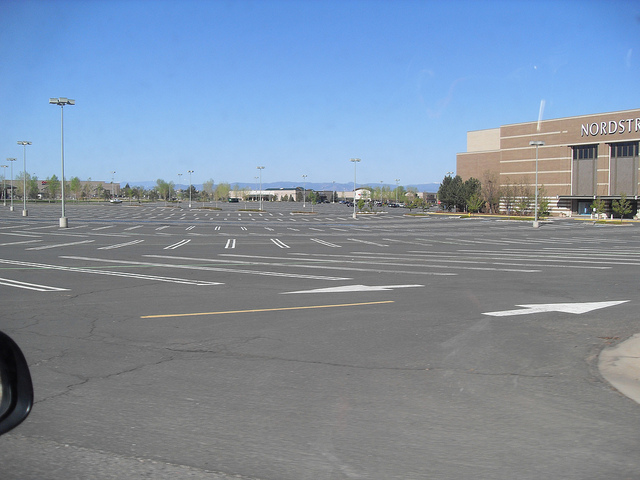
My younger son, almost 19, and my daughter, 20, are learning to drive this summer. (Car-less folks like us are sometimes late to the car-head rites of passage.) So I’m temporarily appreciating the wide open spaces of empty pavement at regional malls and big-box stores. Some of these parking lots are so big they generate their own mirages, and they’re vacant enough that my kids can’t do much damage.

Such parking expanses are a modern puzzle: they are so rarely full that you have to wonder why hard-headed business types ever built them. The answer is simple. They had no choice. Local laws made them do it.

Read more

Checklist for a Healthy Rain Garden

Maintenance guide

Maintenance guide
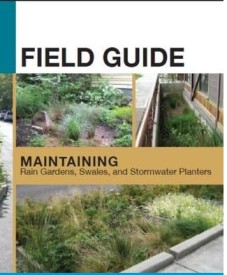
Cover of “Field Guild: Maintaining Rain Gardens, Swales and Stormwater Planters”

Rain garden maintenance has emerged as one of the big hurdles to expanding the use of green stormwater solutions. You build it. The rain comes. Then what?

In some ways, the water-absorbing gardens are not much different than other landscaping features. They need weeding, some summer irrigation, and basic pruning. But they also require more nuanced care.

The standard “mow, blow, and go” strategy that sends some commercial landscapers whacking plants and lawns with mowers or hedge trimmers, then revving up the leaf blower to blast the ground clean just won’t cut it. Rain gardens need lusher plantings to catch rain in their leaves and branches and healthy roots to help water soak into the ground. The green infrastructure often features a thicker cover of water-trapping mulch. Good rain garden maintenance means saying ‘no’ to Edward Scissorhands-inspired pruning and bare soil. It requires attention to how the water flows into—and sometimes out of—the garden, and how quickly the water seeps into the ground.

To help solve these maintenance challenges, some smart stormwater folks in Oregon have released “Field Guide: Maintaining Rain Gardens, Swales and Stormwater Planters (2013),” a handy how-to for keeping rain gardens functional as well as beautiful. The guide opens with specific recommendations on what tools you’ll need for rain garden maintenance, gives cautionary notes—and scary photos!—of some of the injury-inducing weeds lurking out there, and provides explicit instructions on how to maintain the gardens’ stormwater treating capacity.

Read more

Infographic: Living Space v. Parking Space

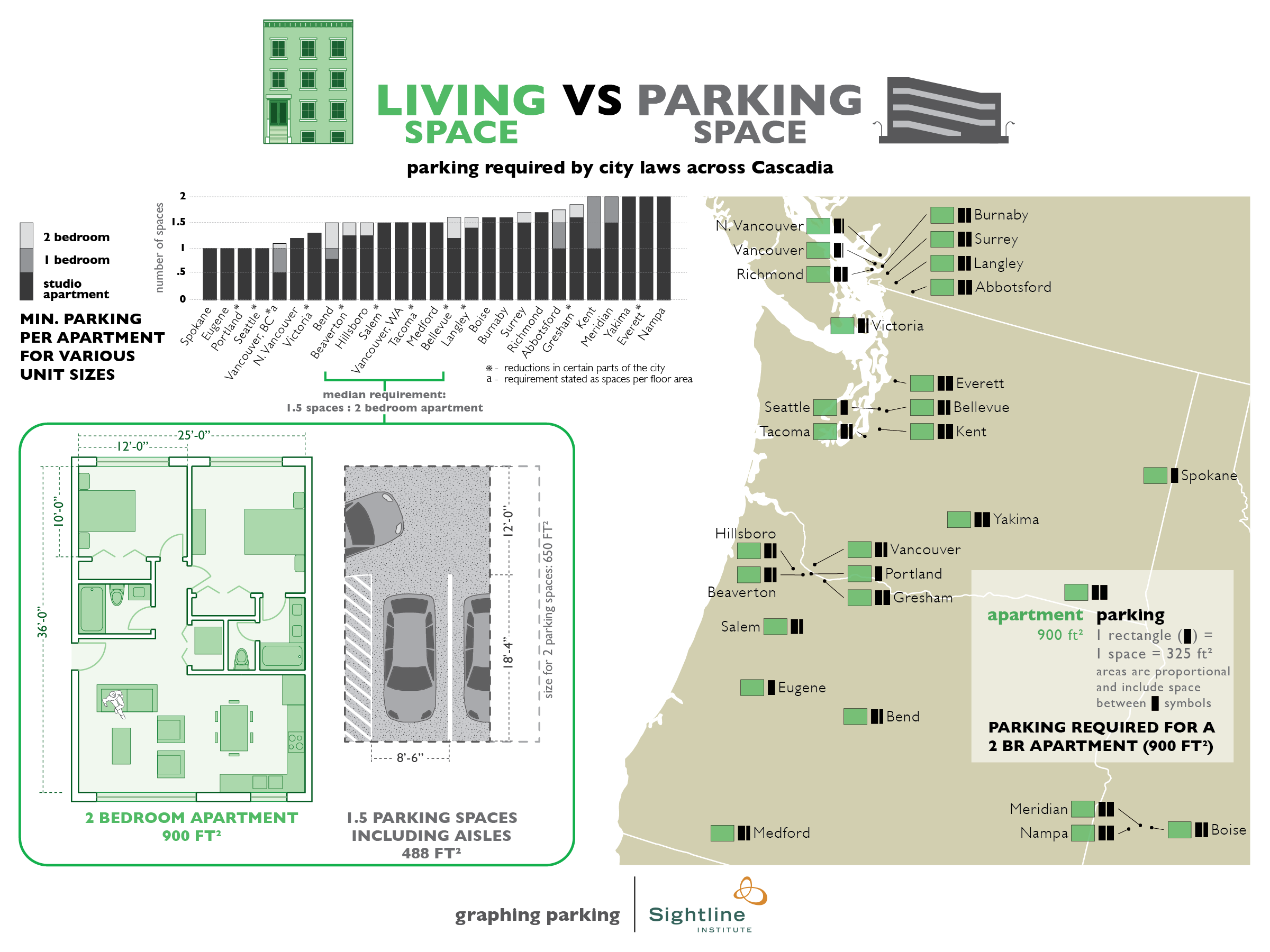
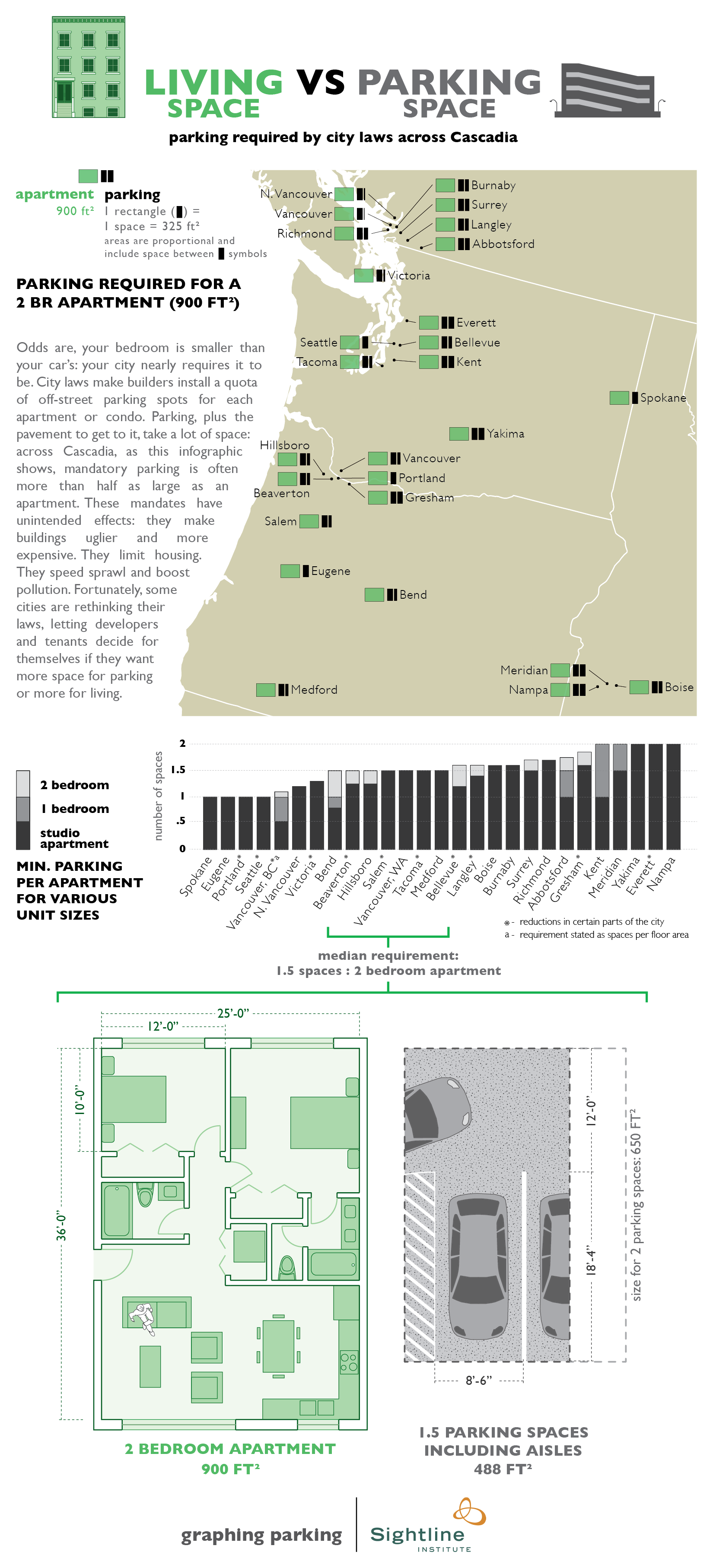
Your bedroom is smaller than your car’s—that and other surprising facts stand out in a new infographic we’ve assembled with architect and designer Seth Goodman of Graphing Parking.

Living Space vs. Parking Space in Cascadia

Click here for the largest version of the infographic (zoom in for full resolution) or here for a landscape version.

Read more

Rain Gardens, the Glamour Issue

Flowers

Flowers
Plants suitable for rain gardens, “Rain Garden Handbook for Western Washington”

Foodies get to drool over countless images online and in print of perfectly posed burgers, mouth-watering slices of pies, and other culinary treats. Now rain garden junkies and the bioretention-curious can indulge in inspiring photos and illustrations of green stormwater solutions in the newly released “Rain Garden Handbook for Western Washington: A Guide for Design, Installation, and Maintenance.”

The handbook is a step-by-step guide on how to plan, build, plant, and maintain a smaller-scale rain garden. It explains how even a modest-sized rain garden will capture and treat significant amounts of polluted runoff that flow off rooftops and driveways.

Suitable to an experienced landscaper or even a novice, the guide provides straightforward instructions in layman’s terms and lots of images to illustrate what’s being discussed. The handbook also answers questions and fears about rain gardens, including the persistent worry about standing water and mosquitoes (well-designed rain gardens drain in one to three days, the guide explains, and mosquitoes go from egg to adult in four or more days).

Read more

Still More Bad News for Ambre

Zepeda found guilty necessity defense Washington

The bad news for Australian coal miner Ambre Energy has been flying fast and furious for the past few weeks.

Back in late June came the revelation that the company’s Morrow Pacific coal export project faces high costs and dim financial prospects—which was inadvertently confirmed by the company’s North American CEO.

Then, at the very end of last week came news that the company is running out of time to settle its ongoing lawsuit with rival Cloud Peak, with whom Ambre co-owns the struggling Decker coal mine in southestern Montana. Worse, Ambre is clearly having trouble coming up with cash for the settlement.  From Matt Brown at the Associated Press:

More signs of problems have emerged with an Australian company’s bid to take over a Montana coal mine, as court documents reveal Ambre Energy has been unable to come up with more than $70 million in cash to close on the deal…

Read more

Huge Oil Train Explosion

Editor’s note: this blog post was updated on October 1, 2013.

One hopes the grim news from Quebec is not a preview for the Northwest. Early yesterday morning an oil train in the province derailed, causing an explosion with deadly results:

Four of the cars – which each carried 30,000 gallons of North Dakotan crude oil – caught fire and blew up in a fireball that mushroomed many hundreds of feet into the air. It destroyed dozens of buildings, many of them totally flattened…

Lapointe said it was hard to calculate the number of possible victims because the area was still too dangerous for police to examine properly.

[sightline-embed]

Moving oil by rail has become increasingly common over the last couple of years, and the Northwest is poised to become a major center of oil-by-rail shipments.

As Sightline documented in our recent report, The Northwest’s Pipeline on Rails, oil trains are already arriving several times a week at three locations in the region, while eight other sites are planning to build facilities to enable oil-by-rail deliveries. If all of the projects were built and operated at capacity, they would move nearly 800,000 barrels of crude oil per day on the Northwest’s rail system. Sightline estimates that would require 11 loaded oil trains per day.

Media outlets are reporting that the train in Quebec was carrying crude oil from North Dakota, which is almost certainly the same Bakken Formation oil destined for Northwest refineries and port terminals. The cause of the explosion is not yet clear, but most coverage suggests that the train had been parked for the night and was without a driver when it began moving.

Read more

×