Donate Newsletters

Wall Street Worries About Kinder Morgan’s Safety Record

Kinder Morgan is a titan in the North American energy sector and a major player in Northwest fossil fuel shipments. The firm was the author of a failed scheme to export huge volumes of coal on the Columbia River in Oregon, and it is lobbying heavily to triple its oil pipeline through British Columbia in a bid to move more tar sands oil to Washington refineries and Asian markets.

It is also, as Sightline has documented, a dangerous and irresponsible company with a clear history of law breaking, deceit, and pollution.

Last week, a financial research firm, Hedgeye, released a scathing report on Kinder Morgan that supports many of Sightline’s conclusions. Aptly titled Is Kinder Morgan Maintaining its Stock Prices Instead of its Assets? (no longer available online), the report is mainly concerned with Kinder Morgan’s books, but it includes a few bombshells that should worry the public.

Consider just this sampling from the summary section:

We believe that Kinder Morgan’s high-level business strategy is to starve its pipelines and related infrastructure of routine maintenance spending in order to maximize Distributable Cash Flow…

And:
Read more

What Caused the Lac-Mégantic Oil Train To Explode?

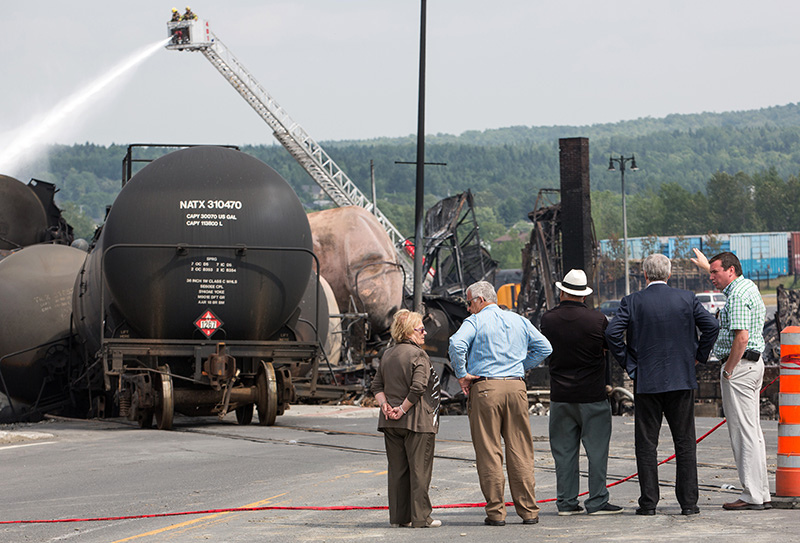
Canadian PM Stephen Harper survey the damage Lac-Mégantic the day after the explosion. Photo credit Stephen Harper, cc.
Canadian PM Stephen Harper surveys the damage in Lac-Mégantic the day after the explosion. Photo credit Stephen Harper, cc.

Last week saw a profusion of head-scratching news stories about July’s catastrophic oil train explosion in Quebec after the Transportation Safety Board of Canada announced that the tanker cars had been mislabeled. It turns out that although the rail cars were correctly classified as containing a “dangerous good,” a label that applies to all types of crude oil, they were incorrectly designated as PG III, the least dangerous sub-category, when they should have been labeled as the more dangerous PG II. (PG I is the most dangerous type.)

Mislabeling is a problem, to be sure, but it’s hardly the main issue. What none of the media accounts properly explained was why the crude oil—which does not normally explode—was so dangerous to begin with.

What we can learn from digging into initial reports from Canadian safety investigators is that the train was bearing crude oil from the Bakken oil fields of North Dakota, the same type of oil that is scaling up for massive increases in rail shipping in the Northwest. It’s also clear that the oil had a relatively low flash point for crude, which means that it would have ignited at lower temperatures. But at this point, we don’t know a lot more about the evidently deadly composition of the product.

Some experts speculate that the culprit may be hydrogen sulfide, a colorless, flammable, and extremely hazardous gas that is sometimes associated with Bakken oil. According to the oil industry, hydrogen sulfide is explosive when mixed with air, and it can cause severe corrosion to oil transport equipment, including pipelines.

Read more

Peak Driving in Oregon

The Oregonian ran an interesting piece in today’s paper, pointing out that total miles driven in the state peaked nearly a decade ago.

When the economy took a nosedive in 2008, dragging jobs and disposable income with it, Oregon residents reacted by driving their cars less. Or so goes the conventional wisdom.

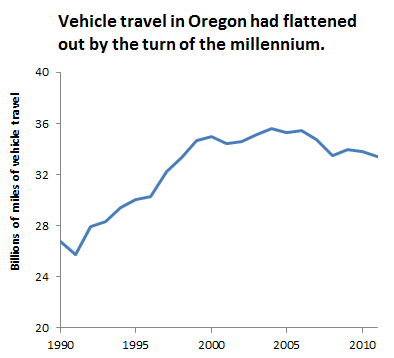
But an analysis of new traffic data by The Oregonian shows that driving in the state actually peaked in 2004, four years before the Great Recession hit. What’s more, for the first time in the history of America’s love affair with the automobile, the driving levels nationally aren’t tracking economic growth.

This is absolutely right. But the backstory is perhaps even stranger: driving in the state effectively stopped growing as far back as 1999 or 2000. Starting around then, vehicle travel in the state reached a bumpy plateau…with a few ups and downs, but nothing like the growth the state had experienced in prior decades.

Read more

Sightline on Coal and Oil Schemes in the Northwest

If you’re following Sightline’s work on Northwest fossil fuel exports and oil train projects, you may enjoy listening to this radio segment I did this morning on KBOO, a community radio station based in Portland. The piece is around 45 minutes long, which I think is a nice length for digging into issues in a more … Read more

Underground Parking

Game day near the University of Washington’s stadium, photo by Judy Dailey
Game day near the University of Washington’s stadium, photo by Judy Dailey.

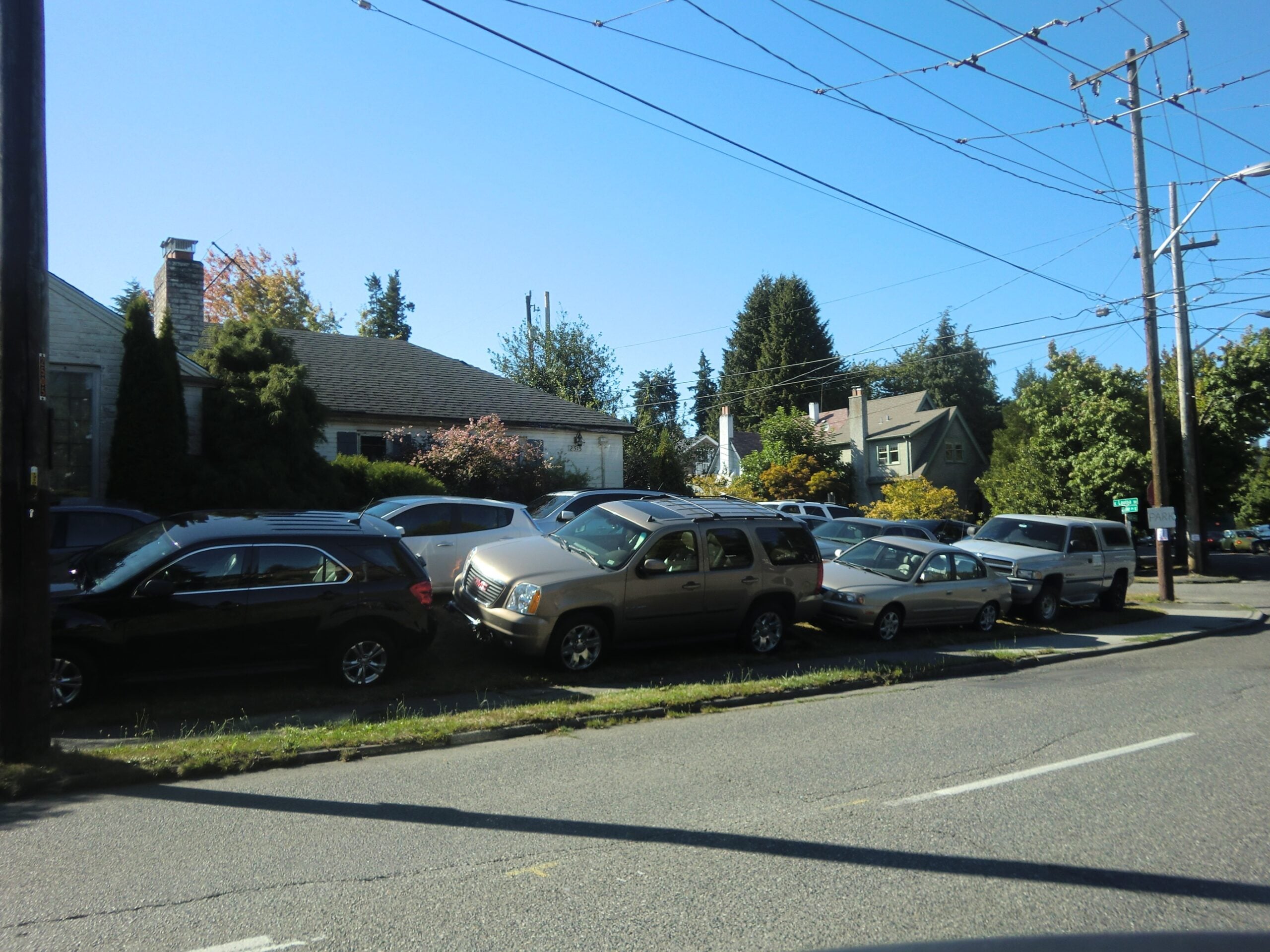
In Peggy Clifford’s neighborhood, out back of the State Capitol in Olympia, Washington, a black market thrives. Early each year during the state’s legislative session, lobbyists go there—just a hop, skip, and a jump from the capitol dome—to buy what they crave: parking spaces. Peggy says, “This is a neighborhood, not a parking lot.”

Tell that to regular Capitol visitors. The neighborhood may be nationally registered as historic and staunchly defended by Peggy and other concerned citizens, but it also has driveways and backyards, and to some residents, the offer of hard currency for use of that real estate is persuasive. They park their cars at the curb, protected by their resident-only permits, and rent out their private spaces to professional Capitol-goers. A lot of money changes hands.

Read more

More Bad News for Ambre Energy

The financial woes of would-be coal exporter Ambre Energy continue.

Yesterday, in a blandly worded press release, the company made a bombshell announcement: Ambre had failed to secure financing to settle its lawsuit with its rival/partner Cloud Peak Energy, with which it co-owns the struggling Decker mine in southern Montana. That means that the two companies will now have to limp along, managing the mine in tandem—even though their last attempt at co-management led to a serious dispute and a pair of lawsuits a mere seven months after the two companies started working together.

The initial lawsuit, filed by Cloud Peak just over a year ago, centered on Ambre’s management decisions at Decker. Cloud Peak wanted to move forward with long-standing plans to shut down the mine, since it was losing money and costs were on the rise. Ambre wanted to keep Decker going, in part (as Ambre’s counter-suit revealed) because shutting the mine down would be even more expensive than keeping it running.

Last December, both parties agreed to a tentative settlement to the two lawsuits: Ambre would buy Cloud Peak’s interest in the mine, and run it as it saw fit. But to finalize the settlement, Ambre would need to replace a $71 million “reclamation” (i.e., cleanup) bond that Cloud Peak had already put up, and also pay somewhere between $57 million and $64 million for the mine itself.  Once Ambre came up with the money, the lawsuit would be officially settled.

Well, the first settlement deadline came and went, and Ambre didn’t come up with the money. The court set a new deadline—and Ambre fumbled again. Ultimately, the presiding judge set a firm cutoff date of August 30: if Ambre didn’t fulfill the settlement terms, the lawsuit would proceed, and the two parties would have to start duking things out in court.

Yesterday, with the clock ticking down, both parties announced that they were voluntarily dropping their lawsuits. The reason: Ambre simply has no hope of raising the money it needs to buy Decker.

Read more

Apartment Blockers

City requirements for off-street parking spaces jack up rents.
Tweet This

Have you ever watched the excavation that precedes a tall building? It seems to take forever. Then, when the digging is finally done, construction rockets upward in no time. For the past few months, I’ve been watching a crew excavate the site of a new condo tower on Seattle’s First Hill. It’s on a route I walk three times a week, so I’ve had a ring-side seat. And here’s the thing that finally dawned on me, after years of not really thinking about these holes in the urban ground: what’s all the excavation for? It’s for parking. Underground parking. In most cities and in most soil conditions, the giant holes are only there to satisfy off-street parking rules, and to do that, you need a deep, deep hole. A hole like this one.

Photo by Alan Durning.
At Eighth Ave. and Seneca St. in Seattle. Photo by Alan Durning.

Digging these holes is astronomically expensive. They’re real-life money holes. The crew I’ve been watching has been laboring away for weeks, deploying enormous machinery and keeping a fleet of dump trucks in constant motion. They’ve undoubtedly spent millions of dollars removing rock and dirt. One Portland developer told me that each successive layer of excavation—each floor down in the garage—costs two to three times as much as the previous one.

Such costs are one reason housing is so expensive nowadays. A one-bedroom apartment in the city of Seattle rents for upwards of $1,300 on average. In Portland, rents are approaching $1,000 and, in Vancouver, BC, $1,400.

Read more

Taxi vs. Lyft: My Commute (Part 2)

Last week I wrote about my experience commuting to work with Yellow Cab vs. Lyft, one of the new on-demand, smartphone-based “ridesharing” services that have recently started operating in Seattle. Personally, my experience with Lyft was much more efficient and pleasant. But that leaves out some important points for policymakers attempting to craft sensible regulations for a growing car-for-hire industry.

For starters, I’m fortunate enough to have the option of owning an iPhone, which gives me the choice to use services like Uber, Lyft, and Sidecar. Those new companies use smartphone apps as their dispatch systems, which put their services out of reach for certain consumers. There are plenty of people who need rides but can’t afford expensive data plans or who are intimidated by new technology.

Park Raving Mad

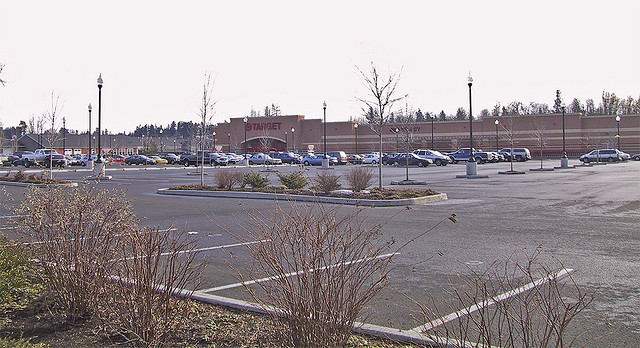
A department store in a mixed-use development still requires a large parking lot.

Off-street parking quotas are on the books in every city in Cascadia, because they are politically expedient. But the specific quotas—two spaces per apartment or ten per 1,000 square feet of retail floor space, for example—are based on little or nothing. Cities just make them up, then state them with precision, as UCLA professor of urban planning Donald Shoup has documented in The High Cost of Free Parking (see chapter 2).

Here’s how it works. Territorial constituents push city leaders to defend free neighborhood curb parking from newcomers, so the leaders instruct city planners to recommend parking quotas sufficient to prevent spillover from new buildings. No visitor to any new development should ever park on the street, leaders tell planners.

Let’s say you’re a planner in a city department. What are you to do? Like all planners, you were trained in a discipline in which the main curricula and classic text books say nothing at all about parking requirements. You have exactly zero training in how to set a parking requirement.

“What I tell you three times is true.”

–Lewis Carroll
Tweet This
 

If you’re typical, what you do is call your peers in nearby jurisdictions and copy their mandates number for number: two off-street spaces per apartment; five per 1,000 square feet of office building; and so on. “It’s magical the way these numbers spread,” parking researcher Richard Willson told LA Magazine. Groupthink fills the void where analysis is lacking. Lewis Carroll, author of Alice in Wonderland, would have readily understood how cities set parking requirements.

Read more

Park Place

Maybe the inventors of Monopoly were onto something when they called their second most expensive property Park Place, because car storage is surprisingly costly.

We think of it as cheap, because we so rarely pay for parking at the time when we are using it. More than 90 percent of the time, our cars end their trips in spaces for which there is no charge.

But just because we’re not paying as drivers does not mean we are not paying in other ways—as residents, employees, and shoppers, for example. The costs of parking are concealed in higher rent and housing prices, lower profits and wages, and higher prices. We rarely think about the costs of parking, because parking itself is so ubiquitous. Because of city off-street parking mandates in land-use codes, it’s so commonplace we hardly notice it. Yet it’s a defining feature of modern cities: it’s one of the principal uses of urban and suburban land, as the image below of several blocks close to downtown Seattle illustrates. Consequently, it’s one of the principal uses of real-estate dollars.

This article quantifies just how expansive and expensive parking is. How much do we have? How much does it cost?

Read more

×