Last time, we reviewed accessory dwelling units’ (ADUs’) paucity and slow pace of development in most of the Northwest outside of Vancouver, BC. This time: the constraints that bind them.
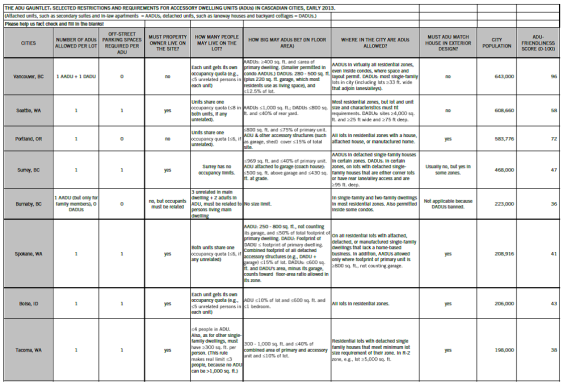
Why are accessory apartments and cottages so rare? One reason, no doubt, is that many homeowners do not want to host an ADU. But a more pernicious reason is that winning approval to rent out an ADU in most cities requires running a harrowing gauntlet of rules. For every decision that Vancouver, BC, has made to welcome secondary suites and laneway houses, other cities have made the opposite decision.
To map the restrictions on ADUs, Sightline assembled a table of ADU rules called The ADU Gauntlet that you can download and review here (or by clicking below).
In 2002, 26 percent of Norwegian contraceptive users relied on a long acting method that they could simply fit and forget, the IUD. In the United States, that rate was 2 percent. Long acting reversible contraceptives (aka LARCs) such as IUDs and implants are rapidly growing in popularity, but the US and Canada lag behind many other countries in making these top tier methods widely available. Around the world, IUDs are the most popular form of reversible contraception, with rates of use as high as 40 percent in China, and over 50 percent in seven smaller countries. By contrast, in the US, the rate of LARC use, while increasing, is still under 10 percent. That means we have a huge and largely untapped public health opportunity.
No one contraceptive works for everyone, but LARCs have a failure rate that is 1/10 to 1/50thof that for the most widely used American contraceptive, the Pill, and they are cheaper in the long run. More effective contraception means fewer unintended pregnancies, with all that implies: healthier babies, lower teen pregnancy rates, less abortion, less strain on public services and budgets, and more flourishing families. Giving women better tools to attain their pregnancy intentions has benefits that ripple through their communities.
Not only are LARCs more effective than the Pill at preventing unwanted pregnancy, they tend to have fewer side effects, higher continuation rates (over 80 percent at one year vs. under 40 percent for other hormonal methods), and higher rates of overall satisfaction. As one doctor put it, “If you ask any OB what they use or what their wives use, it’s an IUD.” So why haven’t American women had better access to these potentially life changing technologies?
We usually keep our heads down in the (policy) books here at Sightline, but we’re turning 20 this year and, what the heck, it’s time to celebrate!
We’re kicking off the year-long celebration on April 5th with a very special shindig in Portland. For all of you in Oregon and Southwest Washington, we hope you’ll join us.
We’re excited to announce that Senator Jeff Merkley will be our special guest for the evening. Alan Durning, Anna Fahey, Eric de Place, and Clark Williams-Derry will be there too, so you’ll get the chance to chat with your favorite researcher in person, rather than in the comments section.
The progress we’ve made since 1993 wouldn’t have been possible without the support of our community. Thank you for sharing, using, and contributing to our work over the past 20 years. Pat yourself on the back, and celebrate with us!
Futurist Sara Robinson has called modern contraception the most disruptive technology of the last hundred years. From the time our ancestors first walked out of the Great Rift Valley—perhaps even before—culture, religion, and division of labor enshrined the simple, universal fact that women had little control over their fertility. When modern contraception arrived in the middle of the 20th Century, it triggered a tidal wave of culture change that left the guardians of tradition frantically trying to shore up their aging structures. Now, a second wave of contraceptive technologies is further threatening the notion that women must allow gods and men to decide whether they end up pregnant.
Today, the most widely used contraceptive in the US is the Pill, released almost half a century ago and refined in intervening years to reduce the hormone load and side effects. For two generations, the Pill has been a game changer. But it is far from perfect. Very few human beings are able to take a daily medication with perfect consistency, and that fact alone largely accounts for an annual pregnancy rate of 1 in 12 for women on the Pill. (For couples using condoms, the rate is 1 in 8. With no contraception, it is over 8 in 10.)
One of the most carefully controlled studies of Pill use required women to keep diaries and remove each pill from a container that electronically recorded missed doses. The participants reported missing only one pill per month on average; the boxes recorded an average of four missed pills per month! Only 16 percent of women in the study kept missed pills down to one per month or less. An estimated 750,000 American women get pregnant each year while on the Pill. With failure rates like that, a woman can plan for her future and her children with confidence only if she has access to abortion as a back-up plan. More than half of women seeking an abortion say that they were using a contraceptive method in the month they got pregnant.
Last fall, researchers in Missouri caught the attention of public health experts and advocates across North America. Some 9,000 St. Louis women had been offered their choice of contraceptives for free in a study that has since been called an “Obamacare simulation.” Two years later, the teen pregnancy rate was at 6 per 1,000 instead of the US average of 34. The abortion rate was less than half the rate of other St. Louis women.
Why did they get such dramatic results? The free birth control triggered a technology shift in a microcosm. When presented with simple, accurate information and a buffet of no-cost options, a majority of the study’s participants, almost 75 percent, switched from old contraceptive technologies like the pill, condoms, and other barrier methods like cervical caps to state-of-the-art “long acting reversible contraceptives” (LARCs).
Unintended pregnancy rates in the US have been frustratingly flat for decades, hovering around half of all conceptions. Now, health advocates and community health agencies are eyeing a potential technology tipping point that could radically change the equation. What would it take to make the St. Louis results the new norm? And what might that mean for Cascadia?
Good news from the Energy Information Administration’s latest electricity update: in Washington and Oregon, generation of coal-fired power fell sharply over the past two years, even as wind has taken flight. By the end of 2012, wind handily outstripped coal in the two states’ generation mix: This makes me happy—but probably requires at least two … Read more
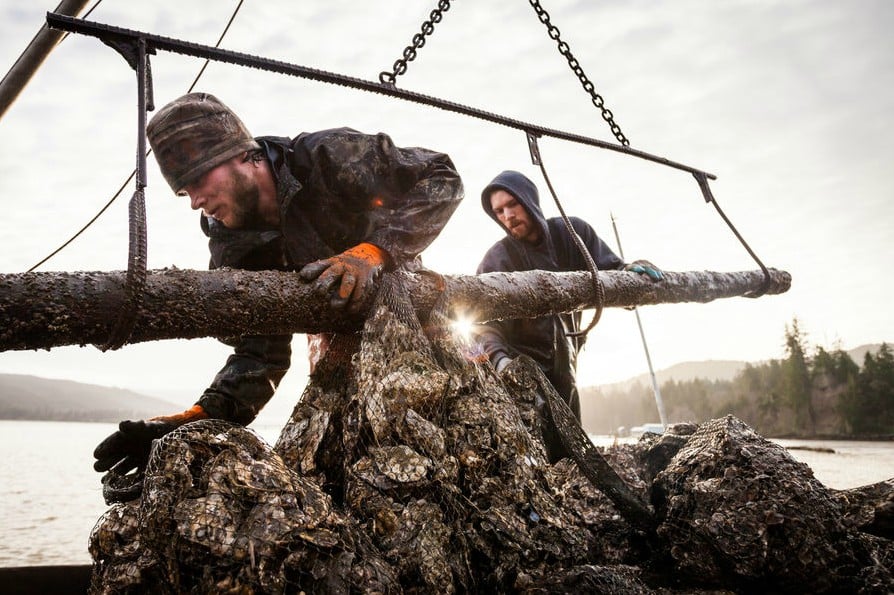
This should be mandatory viewing: four new multimedia films from Northwest artists Benjamin Drummond and Sara Joy Steele. Oyster Farmers, Coastal Tribes, Potato Farmers and Plateau Tribes all explore global climate change through people who live and work in the Pacific Northwest.
The stories are part of a documentary project that makes for an arresting look at the way that climate change and carbon emissions are already transforming the Northwest. Oyster farmers on Washington’s coast are moving their operations out of state
Note: I’m going to continue updating this post as I come across new pieces of evidence.
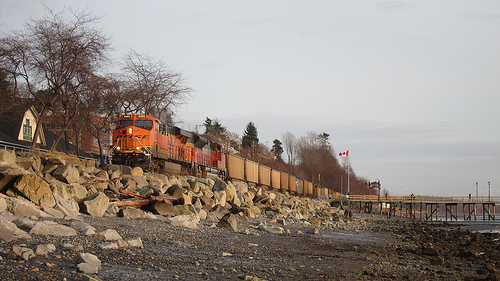
Coal train in White Rock, BC, Canada. Credit AaverageJoe.
At a Seattle Town Hall forum last week, SSA Marine VP Bob Watters’ claimed again—and despite much evidence to the contrary—that it doesn’t matter whether his firm builds a huge coal terminal near Bellingham. According to this theory, if Oregon and Washington communities don’t ship the coal then British Columbia ports will simply export it instead.
But it’s not true.
Coal industry leaders themselves—along with top analysts and journalists—agree that Canadian ports have nowhere near enough capacity to handle the staggering volumes planned for export from the Northwest states. Industry experts have repeatedly said that new terminals would mean dramatic increases in coal shipping. For example:
Some coal already moves from the Powder River Basin through the Pacific Northwest to an export terminal at the Port of Vancouver in British Columbia. But in an interview from Cheyenne, [Wyoming Infrastructure Authority Director Lloyd] Drain said existing West Coast port capacity to ship coal to Asia is maxed out.
US exporters have turned their attention to the Asian market and have been able to capture new market shares in Asia. However, US steam coal exports to Asia are constrained by the lack of export capacity on the West Coast despite several proposals to build new export terminals. Recent market development and strong environmental opposition have impeded the development of coal terminals in the Pacific Northwest so far.
Getting PRB coal to China and the rest of the Asian market has been the challenge… Opening new coal terminals in Washington and Oregon was thought to be the simple solution… But efforts to develop coal ports in the Northwest have been hindered by opposition from environmental groups.
“If either of [the terminals in Washington] go through, that is a very sizable amount of coal for the Powder River Basin. That would be a game changer for the market, because the PRB would have an outlet outside the U.S.”
— Hans Daniels, Doyle Trading Consultants, Casper Star Tribune, September 2, 2014.
…Peabody needs new export routes from the Powder River Basin, specifically via the Pacific Northwest. Hauling coal by rail to the Upper Midwest, barging it down the Mississippi to the Gulf of Mexico, loading it into freighters, and shipping it through the Panama Canal to Guangzhou or Kolkata is a great way to kill your margins. Peabody needs new Asian markets, and to supply Asian markets, Peabody needs new export terminals on the West Coast.
With Canadian terminals close to capacity, even with existing expansions, new US coal exports will struggle to get offshore, presenters at the Coaltrans West Coast conference in Las Vegas said last week. …new shipments of US coal are unlikely to materialize unless the industry is able to develop any of the proposed coal export terminals in the Pacific Northwest, speakers said during Thursday and Friday presentations at the conference.
…this will depend crucially upon the expansion of port capacity, much of which is currently utilised for metallurgical coal exports, particularly at the Canadian West Coast terminals of Westshore and Neptune. This bottleneck prevents Powder River Basin (PRB) coal from reaching the Pacific Basin in large volumes.
— Deutsche Bank, Commodities Special Report, “Thermal Coal: Coal At A Crossroads,” May 9, 2013.
What is really needed for U.S. coal to be competitive in the Asian markets is export terminals on the West Coast that would cut shipping days from 18-22, down to 10-12. This is no secret to anyone with a cursory knowledge of the coal markets (or anyone living in the Pacific Northwest, for that matter).
The market is down and we don’t have any export capacity.
— Marion Loomis, Wyoming Mining Association director, quoted by Darren Epps, “Construction halted at new Haystack mine in Wyoming due to weak coal markets,” SNL Financial, April 8, 2013.
We’ve got the assets in place, what we need now is the terminal.
— Colin Marshall, CEO of Cloud Peak Energy, quoted by Darren Epps, “Cloud Peak CEO: No obvious domestic growth story in PRB,” SNL Financial, March 6, 2013.
Canadian ports are actually at full capacity. A lot of the contracts, at least for the recent expansion proposals, have been for Canadian coal to be exported… I talked to the head of the Westshore Terminal, actually, and he told me that they are already contracted and that it’s not going to be American coal.
— Ashley Ahearn, coal export journalist, KUOW Public Radio at “EarthFix Seattle Coal Export Panel,” February 13, 2013.
At present, there is limited terminal capacity for the export of PRB coal to foreign markets. Our access to existing and any future terminal capacity may be adversely affected by regulatory and permit requirements, environmental and other legal challenges, public perceptions and resulting political pressures, operational issues at terminals and competition among North American coal producers for access to limited terminal capacity, among other factors.
— Cloud Peak Energy, Form 10-K, filed with US Securities and Exchange Commission on February 14, 2013.
We don’t have the capacity to offload the coal.
— Martin Loomis, Wyoming Mining Association director, quoted by Adam Voge, “Coal workers keep eye on foreign markets,” February 18, 2013, Casper Star-Tribune.