Donate Newsletters

WSJ on Vancouver’s add-on dwellings

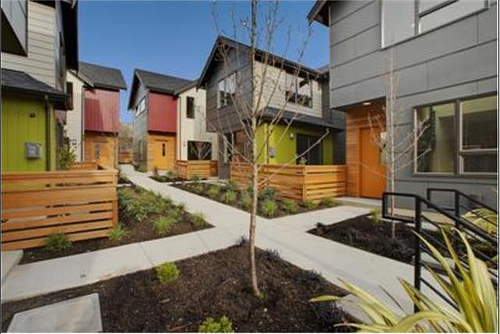
Today’s Wall Street Journal includes a front-page feature on Vancouver, BC’s secondary suites and laneway houses and a video interview with Conor Dougherty, the author. The piece includes a nice Sightline quote; we were a major source for it. (Unfortunately, the full article is behind a pay wall.) To get a sense of how America … Read more

Natural Hair Care Act Passes in Oregon

Hair braiding

In a win for fairness and common sense, the state of Oregon will no longer subject people who practice African-style hair braiding (and other forms of natural hair care) to a bizarrely burdensome licensing process that’s more lengthy than what’s required for someone to fight fires or give lifesaving medical care in ambulances.

As Sightline first highlighted in our Making Sustainability Legal series, Oregon State law previously required anyone who wished to braid, cornrow, twist, lace, wrap, or weave extensions or decorative elements into hair to undergo 1500 hours of cosmetology coursework and training (compared to 130 hours to become an Emergency Medical Technician and a minimum of 385 hours to become a firefighter in some states). This was particularly unhelpful since natural hair care practitioners don’t cut, color, perm, or straighten hair, the basic skills taught in cosmetology school.

The regulations were arguably racist, since they prevented hair braiders—most of whom are African immigrants or African-American women—from earning a living without undergoing largely irrelevant training that can cost up to $17,000.

Read more

Redmond’s Rain Garden Challenge

Rain garden
Rain garden
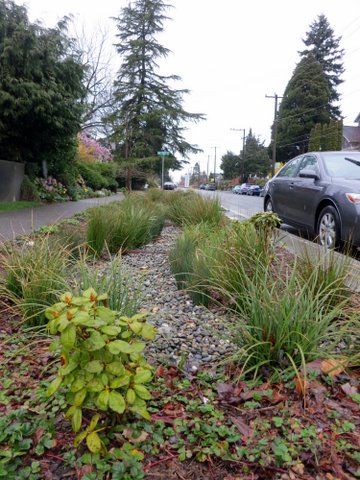
Rain garden, Lisa Stiffler.

In the stormwater world, if a rain garden is releasing more pollution into the environment than it’s capturing, word gets around.

So when the city of Redmond crunched its first flush of data from a new roadside rain garden and discovered the water coming out of it was tainted with alarming levels of phosphorus, nitrates, and copper, the stormwater community took notice. Washington State regulators went on the record to say that they would be studying the data and possibly revising their rain garden recommendations. Proponents of the technology fear that the results will be overblown and exploited by skeptics of so-called low-impact development solutions.

But even city officials in Redmond caution that they’re far from giving up on rain gardens.

“It definitely has not lost its merit in my mind,” said Andy Rheaume, Redmond’s senior watershed planner.

Indeed, there’s a decade worth of data showing that rain gardens and related “natural” technologies are effective at treating polluted stormwater runoff. They can do a terrific job soaking up the renegade rain water, diverting it from house basements and preventing it from scouring streams or causing overflows of sewage. And numerous studies demonstrate that rain gardens will filter out and capture a toxic mix of heavy metals, petroleum pollutants, particles and nutrients. In fact, the Redmond rain garden did treat some of the pollution gushing into it.

But rain gardens aren’t fool proof. Depending on the design of the system and the soil mix that’s used, a rain garden’s ability to remove pollutants can vary—and vary dramatically.

So what is a city or county stormwater engineer to do? Don’t panic.

“We’ve been promoting the message ‘Don’t throw away the baby with the bathwater,’ ” Rheaume said. “We’re pretty sure that (low-impact development) is here to stay.”

Read more

This Year, Waffles

Wow. What else can we say? HUGE THANKS to everyone who chipped in (and even chipped in extra!) to support Sightline during GiveBIG yesterday. All told, we raised $40,940 from 181 donors. From our first gift at 12:52 a.m. to our last at 11:42 p.m., you sent the message to us—over and over again—that you … Read more

Kinder Morgan’s Coal Export Scheme Bites the Dust

Huge news on the coal export front just now. As Scott Learn at The Oregonian reports, “Kinder Morgan drops plan to build coal export terminal at Port of St. Helens industrial park.”

Kinder Morgan had been planning to export as much as 30 million tons of coal each year on the Columbia River from a site near Clatskanie, Oregon, but their plans ran into a buzz saw of opposition from local communities, environmental and health advocates, and even nearby industrial users. This morning they announced that they are officially abandoning their plans to build a coal terminal at Port Westward.

Sightline’s research was instrumental in the debate. We published extensive documentation of Kinder Morgan’s problems with coal dust at their terminals, as well as the company’s lengthy rap sheet of fraud, illegal dumping, and lax safety. A month after we published our research, the utility PGE announced that it would not sublease its land at Port Westward to Kinder Morgan out of concern that the spread of coal dust would damage its gas turbines. Since then, the firm has struggled to configure its plans, but local opposition continued to mount while prices in Asia weakened.

Today’s news amounts to a huge victory for the Power Past Coal campaign. Of the six coal export terminals originally planned for the Northwest, three have now been withdrawn, in large part owing to an enormous backlash to the plans.

Read more

Northwest Birth Rates: A New Low

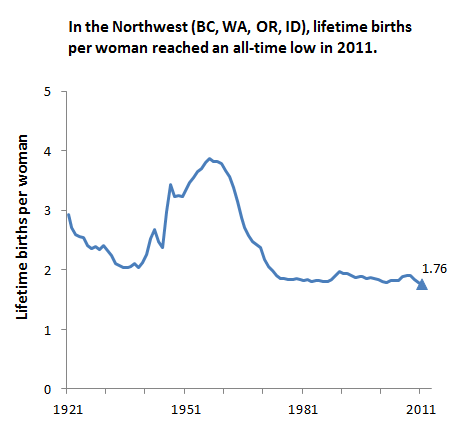
According to the latest figures, birth rates in Cascadia (British Columbia, Washington, Oregon, and Idaho) have fallen to what could very well be an all-time low. And when I say “all time” I mean it: it’s quite possibly the lowest birth rate since humans first came to the Northwest.

Of course, there’s no way to know with any certainty what the birth rate was before records were kept—but in times of high infant mortality, birth rates were generally far above what we see today. So it’s quite likely that the human inhabitants of what we now call the Northwest have never had such small families.

House Transportation Bill: Cars First!

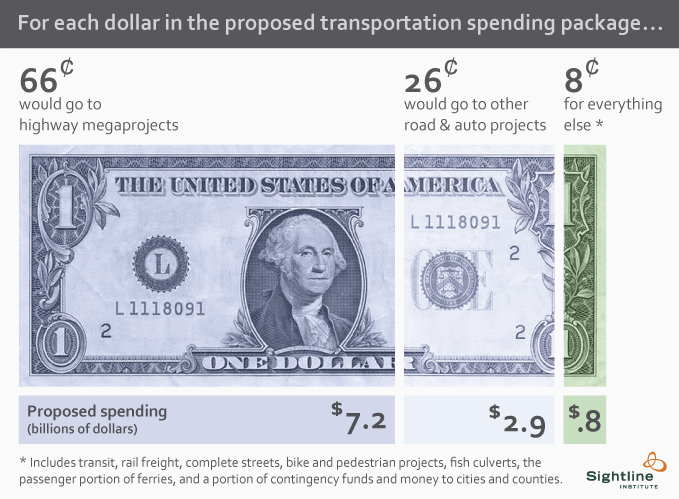
Imagine traveling to an alternate universe, a wacky mirror-world where ostensibly progressive and pro-environment political leaders relentlessly promoted sprawl-inducing highway megaprojects, while offering only a pittance to transit, rail freight, bike paths, sidewalks, or anything else that doesn’t directly support the automobile.

Well, stop imagining: that alternate universe is real-life Olympia, Washington. That’s where the Democrats on the House transportation committee recently announced a highway-centric transportation spending package that might have made Robert Moses blush—and could well represent a low-water mark for the state’s already depressing transportation debate.

The Columbia River Crossing: Sightline’s Greatest Hits

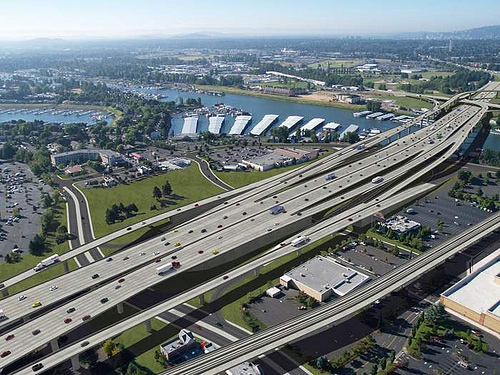
If you’re a keen observer of politics in Olympia, you may already know that the Columbia River Crossing—a massive highway expansion and rail transit project connecting Portland, Oregon with Vancouver, Washington—has emerged as one of the most hotly contested issues in the negotiations over the state’s transportation package.

But if you’re not from Portland, you may not understand how much controversy the CRC has generated. Critics from the right think that the project is simply to expensive. Critics from the left…well, actually they tend to agree that the project is a budget buster, but also quite reasonably point out that a wider bridge could boost traffic, sprawl, and greenhouse gas emissions.

Seattle’s Green Stormwater Goals

Seattle roadside rain garden

Recently, the city of Seattle announced a goal to dramatically increase the amount of water treated by rain gardens, green roofs, green streets, permeable pavement and other alternatives that seek to treat stormwater more naturally instead of carry it away in pipes.

Right now, as the graphic below shows, the city estimates it’s managing somewhere north of 100 million gallons of polluted runoff with “green stormwater infrastructure,” which helps control flash flooding and helps filter out pollution that might otherwise wind up in Puget Sound. Mayor Mike McGinn and some city council members want to ramp that number up to 700 million gallons by 2025.

The city has a road map to get about half of the way there by incorporating green stormwater techniques into streets and other public spaces, providing utility rebates for homeowners who handle rain from their roofs and gutters with cisterns or gardens, updating codes and partnering with developers, or helping neighborhoods incorporate stormwater swales into traffic calming projects or other amenities. But the bulk of the gains will have to come from projects and approaches that city staff will spend a little more than a year identifying.

Read more

The Biggest Blind Spot of Urban Greens?

I have written in recent months about some of the land-use rules that make inexpensive housing uncommon or illegal: roommate caps, accessory dwelling unit rules, minimum apartment sizes and other rooming-house restrictions. What I haven’t discussed is the towering central obstacle to inexpensive housing—the elephant in the living room.

Fortunately, Slate blogger Matt Yglesias has done the job well. His concise e-book The Rent Is Too Damn High explains how tight land-use restrictions on urban density are a major ill of the contemporary United States. Enforced single-family and other low-rise neighborhoods in close-in urban zones jacks up real-estate prices, hobbles service economies’ prosperity, and turbocharges sprawl, which multiplies driving and oil consumption and carbon pollution.

×