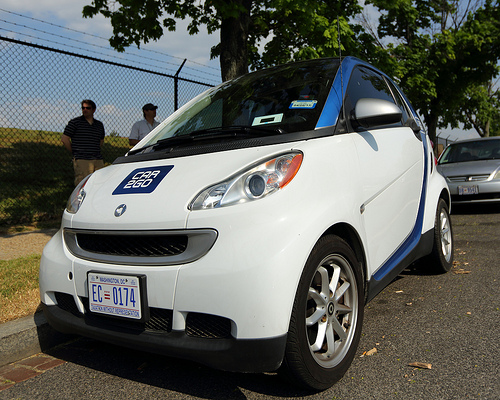
If you live in Seattle and you haven’t yet seen one of those charming little car2go vehicles humming delightfully up your local hill, I really don’t know where you’ve been hiding. There are 330 of them zipping around the city now.
And those numbers helped push the number of car-sharing locations in Seattle to 429—and sixth place nationally—according to a new infographic by the clever folks over at Walk Score. But yet again, Portland bested its northern neighbor: the Rose City ranked number four, with about ten percent more car shares than Seattle (537). That’s consistent with what we found a few months back, when we looked at the Northwest’s car-sharing Olympics—Portland lagged behind Vancouver in our initial ranking but placed well ahead of Seattle.
See the full car-sharing infographic after the jump…
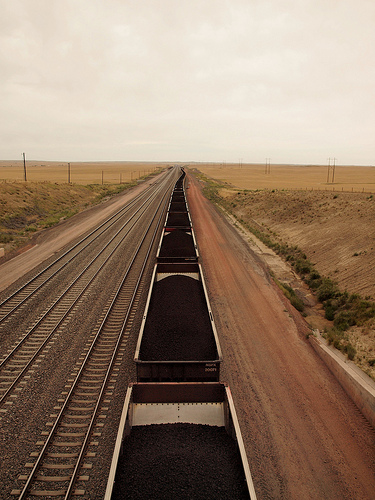
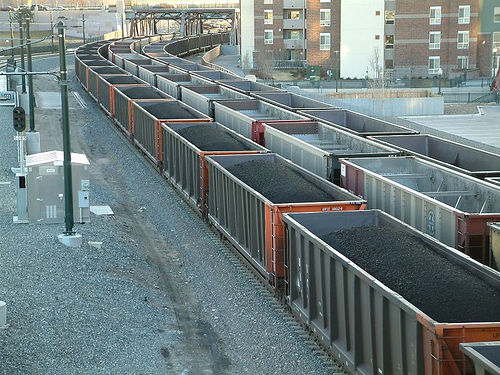
As domestic demand for coal has tumbled, the coal industry has grown increasingly desperate to shore up falling revenues by exporting coal to Asia. And that’s why there have been so many controversial proposals to develop coal export terminals in the Pacific Northwest: the industry thinks that the Northwest offers the cheapest route to move coal from Montana and Wyoming to China, Korea, and Taiwan.
One company, the Australian-based Ambre Energy, Ltd., has put itself in the center of the coal export brouhaha by launching plans to build two major coal export terminal projects on the Columbia River. The larger of the proposed terminal projects, at a brownfield site in Longview, WA, would handle up to 44 million tons of coal per year. The smaller project, proposed to ship coal by rail to Oregon’s Port of Morrow and then barge it downstream to ocean-going vessels at Port Westward, would handle up to 8 million tons of coal annually. Both projects face major permitting, regulatory, and financing hurdles before they can get off the ground, let alone turn a profit.
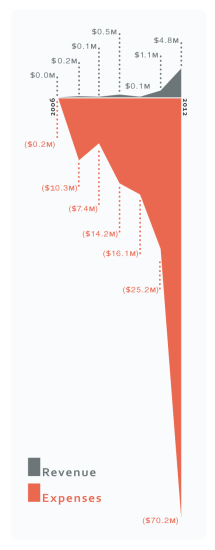
Ambre has racked up minimal revenues and massive expenses.
But while some of the other players in the coal export game are relatively well known, there’s surprisingly little reliable information in circulation in the Northwest about Ambre Energy. The company’s history, its track record, and its finances remain something of a mystery to the businesses and communities that would be affected by their coal export proposals, and to decision-makers who are deciding how to navigate the controversy. Because there’s so little information about the company out there, many people in the Northwest assume that Ambre is a major international coal company with a significant track record in the global energy industry.
But we just completed an in-depth review of Ambre’s finances, and found a story of a company with no track record of success, deeply troubled finances, minuscule overseas assets, and just over one years’ worth of experience in the US coal industry.
The chart to the right is pretty self-explanatory: the company has racked up massive expenses over the last seven fiscal years, with minimal revenues.
In short, Ambre’s finances paint a picture of a high-risk startup, rather than a stable and reliable business. The company has been losing money on risky energy investments in the US and Australia since 2005. And it didn’t even start producing coal commercially anywhere in the world until late 2011, when it bought an under-performing mining business from a US company angling to get out of the coal industry. Ambre has never come anywhere close to earning a profit, and instead has racked up massive losses for its investors—including $65 million in 2012 alone.
It was dark but it wasn’t stormy when the Salish Sea saw its first recorded sinking of a coal vessel. At 6:45 a.m. on November 21, 1886 the Barnard Castle, a freighter laden with 2,300 tons of Vancouver Island coal bound for San Francisco, struck the Race Rocks about 10 miles southwest of Victoria. The captain managed to beach the foundering ship in a shallow bay at nearby Bentinck Island. Workers were later able to remove much of the coal before abandoning the ship where it remained lodged in the mud until it was eventually destroyed by storms.
The region’s second recorded sinking happened just five years later, on November 28, 1891 when the iron steamship San Pedro came to grief while carrying 4,000 tons of coal from Vancouver Island to San Francisco. In dead calm waters at about 8:30 p.m. the ship struck a submerged ledge near Trial Island just off Victoria. Rescue tugs arrived a few hours later and removed some of the coal before the vessel sank suddenly into shallow water.
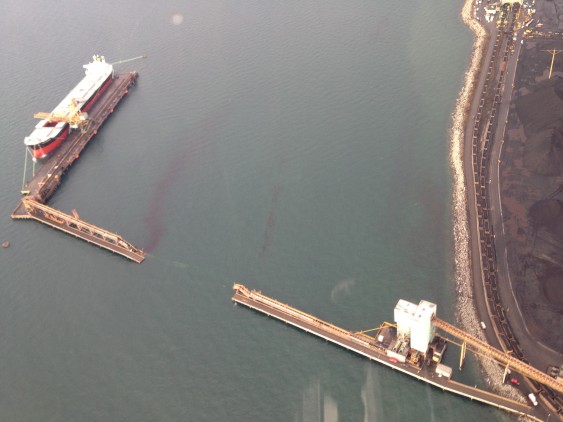
The Westshore coal terminal after it was struck by the Cape Apricot in 2012. (Photo credit: CKNW News, British Columbia.)
Fast forward a little more than 120 years. British Columbia maintains a robust coal export industry that sends hundreds of coal-laden vessels through the Salish Sea, mostly in safety. Yet 2012 very nearly saw the region add another coal carrier to history’s list of casualties when the apparently out-of-control Cape Apricot smashed through a loading trestle at BC’s Westshore coal terminal.
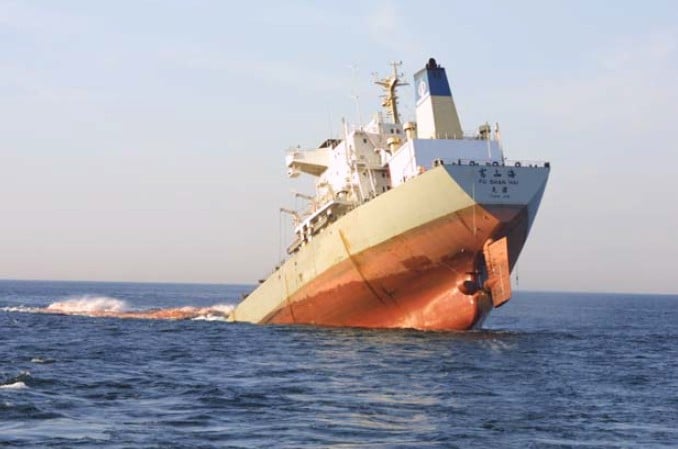
The recent explosion of proposals for Northwest coal port expansions and new terminals has many in the region wondering just how safe are the giant bulk carriers that move coal across the Pacific. The proposed coal terminal at Cherry Point, Washington would add 974 bulk vessel trips through the San Juan Islands every year, a prospect that has plenty of observers worried. What would happen if one of these vessels were to go down?
Discussions of how to make vehicles more energy efficient often focus on nifty new technology: the latest hybrid twist, or the coolest new electric vehicle. But much of the recent gain in fuel economy seems to be coming from something much more mundane: cars are becoming more popular than SUVs and pickups.
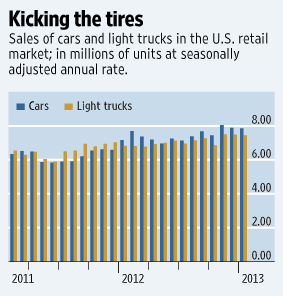
The chart to the right—from the Wall Street Journal‘s website—may not be the clearest, but it shows that sales of passenger cars (the blue bars) inched ahead of SUVs, pickups, and minivans (the orange bars) during most of 2012.
You may recall that this happened once before. The 2008 double whammy—recession plus spiking gas prices—sent all vehicle sales tumbling; but light truck sales fell particularly quickly, meaning that cars edged out SUVs, minivans, and pickups in both 2008 and 2009. Yet after gas prices dropped and the economy came out of freefall in 2010 and 2011, light trucks once again outsold cars—which made last year’s resurgence of the passenger car come as a pleasant surprise.
Historically, the shifts in car vs. truck sales have had a big influence on vehicle efficiency. Look, for example, at the estimates of new vehicle fuel economy published by the University of Michigan’s Transportation Research Institute.
Widely despised for the range of harm it leaves in its wake—from asthma in kids to mercury in fish to dangerous drinking water pollution—the coal industry long ago became dependent on law firms to run interference with the rules that would protect public health and the environment. And now that coal is coming to the Northwest in a big way, it’s hiring a small army of lawyers to smooth the path from unwelcome interloper to permanent fixture.
Several well-known Northwest law firms, including two that cheerfully market themselves as green leaders, have thrown in their lot with the coal industry. They aim to help coal companies avoid a comprehensive public review of plans to export as much as 140 million tons of coal annually from the region. Yet it’s probably fair to say that many of these law firms care deeply about their reputations and would rather not have their work for the coal industry broadcast too widely.
A Northwest law firm with offices in Seattle and Tacoma, Gordon Thomas Honeywell adorns its website with photos of windmills and orcas. The firm sells itself as green, even devoting an entire webpage to its “commitment to sustainability”:
Gordon Thomas Honeywell understands how vital sustainability is to the environment and our future generations. And we recognize that business operations can impact the world around us. We make every effort to limit that impact for our employees, our clients, and our community.
The truth is that Gordon Thomas Honeywell is deeply connected to the coal industry.
When my husband and I bought our first house, its 800 square feet of living space was perfect for two. It was what we could afford, and it suited us. We fought rarely, lived within our means without too much trouble, loved living within easy walking distance of restaurants and parks, went away many weekends, divided up the two closets, and dumped all the extra stuff in the basement.
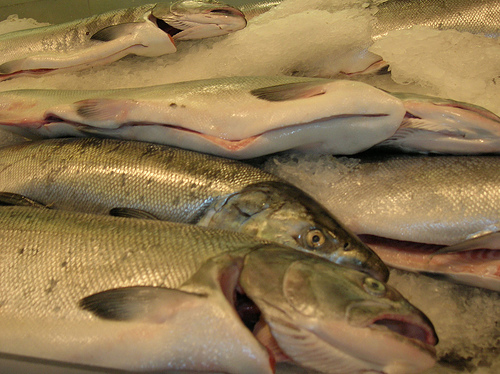
Fresh salmon at market, photo credit Maureen Reilly
Over the holiday season, the US Food and Drug Administration (FDA) issued an administrative finding that may remove one of the last obstacles before the agency approves the sale of genetically modified salmon in grocery stores. Here’s how we got to this point.
In 1995, AquaBounty Technologies, a Massachusetts biotechnology company, filed an application with the FDA to allow its engineered salmon to be the first genetically modified animal in the American food supply. The company had patented AquAdvantage Salmon, a sterile Atlantic salmon female containing a Chinook salmon growth hormone gene, along with a DNA sequence from an ocean pout, a fish resembling an eel. The combination of genetic material allows the modified salmon to grow year-round, reaching market size within 18 months, about twice as fast as conventional salmon.
Commercial fishing interests, including those in Alaska—the state that produces more than 90 percent of all the wild salmon harvested in the US—view genetically modified (GM) salmon as a threat to wild fisheries. Accordingly, the Alaska Congressional delegation is united in opposing these modified salmon.
If you’re concerned about water pollution, you’ve likely heard this message: The water that gushes off our roofs, driveways, streets, and landscaped yards is to blame for the bulk of the pollution that dirties Puget Sound and other Northwest waterbodies. You probably also know about the most popular stormwater solutions, including rain gardens and other green infrastructure that soak up the filthy water, cleaning it before it reaches sensitive waterways that are home to salmon, frogs, orcas, and other wildlife.
But those two ideas taken together are making some people anxious. If stormwater is the source of such devastating amounts of petroleum and heavy metals, won’t the rain garden in my front yard become a mini toxic waste site that could harm children and pets?
I’ll be speaking Portland State University next week. If you’re hanging around the Rose City and you can’t stop obsessing about coal exports, you might want to check it out.
Here are the details:
Where: Simon Benson House, Portland State University, 1803 SW Park Avenue. (A campus map is here.)
When: Wed, Jan 23, 2013
5:30-6:30pm Socializing with light snacks and wine
6:30-7:00pm Eric de Place: presentation and discussion
7:00-8:30pm Socializing with light snacks and wine
Who: Sigma Xi members, faculty, students, public. Each member is encouraged to bring a guest. No admission fee.
Thanks to Sigma Xi Columbia-Willamette Chapter and Northwest Friends of the Union of Concerned Scientists for putting on the event. Given the audience, I’ll be focusing this talk on what the science tells us about key dimensions of the Northwest coal export proposals.
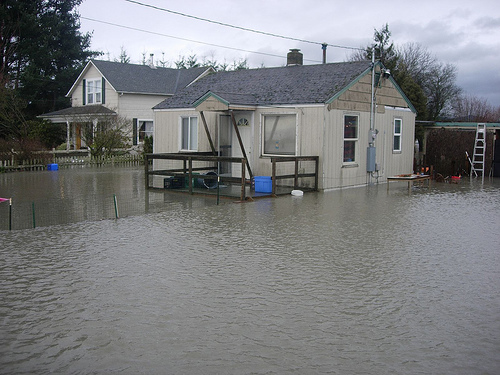
Flooded home in Skagit County, Chris and Jenni on Flickr.
See mud on tree, build higher.
This was the advice that Native Americans reportedly offered the pioneers that settled along flood-prone stretches of the Skagit River. The immigrants were of hearty stock, but they weren’t good listeners.
“They decided to ignore the Indians,” said Noel Bourasaw, editor of the Skagit River Journal.
In the late 1890s, two riverside settlements essentially floated away in the Skagit’s flood waters. But the neighboring town of Hamilton held on.
Fast forward 120 years.
Despite being repeatedly inundated by the Skagit, Hamilton’s inhabitants have kept their tenuous grip thanks in large part to the National Flood Insurance Program, which has helped residents rebuild time after time. It’s the same FEMA program that is expected this week to run out of money to pay flood insurance claims, never mind the billions of additional dollars that are needed to aid the victims of Hurricane Sandy. Did I mention that over the years the program has borrowed $18 billion from taxpayers to settle claims nationwide?