Donate Newsletters

The Northwest’s Native Residents

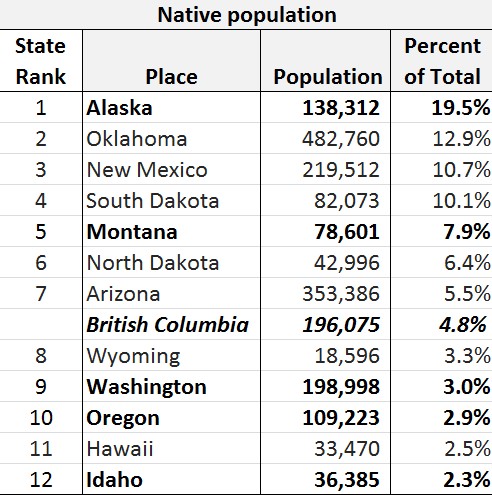
November is American Indian & Alaska Native Heritage Month, and that makes a good opportunity to take a quick look at the Northwest’s original residents. In North American terms, Cascadia is home to an unusually high concentration of people of Native descent.

In fact, Northwest jurisdictions are home to more than three quarters of a million people of Native descent with nearly 200,000 in British Columbia and Washington each.

As a share of the population, no state has more Native Americans than Alaska where nearly 20 percent of residents self-identify as all or part Native. Montana ranks 5th nationally while Washington, Oregon, and Idaho occupy the 9th, 10th, and 12th spots, respectively. British Columbia’s population has a very similar profile to its US neighbors.

Let’s look more closely at the US portion of the Northwest, where localized population figures are easily available.

Read more

The Changing Face of the Northwest Electorate

Yesterday’s Seattle Times brought news of a trend that will shape the Northwest electorate for decades: the steady increase in the share of minority voters. Compared with some parts of the nation, the Northwest isn’t particularly diverse. Still, the latest census figures show that nearly one-fourth of Washington residents over the age of 18 now self-identify as Hispanic or non-white. In Oregon, 18 percent identify as Hispanic or non-white; in Idaho, it’s about 13 percent.

But every respectable demographic projection shows that the Northwest’s voting age population will continue to diversify over the coming years. And that’s true regardless of what happens with future immigration trends. That’s right: you don’t have to assume that there will be an influx of non-white voters to be confident that the region’s electorate will continue to diversify. You just need to look at what will happen as today’s residents age.

Read more

It Takes a Cluster to Build a Rain Garden

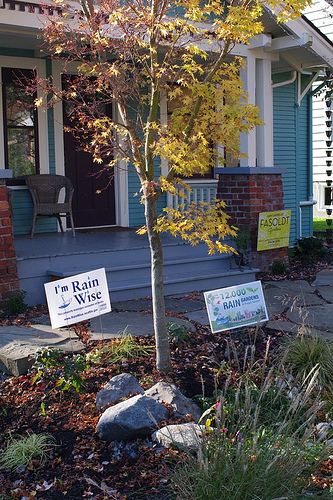
Rain garden in Ballard

As he stands admiring his front-yard rain garden on a recent fall morning, Steve Severin is darn near giddy.

“Isn’t it great?” he asks. “My yard before was all grass. I’m very, very happy.”

A copper “rain chain” that looks like a series of tulip blossoms strung together hangs down from a corner of his roof. At the bottom of the chain is a hammered copper bowl nestled among river rock ready to catch the rain that drips down. The rocks lead downhill to a rain garden planted with small grasses and shrubs. On the other side of the walkway to his front porch is a second, smaller rain garden.

In addition to the rain chain, PVC pipe wraps around Severin’s Ballard-neighorhood house and underground, draining all of the water that hits his 1,800-square-foot roof into the rain gardens.

In an average year in Seattle, Severin’s rain gardens will capture and treat about 41,500 gallons of water that would otherwise have become polluted runoff.

“It looks beautiful,” he said, “but it’s also functional.”

There’s an added bonus: the $5,500 rain garden was paid for by Seattle Public Utilities’ RainWise program, which reimburses residents in certain neighborhoods for installations of green stormwater solutions.

While stormwater experts agree that rain gardens and similar strategies are essential tools for cleaning up and shrinking the amount of filthy runoff that pours from our roadways and roofs, the technologies have been slow to take off in most places. Property owners often don’t  understand how big of a problem stormwater is, or they fear that rain gardens won’t work because of a couple of well-publicized problem gardens in the past.

But new public-private partnerships are cropping up in Seattle to help residents learn more about rain gardens and take advantage of programs like RainWise. Nonprofit groups including Stewardship Partners, Sustainable Seattle and Sustainable Ballard — all of whom promote environmentally friendly practices — are helping in the effort.

Read more

The Northwest’s Asian Indian Residents

Today is the beginning of Diwali—one of the most important events in the Hindu calendar—and that seems like a decent reason to take a look at a new facet of the Northwest’s demographic makeup.

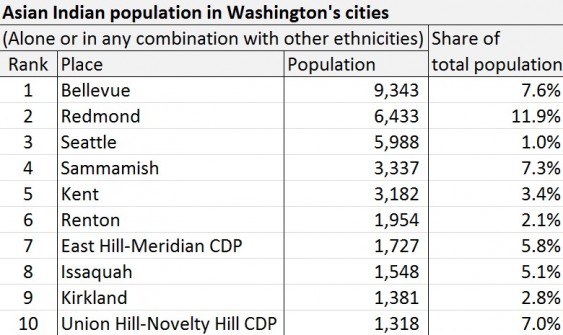
The world’s largest Hindu country, India, has added a substantial share of its people to some Northwest cities. Bellevue has far and away the highest number of Indian people in the state, though nearby Redmond claims the top spot on percentage basis.

Both have more in absolute numbers than the much bigger city of Seattle.

A quick word about the numbers. Theses figures come from the 2010 Census and refer to people who self-identify as either “Asian Indian alone” or “Asian Indian in combination with some other ethnicity” in official parlance.

Interestingly, every single one of Washington’s top cities for people of Indian descent is in King County and in particular, the high-tech cities of Seattle’s eastern suburbs—Bellevue, Redmond, Sammamish, Issaquah, Kirkland, and Union Hill-Novelty Hill—are home to a remarkable share of residents who identify as Indian. South King County rounds out the mix.

Read more

Belly-Up Fish and Other Stormwater Mayhem

Tox-Ick poster

It’s a challenge to drive home the importance of controlling polluted runoff. After all, what is stormwater but rain that’s hit the ground?

The trouble is, the ground isn’t always such a clean place, particularly in urban areas with lots of roads, rooftops, and parking lots that repel the rain and send it gushing through gutters, picking up pollutants and trash along the way.

Still, it’s tough to imagine how much toxic muck can be swept up by runoff — until now.

A video shot by scuba diver Laura James features time-lapse, underwater footage of a stormwater outfall in West Seattle off Alki Beach, a popular spot for beachgoers. The video opens with fish flitting past a gaping concrete outfall as seaweed and white anemones sway in the current. Then a smoggy haze starts clouding the water. More time passes, and a constant plume of blackened runoff gushes out of the pipe, looking like someone is pouring black paint straight into the other end of it. The minutes whiz by and the filthy stormwater spews for hours.

https://vimeo.com/51456008

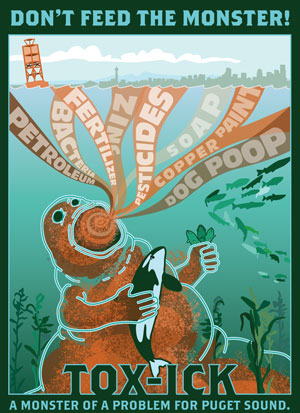
James has nicknamed the West Seattle outfall “The Monster” and is promoting an educational campaign called “Don’t Feed the Tox-Ick Monster” that’s aimed at reducing stormwater pollution.

Read more

Northwest Election Results, November 2012

Voting check

It was a long and brutal campaign season for the Northwest, as for the rest of the United States. In the end, it brought a historic vote on marriage equality, a new approach to marijuana regulation, a small leftward shift in the Oregon House and the Northwest’s Congressional delegation, election of a strong champion for clean energy to the governor’s mansion in Olympia, and an awful lot of the same people—or the same party—returning to office. Many races remain undecided, and Sightline staff has been monitoring results across the region. We’ll keep updating this as results come in.

President

As expected, President Obama won most of the Northwest’s electoral votes, running up leads in Oregon and Washington and claiming those 19 electoral votes. In Idaho, which has four electoral votes, and Alaska and Montana, which have three electors each, challenger Mitt Romney prevailed, giving him 10 of Cascadia’s electors. None of these states were “battlegrounds” contested by the campaigns. We’ll be interested to see the final popular vote for the president in the three main Northwest states of Idaho, Oregon, and Washington (as of November 9 at 11:00 a.m., it was 53 percent for Obama), but we have to wait for the half-million-or-so ballots that are still in the mail, mostly in Washington, to be counted. (If British Columbia could vote for the US president, the province would have supported him by much larger margins.)

Read more

Legalizing Inexpensive Housing

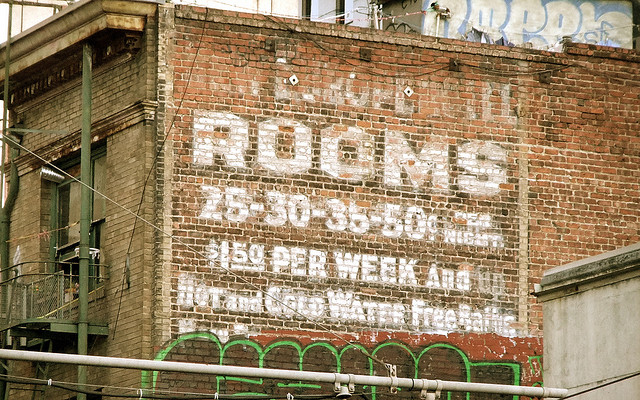
Old sign painted on brick building "Rooms 25 - 50 cents per night, $1.50 per week."

A month ago, the Seattle City Council passed the latest in more than a century of laws across the Northwest and beyond to improve the safety and health conditions of rental housing. Without a single “no” vote, council members required all landlords to register their units and submit to periodic inspections.

A bold victory for sustainable communities? I’m not sure. I do not know enough about the particulars of this policy to pass judgment on it. But it makes me nervous. In fact, I fear it is a move in exactly the opposite direction from where housing policy ought to be going. Where it ought to be going is toward repealing a raft of restrictions that effectively ban inexpensive housing in complete, compact communities. Repealing these rules, I believe, is the single largest sustainability opportunity that most cities have within their legal authority.

Read more

Farm Workers, Arctic Tribes, and Pesticides on Northwest Crops

map of endsulfan use in the northwest

Fifty years ago this last month, Silent Spring hit the shelves. The book that is sometimes credited with sparking the environmental movement in the United States pitted author Rachel Carson against the manufacturers of dangerous pesticides. Although Carson’s book fundamentally changed the public debate about chemical pollution, it has taken decades for many of her recommendations to gain the force of law. Now, five decades later, the revolution launched by Silent Spring takes another step toward completion.

As of August 2012, use of the pesticide Endosulfan is no longer allowed on a range of food crops, such as cherries, plums, and apricots, which are all tree fruits grown in the Pacific Northwest. Endosulfan will still be used for a few more years on many other crops, including apples and potatoes, but this marks the first step in phasing out a pesticide with some truly nasty side effects: it is recognized as a neurotoxin; an endocrine disruptor that can damage a variety of biological systems (by altering the body’s production of hormones); and a “bio-accumulative” toxic substance so persistent that it is transported by winds, currents, and sea life, and found even in the Arctic, thousands of miles from where it might be used.

Endosulfan cuts a big swath through the Northwest, and the phase-out marks important progress for the region. Washington leads the nation in cherry production, while Oregon and Idaho are the third and fifth biggest producers respectively. Endosulfan cannot be used on the region’s next crop of cherries and other stone fruits (fruits with pits), and by 2016 will be prohibited on the Northwest’s apples and potatoes as well.

Read more

×